1994 College Scholastic Ability Test No.1

Mathematics·Studies (I)

For positive numbers \(a, x\) and \(y\), let
\(A=\log_a \dfrac{x^2}{y^3}\:\) and \(\:B=\log_a\dfrac{y^2}{x^3}\).
Which option is equal to \(3A+2B\)? (※ \(a\ne1\))
  1. \(\log_a\dfrac{1}{x^5}\)
  2. \(\log_a\dfrac{1}{y^5}\)
  3. \(\log_a\dfrac{1}{xy}\)
  4. \(\log_a\dfrac{x^5}{y^5}\)
  5. \(\log_a\dfrac{x^5}{y^7}\)
For a polynomial function \(f(x)\), what is the value of
\(\displaystyle\lim_{n\;\!\to\;\!\infty} n\left\{f\!\left(\!a+\dfrac{b}{n}\!\right) - f\!\left(\!a-\dfrac{b}{n}\!\right) \right\}\)?
(※ \(b\ne0\))
  1. \(\dfrac{1}{b}f'(a)\)
  2. \(0\)
  3. \(f'(a)\)
  4. \(bf'(a)\)
  5. \(2bf'(a)\)
Let \(A\) and \(B\) be invertible \(2 \times 2\) matrices. Which option below is incorrect?
  1. \((A^2)^{-1}=(A^{-1})^2\)
  2. \((B^{-1}AB)^2=B^{-1}A^2B\)
  3. If \(A^2=B^2\) then \(A=B\) or \(A=-B\).
  4. \(A^{-1}(A+B)B^{-1}=A^{-1}+B^{-1}\)
  5. If \(A\begin{pmatrix}x\\y\end{pmatrix}=\begin{pmatrix}0\\0\end{pmatrix}\) then \(x=y=0\).
The Ahmes Papyrus, a mathematical textbook from ancient Egypt(circa B.C. 1650), contains the following problem.
Divide \(120\) loaves of bread among \(5\) people, such that the shares of each person form an arithmetic progression, and the sum of the two smallest shares is \(\dfrac{1}{7}\) of the sum of the three greatest shares.
If we divide loaves of bread as shown above, what is the share of the person who receives the most?
  1. \(52\)
  2. \(50\)
  3. \(48\)
  4. \(46\)
  5. \(44\)

Mathematics·Studies (I)

Let \(a\) and \(b\) be the coefficient of \(x^3\) in polynomials
\((1+x+x^2+x^3)^3\:\) and \(\:(1+x+x^2+x^3+x^4)^3\)
respectively. What is the value of \(a-b\)?
  1. \(4^3-5^3\)
  2. \(3^3-3^4\)
  3. \(0\)
  4. \(1\)
  5. \(-1\)
Let \(f(x)\) and \(g(x)\) be functions such that
\(f(x)g(x)=0\)
for all real numbers \(x\). Which option below is correct about the sets
\(A=\{x\,|\,f(x)=0\}\:\) and \(\:B=\{x\,|\,g(x)=0\}\)?
  1. \(A\) and \(B\) are both infinite sets.
  2. \(A\) and \(B\) are both finite sets.
  3. If \(A\) is a finite set, then \(B\) is an infinite set.
  4. If \(A\) is an infinite set, then \(B\) is a finite set.
  5. If \(A\) is an infinite set, then \(B\) is an infinite set.
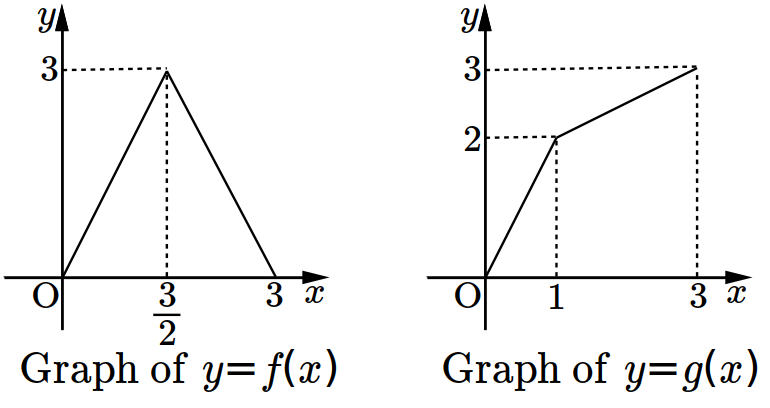
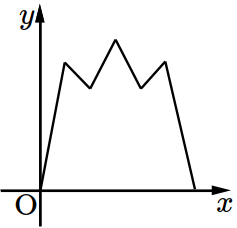
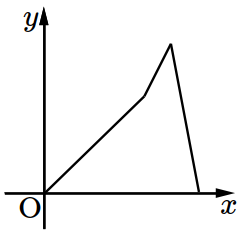
The graphs of functions \(y=f(x)\) and \(y=g(x)\) are shown below.
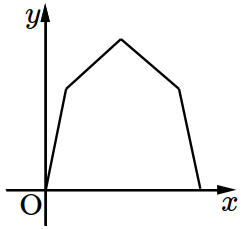
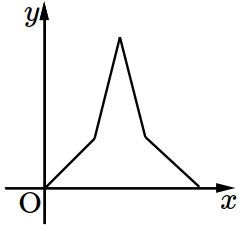
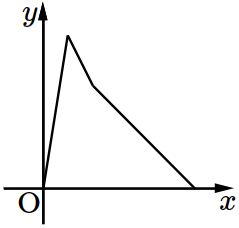
Which option below is an appropriate graph of \(y=(g\circ f)(x)\)?

Mathematics·Studies (I)

Let \(a\) and \(b\) be real numbers such that \(1+\sqrt{2}i\) is a solution to the cubic equation \(x^3+ax^2+bx-3=0\). What is the value of \(ab\)? (※ \(i=\sqrt{-1}\))
  1. \(10\)
  2. \(5\)
  3. \(0\)
  4. \(-15\)
  5. \(-10\)
For an integer \(n\,(n\geq 4)\), let
\(A_n=\{x\,|\,x\) is the length of a diagonal of a regular polygon with \(n\) sides of length \(1\}\),
and let \(a_n\) be the number of elements in the set \(A_n\). For example, \(a_4=1\).
What is the value of \(\displaystyle\sum_{n\;\!=\;\!4}^{25}a_n\)?
  1. \(140\)
  2. \(138\)
  3. \(136\)
  4. \(134\)
  5. \(132\)
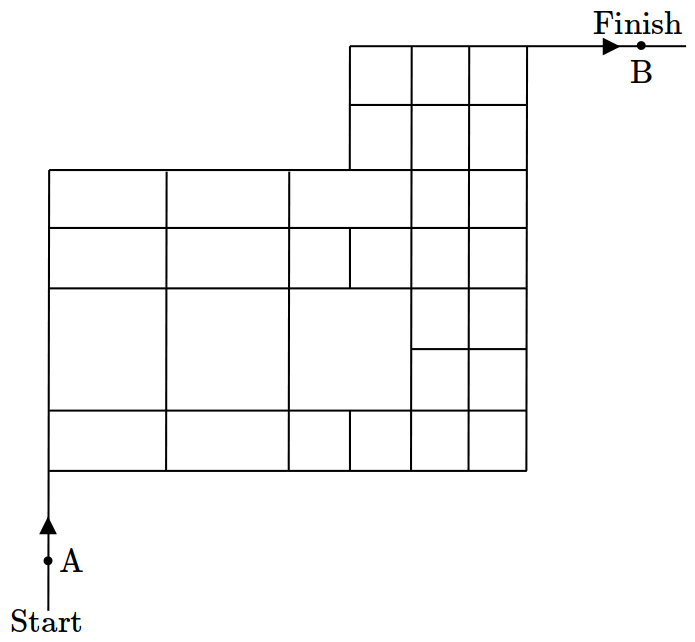
On the network of roads in the figure below, a car drives from point \(\mathrm{A}\) to point \(\mathrm{B}\) in the shortest path possible. Let \(a\) and \(b\) be the number of right-turns and left-turns made by the car respectively.
Which option below is always correct?
  1. \(a\) is even.
  2. \(b\) is odd.
  3. if \(a\) is even, then \(b\) is even.
  4. if \(a\) is even, then \(b\) is odd.
  5. if \(a\) is odd, then \(b\) is odd.
A function \(f(x)\) defined on the set of all real numbers satisfies the conditions in the <List> below.
  1. \(f(x)\) is continuous and \(f(x)=f(-x)\).
  2. \(f(x)=0\) when \(|x|>5\).
  3. \(|f(x)|\leq10\) when \(|x|<5\), and there is exactly \(1\) value of \(x\) such that \(f(x)=10\).
Which option below is incorrect?
  1. \(f(5)=f(-5)=0\)
  2. \(f(x)\) has a global maximum at \(x=0\).
  3. There are at least \(2\) values of \(x\) such that \(f(x)=5\).
  4. There is exactly \(1\) value of \(x\) such that \(f(x)\) has a global minimum.
  5. \(f(x+5)f(x-5)=0\) for all real numbers \(x\).

Mathematics·Studies (I)

Set \(P\) is a subset of the set of all real numbers, and has the following properties \((\mathrm{A})\) and \((\mathrm{B})\).
\((\mathrm{A})\:\) One statement, but no more than one statement, is true among the three statements
\(a\in P,\: a=0\:\) and \(\:-a\in P\)
for all real numbers \(a\).
\((\mathrm{B})\:\) If \(a\in P\) and \(b\in P\), then \(ab\in P\).
The following is a proof of the statement ‘If \(a\in P\), then \(\dfrac{1}{a}\in P\,\)’ using the properties above.
(Proof) The assumption is that \(a\in P\). Thus \(a\ne0\) by \((\mathrm{A})\). Then \(\dfrac{1}{a}\) is a nonzero real number, so it should be that either \(\dfrac{1}{a}\in P\:\) or \(-\dfrac{1}{a}\in P\:\) by the property \(\fbox{\(\;(\alpha)\;\)}\).
Suppose \(-\dfrac{1}{a}\in P\). Then, by the property \(\fbox{\(\;(\beta)\;\)}\) and the assumption, \(-1=a\times\left(\!-\dfrac{1}{a}\!\right)\in P\). However, if \(-1\in P\:\) then \(\:1=(-1)\times(-1)\in P\) by \((\mathrm{B})\), thus contradicting the property \(\fbox{\(\;(\gamma)\;\)}\).
Therefore, \(\dfrac{1}{a}\in P\:\).
In the proof above, what are appropriate for \((\alpha), (\beta)\) and \((\gamma)\) in this order?
  1. \((\mathrm{A}), (\mathrm{B})\), \((\mathrm{A})\)
  2. \((\mathrm{A}), (\mathrm{B})\), \((\mathrm{B})\)
  3. \((\mathrm{B}), (\mathrm{A})\), \((\mathrm{A})\)
  4. \((\mathrm{A}), (\mathrm{A})\), \((\mathrm{B})\)
  5. \((\mathrm{B}), (\mathrm{A})\), \((\mathrm{B})\)
Consider the circle \((x-1)^2+(y-2)^2=r^2\) on the \(xy\)-plane, and a point \(\mathrm{A}(5, 4)\) outside the circle. Two tangent lines to the circle which pass through point \(\mathrm{A}\) are perpendicular to each other. What is the length of the radius \(r\)?
  1. \(\sqrt{10}\)
  2. \(\sqrt{11}\)
  3. \(\sqrt{12}\)
  4. \(\sqrt{13}\)
  5. \(\sqrt{14}\)
Let \(\mathrm{A}(x_1,y_1)\) and \(\mathrm{B}(x_2,y_2)\) be points on the \(xy\)-plane. Let \(\mathrm{C}(x_3,y_3)\) and \(\mathrm{D}(x_4,y_4)\) respectively be the point internally dividing, and the point externally dividing, the line segment \(\mathrm{AB}\) in the ratio \(4:3\).
Then, there exists a \(2 \times 2\) matrix \(X\) such that
\(X\begin{pmatrix}x_1&y_1\\x_2&y_2\end{pmatrix} =\begin{pmatrix}x_3&y_3\\x_4&y_4\end{pmatrix}\).
Which option is equal to \(X\)?
  1. \(\begin{pmatrix}\dfrac{4}{7}&\dfrac{3}{7}\\-3&4\end{pmatrix}\)
  2. \(\begin{pmatrix}\dfrac{4}{7}&\dfrac{3}{7}\\4&-3\end{pmatrix}\)
  3. \(\begin{pmatrix}\dfrac{3}{7}&-3\\\dfrac{4}{7}&4\end{pmatrix}\)
  4. \(\begin{pmatrix}\dfrac{3}{7}&\dfrac{4}{7}\\3&-4\end{pmatrix}\)
  5. \(\begin{pmatrix}\dfrac{3}{7}&\dfrac{4}{7}\\-3&4\end{pmatrix}\)
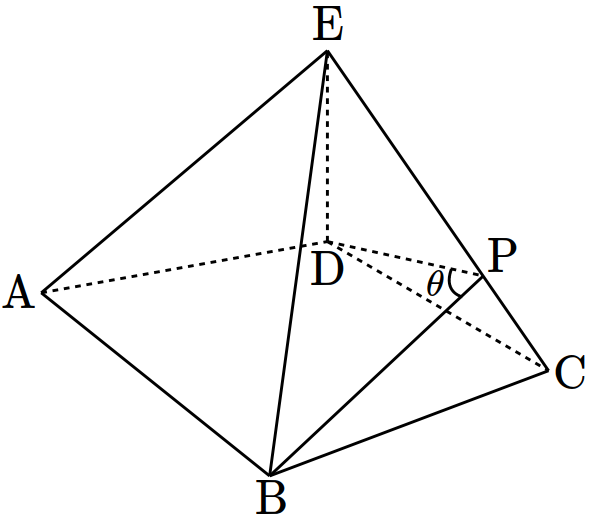
Figure below shows a square pyramid whose side lengths are all \(1\). For a point \(\mathrm{P}\) moving on the edge \(\mathrm{EC}\), let \(\angle\mathrm{BPD}=\theta\). What is the sum of the maximum value and the minimum value of \(\cos\theta\)?
  1. \(-\dfrac{1}{3}\)
  2. \(-\dfrac{\sqrt{3}}{6}\)
  3. \(0\)
  4. \(\dfrac{\sqrt{3}}{6}\)
  5. \(\dfrac{1}{3}\)

Mathematics·Studies (I)

What is the sum of the \(55\) numbers listed below?
\(1\)
\(2\quad4\)
\(3\quad6\quad9\)
\(4\quad8\quad12\quad16\)
\(5\quad10\quad15\quad20\quad25\)
\(6\quad12\quad18\quad24\quad30\quad36\)
\(7\quad14\quad21\quad28\quad35\quad42\quad49\)
\(8\quad16\quad24\quad32\quad40\quad48\quad56\quad64\)
\(9\quad18\quad27\quad36\quad45\quad54\quad63\quad72\quad81\)
\(10\quad20\quad30\quad40\quad50\quad60\quad70\quad80\quad90\quad100\)
  1. \(1755\)
  2. \(1705\)
  3. \(1655\)
  4. \(1605\)
  5. \(1555\)
On the \(xy\)-plane, consider the region that satisfies three inequalities
\(3x+4y-16<0\), \(\:3x-4y+10>0\:\) and \(\:y>0\)
at the same time. Consider a point in this region such that the distance from the point to the three lines forming the boundary of this region are all positive integers. What is the number of all such points?
  1. \(0\)
  2. \(1\)
  3. \(3\)
  4. \(5\)
  5. \(7\)
Two cars \(\mathrm{A}\) and \(\mathrm{B}\) start from the same position at the same time, and only moves forward on a straight road. The distance that \(\mathrm{A}\) and \(\mathrm{B}\) travels for \(t\) seconds are given as differentiable functions \(f(t)\) and \(g(t)\) respectively, which satisfy the following.
  1. \(f(20)=g(20)\)
  2. \(f'(t)<g'(t)\) for \(10\leq t\leq 30\)
When \(10\leq t\leq 30\), which option below is correct about the positions of \(\mathrm{A}\) and \(\mathrm{B}\)?
  1. \(\mathrm{B}\) is always ahead of \(\mathrm{A}\).
  2. \(\mathrm{A}\) is always ahead of \(\mathrm{B}\).
  3. \(\mathrm{B}\) overtakes \(\mathrm{A}\) once.
  4. \(\mathrm{A}\) overtakes \(\mathrm{B}\) once.
  5. \(\mathrm{A}\) overtakes \(\mathrm{B}\), and then \(\mathrm{B}\) overtakes \(\mathrm{A}\) again.

Mathematics·Studies (I)

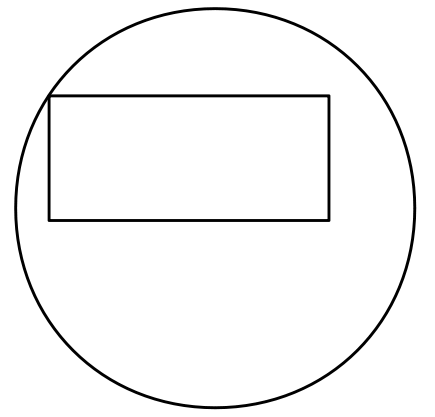
Suppose we build a rectangular stadium with a
perimeter of \(800\) meters on a circular ground with a diameter of \(300\) meters. Consider the stadium with the smallest possible area. What is the difference of its length and width in meters?
  1. \(100\sqrt{3}\)
  2. \(100\sqrt{2}\)
  3. \(50\sqrt{2}\)
  4. \(50\sqrt{3}\)
  5. \(100\)
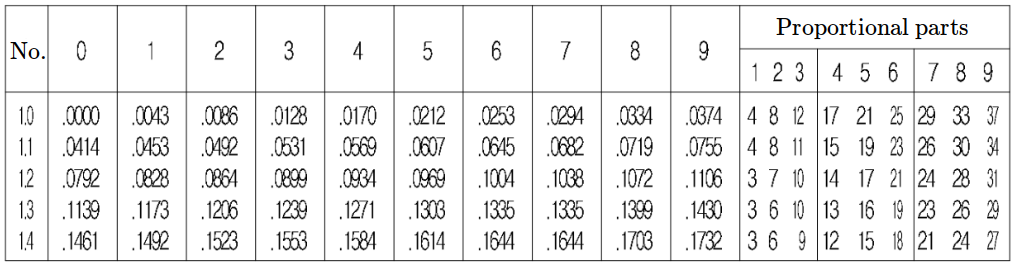
In \(1993\), the education budget of Korea is \(3.7\%\) of the GNP. Suppose the growth rate of the GNP of Korea is \(7\%\) every year from \(1993\) to \(1998\). For the next \(5\) years after the year \(1993\), in what rate should the education budget be increased every year, so that in \(1998\) the education budget is \(5\%\) of the GNP?
Table of common logarithms (\(\log\,3.7=0.5682,\; \log\,5=0.6990,\; \log\,7=0.8451\))
  1. About \(10.7\%\)
  2. About \(11.7\%\)
  3. About \(12.7\%\)
  4. About \(13.7\%\)
  5. About \(14.7\%\)