1995 College Scholastic Ability Test

Mathematics·Studies (I)

Hum. & Arts
Let \(\alpha\) and \(\beta\) be the two solutions to the quadratic equation \(2x^2-4x-1=0\). What is the value of \(\alpha^3 + \beta^3\)? [1 point]
  1. \(1\)
  2. \(3\)
  3. \(4\)
  4. \(8\)
  5. \(11\)
Let \(\alpha\) be the solution to the equation \(3^{x+2}=96\). Which option below is correct? [1 point]
  1. \(0 < \alpha < 1\)
  2. \(1 < \alpha < 2\)
  3. \(2 < \alpha < 3\)
  4. \(3 < \alpha < 4\)
  5. \(4 < \alpha < 5\)
Consider the following \(2 \times 2\) matrices \(A\) and \(B\).
\(A=\begin{pmatrix*}[r] 2&-4 \\ -1&2 \end{pmatrix*},\; B=\begin{pmatrix} 1&2 \\ 2&4 \end{pmatrix}\)
Which option is equal to the matrix \(\dfrac{1}{3}AB-BA\)? [1 point]
  1. \(\begin{pmatrix*}[r] -2&-4 \\ 1&2 \end{pmatrix*}\)
  2. \(\begin{pmatrix*}[r] -2&8 \\ 2&-4 \end{pmatrix*}\)
  3. \(\begin{pmatrix*}[r] -4&-8 \\ 2&4 \end{pmatrix*}\)
  4. \(\begin{pmatrix*}[r] -6&-12 \\ 3&6 \end{pmatrix*}\)
  5. \(\begin{pmatrix*}[r] 0&0 \\ 0&0 \end{pmatrix*}\)
What is the value of \(\displaystyle\int_{0}^{3}|x-1|dx\)? [1 point]
  1. \(1\)
  2. \(\dfrac{3}{2}\)
  3. \(2\)
  4. \(\dfrac{5}{2}\)
  5. \(3\)

Mathematics·Studies (I)

Hum. & Arts
Consider the universe \(U\) and its subsets \(A\) and \(B\). Given that \(A \subseteq B\), which option below is not always true? (※ \(U\ne\varnothing\)) [1 point]
  1. \(A\cup B=B\)
  2. \(A\cap B=A\)
  3. \((A\cap B)^c=B^c\)
  4. \(B^c \subseteq A^c\)
  5. \(A-B=\varnothing\)
Let \(f(x)=2x-1\). A function \(g(x)\) satisfies
\((h \circ g \circ f)(x)=h(x)\)
for all functions \(h(x)\). What is the value of \(g(3)\)?
(※ \(f(x), g(x)\) and \(h(x)\) are functions from \(\mathbb{R}\) to \(\mathbb{R}\), where \(\mathbb{R}\) is the set of all real numbers.) [1 point]
  1. \(-2\)
  2. \(-1\)
  3. \(0\)
  4. \(1\)
  5. \(2\)
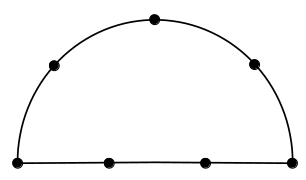
Figure below shows \(7\) points on a semicircle. What is the number of triangles that have three of these points as its vertices? [1 point]
  1. \(34\)
  2. \(33\)
  3. \(32\)
  4. \(31\)
  5. \(30\)
Suppose
\(\dfrac{1}{(x-1)(x-2)\cdots(x-10)}\)
\(=\dfrac{a_1}{x-1} + \dfrac{a_2}{x-2} + \cdots + \dfrac{a_{10}}{x-10}\)
holds for all real numbers \(x\) which does not make the denominator \(0\). What is the value of \(a_1+a_2+\cdots+a_{10}\)? [1.5 points]
  1. \(0\)
  2. \(-1\)
  3. \(1\)
  4. \(-10\)
  5. \(10\)

Mathematics·Studies (I)

Hum. & Arts
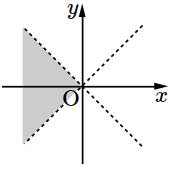
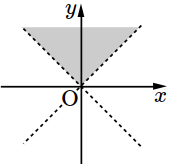
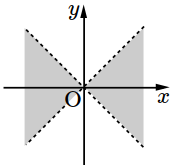
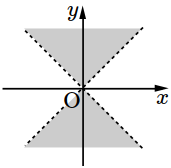
Let \(x\) and \(y\) be real numbers such that \((x+y)(x-y)\ne 0\) and
\(\sqrt{\dfrac{x+y}{x-y}}=-\dfrac{\sqrt{x+y}}{\sqrt{x-y}}\).
Which option below depicts the region on the \(xy\)-plane where the point \((x, y)\) can exist?
(※ The dotted lines are not included.) [1 point]
The instantaneous rate of change of the function \(f(x)\) at \(x=a\) is \(2\). If a differentiable function \(g(x)\) satisfies
\(\displaystyle\lim_{h\;\!\to\;\!\,0}\!\dfrac{f(a+2h)-f(a)-g(h)}{h}=0\),
what is the value of \(\displaystyle\lim_{h\;\!\to\;\!\,0}\!\dfrac{g(h)}{h}\)? [1.5 points]
  1. \(4\)
  2. \(2\)
  3. \(0\)
  4. \(-2\)
  5. \(-4\)
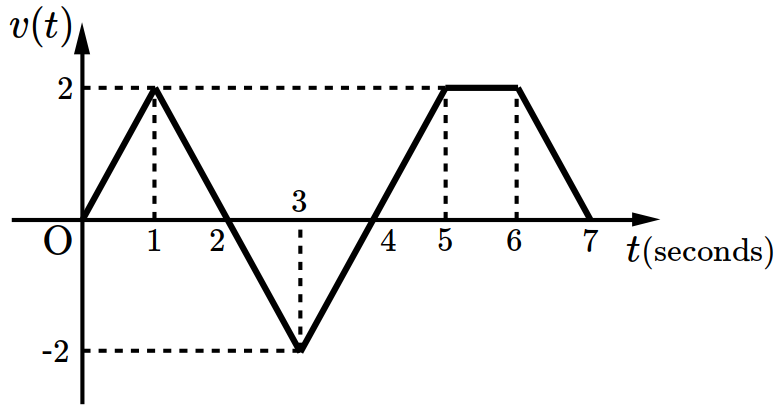
A point \(\mathrm{P}\) starts from the origin and moves on the number line for \(7\) seconds. Its velocity \(v(t)\) at time \(t\) is shown below. What is the list of correct statements in the <List>? [1.5 points]
  1. After point \(\mathrm{P}\) started moving, there was a time where it stopped for \(1\) second.
  2. While point \(\mathrm{P}\) was moving, it changed its direction \(4\) times.
  3. Point \(\mathrm{P}\) was on the starting point
    \(4\) seconds after it started moving.
  1. a
  2. c
  3. a, b
  4. a, c
  5. b, c
† Rephrasing statement a. “Between \(\boldsymbol{0\leq t \leq 7}\), there was a time where point \(\mathrm{P}\) stopped for \(1\) second.”
Let \(f(x)\) and \(g(x)\) be probability density functions defined on the closed interval \([0,1]\). Which option below can always be a probability density function? [1 point]
  1. \(f(x)-g(x)\)
  2. \(f(x)+g(x)\)
  3. \(\dfrac{1}{2}\{f(x)-g(x)\}\)
  4. \(\dfrac{1}{3}\{2f(x)+g(x)\}\)
  5. \(2f(x)-g(x)\)
† No options were correct in the source due to a typo.

Mathematics·Studies (I)

Hum. & Arts
For \(2 \times 2\) matrices \(A\) and \(B\) such that
\(A^2+A=E\) and \(AB=2E\),
what is \(B^2\) in terms of \(A\) and \(E\)? (※ \(E\) is the identity matrix of size \(2\).) [1.5 points]
  1. \(2A+4E\)
  2. \(2A-E\)
  3. \(4A+8E\)
  4. \(4A-8E\)
  5. \(8A-4E\)
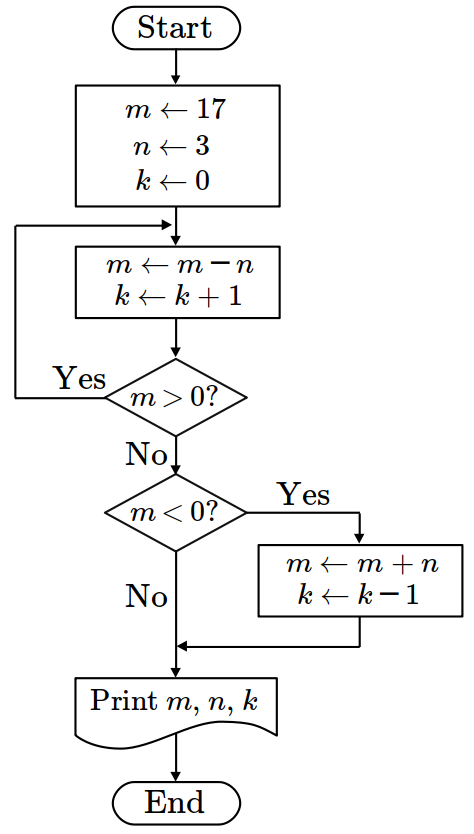
What is the value of \(m, n\) and \(k\) printed by the following flowchart, respectively? [1.5 points]
  1. \(0,2\) and \(5\)
  2. \(0,2\) and \(6\)
  3. \(0,5\) and \(3\)
  4. \(2,3\) and \(6\)
  5. \(2,3\) and \(5\)
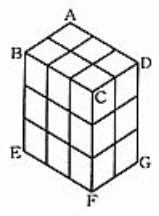
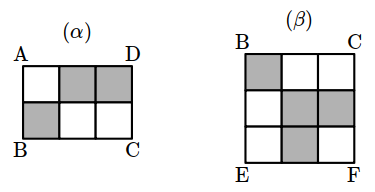
\(18\) identical cube-shaped glass boxes were stacked to make a rectangular cuboid as shown to the right. Some of these boxes were replaced with a black box with the same size. Let \((\alpha)\) be the shape of this cuboid seen from above the rectangle \(\mathrm{ABCD}\), and let \((\beta)\) be the shape of this cuboid seen from the front of the rectangle \(\mathrm{BEFC}\). \((\alpha)\) and \((\beta)\) are as follows.
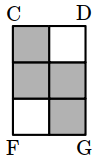
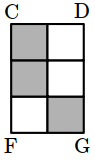
What is the shape of this cuboid seen from the front of the rectangle \(\mathrm{CFGD}\)? [1.5 points]
Let events \(A\) and \(B\) be subsets of a sample space \(S\) such that \(\mathrm{P}(A)\ne0\) and \(\mathrm{P}(B)\ne0\). What is the list of correct statements in the <List>? [1.5 points]
  1. If \(A\) and \(B\) are independent, then \(\mathrm{P}(A|B)\) and \(\mathrm{P}(B|A)\) are equal.
  2. If \(A\) and \(B\) are mutually exclusive, then \(\mathrm{P}(A)+ \mathrm{P}(B)\leq 1\).
  3. If \(\mathrm{P}(A\cup B)=1\), then \(B\) is a complement of \(A\).
  1. a
  2. b
  3. a, c
  4. b, c
  5. a, b, c

Mathematics·Studies (I)

Hum. & Arts
The annual income of an employee is \(Y\) (won). Tax is not imposed for \(a\%\) of this income, and a tax of \(b\%\) is imposed for the rest of the income. After paying the taxes, this person spends \(C\) (won) and deposits all of the rest of the income. What is the annual deposit \(S\) (won) of this person? [1 point]
  1. \(S= \left(\!1- \dfrac{a}{100}- \dfrac{b}{100}\!\right)Y-C\)
  2. \(S= \left(\!1- \dfrac{a}{100}- \dfrac{b}{100}\!\right)Y+C\)
  3. \(S= \left(\!1- \dfrac{a}{100}\cdot \dfrac{b}{100} - \dfrac{b}{100}\!\right)Y-C\)
  4. \(S= \left(\!1+ \dfrac{a}{100}\cdot \dfrac{b}{100} - \dfrac{b}{100}\!\right)Y+C\)
  5. \(S= \left(\!1+ \dfrac{a}{100}\cdot \dfrac{b}{100} - \dfrac{b}{100}\!\right)Y-C\)
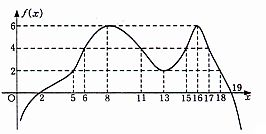
Figure below is the graph of the function \(y=f(x)\). Which option below lists the number of distinct real solutions, and the sum of distinct real solutions, of the equation \(f(f(x+2))=4\) solved for \(x\)?
(※ \(f(x)<0\) when \(x<2\) or \(x>19\).) [1.5 points]
  1. \(2,20\)
  2. \(2,22\)
  3. \(3,30\)
  4. \(4,42\)
  5. \(4,50\)
Let us represent a positive integer \(n\) as \(n=2^p \cdot k\)
(\(p\) is a nonnegative integer and \(k\) is an odd number).
Let \(f(n)=p\). For example, \(f(12)=2\). What is the list of correct statements in the <List>? [1 point]
  1. If \(n\) is an odd number, then \(f(n)=0\).
  2. \(f(8)<f(24)\).
  3. There are infinitely many positive integers \(n\) that satisfy \(f(n)=3\).
  1. a
  2. b
  3. a, b
  4. a, c
  5. b, c
Let the set \(U=\{1,2,3,4,\cdots,100\}\). Consider a set \(A\) which is a subset of \(U\) and satisfies the following conditions (A) and (B). What such set \(A\) has the smallest number of elements? [1 point]
  1. \(3\in A\)
  2. If \(m, n\in A\) and \(m+n \in U\), then \(m+n \in A\).
  1. \(A=\{3,9,15,21,\cdots,99\}\)
  2. \(A=\{3,6,9,12,\cdots,99\}\)
  3. \(A=\{3,4,5,6,\cdots,100\}\)
  4. \(A=\{1,3,5,7,\cdots,99\}\)
  5. \(A=\{1,2,3,4,\cdots,100\}\)

Mathematics·Studies (I)

Hum. & Arts
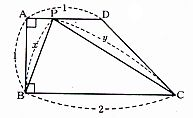
Figure shows a trapezoid \(\mathrm{ABCD}\) with
\(\overline{\mathrm{AB}}=\overline{\mathrm{AD}}=1\), \(\:\overline{\mathrm{BC}}=2\),
and the magnitude of \(\angle \mathrm{A}\) and \(\angle \mathrm{B}\) are \(\dfrac{\pi}{2}\).
Let \(\mathrm{P}\) be a point on the edge \(\mathrm{AD}\). Let \(\overline{\mathrm{PB}}=x\) and \(\overline{\mathrm{PC}}=y\). What is the list of correct statements in the <List>? [1.5 points]
  1. \(xy\geq 2\).
  2. If \(xy=2\), then \(\triangle \mathrm{BCP}\) is a right triangle.
  3. \(xy\leq \sqrt{5}\).
  1. a
  2. c
  3. a, c
  4. b, c
  5. a, b, c
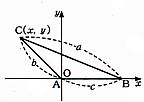
The following is a proof of the law of cosines relating the side lengths of a triangle to the cosine of an angle, specifically if \(\angle \mathrm{A}\) is obtuse in \(\triangle \mathrm{ABC}\).
(Proof) As the figure shows, let \(\triangle \mathrm{ABC}\) with side lengths \(a, b\) and \(c\) be on the \(xy\)-plane so that point \(\mathrm{A}\) is on the origin. Let \((x,y)\) be the coordinates of point \(\mathrm{C}\). Then
\(x= \fbox{\(\;(\alpha)\;\)}\) and \(y= \fbox{\(\;(\beta)\;\)}\),
so the following holds by the Pythagorean theorem.
\(\begin{align}a^2 &= (\fbox{\(\;(\gamma)\;\)})^2+y^2\\ &= b^2+c^2-2bc \cos A \end{align}\)
In the proof above, what are appropriate for \((\alpha), (\beta)\) and \((\gamma)\) in this order? [1 point]
\(b\cos A\), \(b\sin A\), \(c+x\)
\(b\cos A\), \(b\sin A\), \(c-x\)
\(b\cos A\), \(-b\sin A\), \(c+x\)
\(-b\cos A\), \(-b\sin A\), \(c-x\)
\(-b\cos A\), \(-b\sin A\), \(c+x\)
Consider a cubic equation \(x^3+ax^2+bx+c=0\) with three real solutions \(\alpha, \beta\) and \(\gamma\). The following is a proof that at least one of the three solutions has an absolute value greater than or equal to \(\dfrac{|a|}{3}\).
(Proof)
Let us assume the conclusion is false and that \(\fbox{ (A) }\). Then
\(|\,\alpha\,|< \dfrac{|a|}{3},\; |\,\beta\,|< \dfrac{|a|}{3}\:\) and \(\:|\,\gamma\,|< \dfrac{|a|}{3}\).
Using the relation between solutions and coefficients,
\(a= \fbox{ (B) }\),
and
\(\begin{align} |a| &\leq |\alpha+\beta| + |\gamma| \\ &\leq \fbox{ (C) }\\ &< \dfrac{|a|}{3}+\dfrac{|a|}{3}+\dfrac{|a|}{3}=|a|. \end{align}\)
This is a contradiction. Therefore at least one of the three solutions has an absolute value greater than or equal to \(\dfrac{|a|}{3}\).
In the proof above, what are appropriate for \(\text{(A)}, \text{(B)}\) and \(\text{(C)}\) in this order? [1 point]
  1. some solutions have an absolute value less than \(\dfrac{|a|}{3}\),
    \(-(\alpha+\beta+\gamma),\quad |\alpha|+|\beta|+|\gamma|\)
  2. some solutions have an absolute value less than or equal to \(\dfrac{|a|}{3}\),
    \(\alpha+\beta+\gamma,\quad |\alpha|+|\beta|+|\gamma|\)
  3. all solutions have an absolute value less than \(\dfrac{|a|}{3}\),
    \(\alpha+\beta+\gamma,\quad |\alpha+\beta+\gamma|\)
  4. some solutions have an absolute value less than \(\dfrac{|a|}{3}\),
    \(-(\alpha+\beta+\gamma),\quad |\alpha|+|\beta|+|\gamma|\)
  5. all solutions have an absolute value less than or equal to \(\dfrac{|a|}{3}\),
    \(\alpha+\beta+\gamma,\quad |\alpha+\beta+\gamma|\)

Mathematics·Studies (I)

Hum. & Arts
The following is a proof of a theorem about the harmonic mean.
(Proof) For positive numbers \(a,b\) and \(H\), suppose a real number \(r\) exists such that
\(a=H+\dfrac{a}{r}\) and \(H=b+\dfrac{b}{r}\).
\((\mathrm{A})\)
Then, \(a\ne b\) and
\(\dfrac{a-H}{a}= \fbox{\(\;(\alpha)\;\)}\)
\((\mathrm{B})\)
therefore \(H=\fbox{\(\;(\beta)\;\)}\).
Conversely, let \(a\) and \(b\) be positive numbers such that \(a\ne b\). Let \(H=\fbox{\(\;(\beta)\;\)}\). Then \((\mathrm{B})\) holds and \(\dfrac{a-H}{a}\ne 0\).
From \((\mathrm{B})\), let \(\dfrac{a-H}{a}=\dfrac{1}{r}\). Then \((\mathrm{A})\) also holds.
Therefore, for positive numbers \(a, b\) and \(H\),
‘\(a\ne b\) and \(H=\fbox{\(\;(\beta)\;\)}\)’ is \(\fbox{\(\;(\gamma)\;\)}\) for the existence of a real number \(r\) such that \((\mathrm{A})\) holds.
In the proof above, what are appropriate for \((\alpha), (\beta)\) and \((\gamma)\) in this order? [1.5 points]
  1. \(\dfrac{H-b}{b}\), \(\dfrac{2ab}{a+b}\), necessary and sufficient
  2. \(\dfrac{H-b}{b}\), \(\dfrac{ab}{a+b}\), necessary and sufficient
  3. \(\dfrac{H-b}{b}\), \(\dfrac{2ab}{a+b}\), sufficient
  4. \(\dfrac{b-H}{b}\), \(\dfrac{2ab}{a+b}\), necessary
  5. \(\dfrac{b-H}{b}\), \(\dfrac{ab}{a+b}\), sufficient
For all positive numbers \(n\), the polynomial function \(f_n(x)\) has the following properties.
  1. \(f_1(x)=x^2\)
  2. \(f_{n+1}(x)=f_n(x)+f_n'(x)\)
What is the constant term of \(f_{25}(x)\)? [1.5 points]
  1. \(548\)
  2. \(550\)
  3. \(552\)
  4. \(554\)
  5. \(556\)
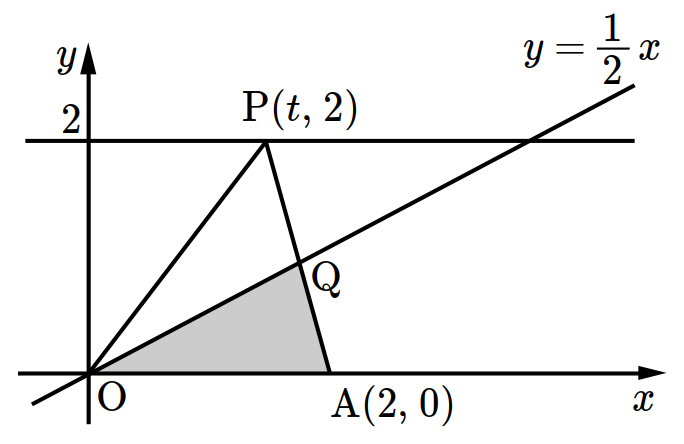
Consider two points \(\mathrm{O}(0,0)\) and \(\mathrm{A}(2,0)\) on the \(xy\)-plane, and a point \(\mathrm{P}(t,2)\) moving on the line \(y=2\). Let \(\mathrm{Q}\) be the point where the line \(\mathrm{AP}\) meets the line \(y=\dfrac{1}{2}x\). Let \(f(t)\) be the the area of \(\triangle\mathrm{QOA}\) divided by the area of \(\triangle\mathrm{POA}\).
Let \(t_1\) be the value of \(t\) such that \(f(t)= \dfrac{1}{3}\),
let \(t_2\) be the value of \(t\) such that \(f(t)=\dfrac{1}{2}\),
\(\cdots\), let \(t_n\) be the value of \(t\) such that \(f(t)=\dfrac{n}{n+2}\). What is the value of \(\displaystyle\lim_{n\;\!\to\;\!\,\infty}t_n\)? [2 points]
  1. \(0\)
  2. \(1\)
  3. \(2\)
  4. \(3\)
  5. \(4\)
† This question has been rephrased with the inclusion of \(f(t)\), since the original sentence structure was hard to translate.
What is the maximum value of the function \(f(x)=\log_9 (5-x) + \log_3 (x+4)\)? [1.5 points]
  1. \(\dfrac{7}{2}\)
  2. \(4\)
  3. \(\dfrac{2}{5}+\log_3 4\)
  4. \(\dfrac{3}{2}+\log_3 2\)
  5. \(4+\log_3 6\)

Mathematics·Studies (I)

Hum. & Arts
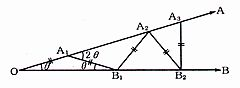
As the figure shows, Let \(\mathrm{A_1, A_2,}\cdots\) be points on the ray \(\mathrm{OA}\), and let \(\mathrm{B_1, B_2,}\cdots\) be points on the ray \(\mathrm{OB}\), such that
\(\overline{\mathrm{OA_1}}=\overline{\mathrm{A_1B_1}}=\overline{\mathrm{B_1A_2}}=\cdots\).
Suppose that using this method, we can create four isosceles triangles
\(\triangle\mathrm{OA_1B_1}, \triangle\mathrm{A_1B_1A_2}, \triangle\mathrm{B_1A_2B_2}, \triangle\mathrm{A_2B_2A_3}\)
but cannot create a fifth isosceles triangle. Let \(\theta\) be the magnitude of \(\angle \mathrm{AOB}\). What is the range of \(\theta\)? [2 points]
  1. \(\dfrac{\pi}{4} \leq\theta\leq \dfrac{\pi}{2}\)
  2. \(\dfrac{\pi}{7} \leq\theta\leq \dfrac{\pi}{5}\)
  3. \(\dfrac{\pi}{10} \leq\theta\leq \dfrac{\pi}{8}\)
  4. \(\dfrac{\pi}{14} \leq\theta\leq \dfrac{\pi}{12}\)
  5. \(\dfrac{\pi}{17} \leq\theta\leq \dfrac{\pi}{15}\)
Let \(x\) be the amount of labor input and \(y\) be the amount of capital input for some industry. Then, the output \(z\) of the industry is known to be as follows.
\(z=2x^\alpha y^{1-\alpha}\) (\(\alpha\) is a constant with \(0<\alpha<1\))
According to some data, the amount of labor input and capital input in the year \(1993\) was \(4\) times, and \(2\) times, that of the year \(1980\), respectively, and the industry output in the year \(1993\) was \(2.5\) times that of the year \(1980\). From this data, what is the value of the constant \(\alpha\) calculated to the hundredth?
(※ \(\log_{10}2=0.30\)) [2 points]
  1. \(0.50\)
  2. \(0.33\)
  3. \(0.25\)
  4. \(0.20\)
  5. \(0.10\)
A fully automated shelf factory produces two kinds of shelves, ‘\(X\)’ and ‘\(Y\)’. Two machines \(\mathrm{A}\) and \(\mathrm{B}\) are used to produce these shelves. For safety reasons, machines \(\mathrm{A}\) and \(\mathrm{B}\) cannot be operated for more than \(18\) hours a day and \(20\) hours a day, respectively. To produce \(1\) unit of shelf ‘\(X\),’ machines \(\mathrm{A}\) and \(\mathrm{B}\) must be operated for \(3\) hours and \(5\) hours respectively, and to produce \(1\) unit of shelf ‘\(Y\),’ machines \(\mathrm{A}\) and \(\mathrm{B}\) must be operated for \(6\) hours and \(5\) hours respectively. A unit of shelf ‘\(X\)’ and shelf ‘\(Y\)’ are sold for \(2\) million won and \(3\) million won respectively. Assuming that all shelves produced are instantly sold, what is the greatest possible sales in a day? [2 points]
Shelf ‘\(X\)’ Shelf ‘\(Y\)’ Operating
time limit
Machine \(\mathrm{A}\) \(3\) hours \(6\) hours \(18\) hours
Machine \(\mathrm{B}\) \(5\) hours \(5\) hours \(20\) hours
Selling
price
\(2\) million
won
\(3\) million
won
  1. \(9\) million won
  2. \(10\) million won
  3. \(11\) million won
  4. \(12\) million won
  5. \(13\) million won