1998 College Scholastic Ability Test

Mathematics·Studies (I)

Nat. Sciences
What is the value of \(\bigg\{\!\left(\dfrac{4}{9}\right)^{\!-\,\begin{array}{c}2 \\\hline 3\end{array}}\bigg\}^{\begin{array}{c}9 \\\hline 4\end{array}}\:\)? [2 points]
  1. \(\dfrac{8}{27}\)
  2. \(\dfrac{16}{81}\)
  3. \(\dfrac{81}{16}\)
  4. \(\dfrac{27}{8}\)
  5. \(\dfrac{64}{81}\)
What is the value of \(\sqrt{4+2\sqrt{3}}-\sqrt{4-2\sqrt{3}}\)? [2 points]
  1. \(-2\)
  2. \(-\sqrt{3}\)
  3. \(1\)
  4. \(\sqrt{3}\)
  5. \(2\)
What is the remainder of the division of the polynomial \(2x^3+x^2+3x\;\) by \(\;x^2+1\)? [3 points]
  1. \(x-1\)
  2. \(x\)
  3. \(1\)
  4. \(x+3\)
  5. \(3x-1\)
What is the value of \(x\) at which the function \(y= \dfrac{\ln x}{x}\) has a global maximum? [2 points]
  1. \(1\)
  2. \(e\)
  3. \(\dfrac{1}{e}\)
  4. \(2e\)
  5. \(e^2\)
For complex numbers \(z_1=i\) and \(z_2=1+i\), which option below has the greatest argument?
(※ \(i=\sqrt{-1}\), and suppose the range of the argument \(\theta\) is \(0 \leq \theta < 2\pi\).) [2 points]
  1. \(4z_1\)
  2. \(z_1+z_2\)
  3. \(z_1-z_2\)
  4. \(z_1 z_2\)
  5. \(\dfrac{z_1}{z_2}\)

Mathematics·Studies (I)

Nat. Sciences
On the \(xy\)-plane, which of the following functions has a graph that always meets with any given line? [3 points]
  1. \(y=|x|\)
  2. \(y=x^2\)
  3. \(y=\sqrt{x}\)
  4. \(y=x^3\)
  5. \(y=\dfrac{1}{x}\)
If \(1\) is a solution to the quadratic equation \(x^2-mx+2m+1=0\), what is the other solution?
(※ \(m\) is a constant) [2 points]
  1. \(3\)
  2. \(2\)
  3. \(0\)
  4. \(-1\)
  5. \(-3\)
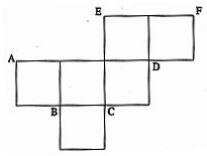
Figure below is the net of a cube.
Which option is equal to the vector \(\overrightarrow{\mathrm{AB}}\) in the original cube? [3 points]
  1. \(\overrightarrow{\mathrm{CD}}\)
  2. \(\overrightarrow{\mathrm{DC}}\)
  3. \(\overrightarrow{\mathrm{ED}}\)
  4. \(\overrightarrow{\mathrm{DE}}\)
  5. \(\overrightarrow{\mathrm{FD}}\)
What is the area of the triangle enclosed by the
\(x\)-axis, the \(y\)-axis, and the tangent line to the hyperbola \(\dfrac{x^2}{9} - \dfrac{y^2}{16}=1\) at point \((a, b)\)?
(※ \(a>0\) and \(b>0\)) [3 points]
  1. \(\dfrac{36}{ab}\)
  2. \(\dfrac{54}{ab}\)
  3. \(\dfrac{72}{ab}\)
  4. \(\dfrac{90}{ab}\)
  5. \(\dfrac{108}{ab}\)
For real numbers \(x\), let \(\lfloor x \rfloor\) be the greatest integer less than or equal to \(x\). Consider the set of solutions to the equation
\(\lfloor x \rfloor^2+\lfloor x \rfloor-2=0.\)
Which inequality below has a set of solutions equal to this set? [3 points]
  1. \(\dfrac{(x+2)(x-2)}{(x+1)(x-1)}\leq 0\)
  2. \(\dfrac{(x+1)(x+2)}{(x-1)(x-2)}\leq 0\)
  3. \(\dfrac{1}{(x+1)(x-1)}\leq 0\)
  4. \(\dfrac{(x-1)(x+2)}{(x+1)(x-2)}\leq 0\)
  5. \(\dfrac{(x-2)(x-3)}{(x+2)(x+3)}\leq 0\)
Mathematics·Studies (I)

Nat. Sciences
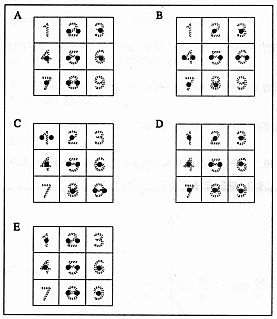
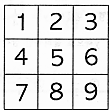
Consider a target marked with numbers from \(1\) to \(9\) as shown to the right. \(5\) shooters \(\mathrm{A, B, C, D}\) and \(\mathrm{E}\) each shot \(10\) times, and each person hit \(10\) numbers with a mean of \(5\). The results of the \(5\) people are as follows.
Among the \(5\) people, which person hit \(10\) numbers with the smallest standard deviation? [2 points]
  1. \(\mathrm{A}\)
  2. \(\mathrm{B}\)
  3. \(\mathrm{C}\)
  4. \(\mathrm{D}\)
  5. \(\mathrm{E}\)
What is the value of \(\left(\dfrac{1+i}{1-i}\right)^{\!1998}\)? (※ \(i=\sqrt{-1}\).) [2 points]
  1. \(-1\)
  2. \(1\)
  3. \(-i\)
  4. \(i\)
  5. \(1998\)
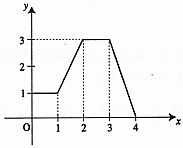
Figure shows the graph of the function \(y=f(x)\) defined on \(0\leq x\leq 4\). What is the value of \(\displaystyle\int_{0}^{1}f(2x+1)dx\)? [2 points]
  1. \(1\)
  2. \(\dfrac{3}{2}\)
  3. \(2\)
  4. \(\dfrac{5}{2}\)
  5. \(3\)
What is the list of correct statements in the <List>? (※ A coin lands on heads or tails with equal probability.) [2 points]
  1. If a coin is tossed \(10\) times, the probability that it lands on heads \(4\) times is equal to the probability that it lands on heads \(6\) times.
  2. The probability that a coin tossed \(10\) times lands on heads \(5\) times, is equal to the probability that a coin tossed \(20\) times lands on heads \(10\) times.
  3. The probability that a coin tossed \(10\) times lands on heads \(5\) times or less, is greater than \(0.5\).
  1. a
  2. c
  3. a, b
  4. a, c
  5. a, b, c

Mathematics·Studies (I)

Nat. Sciences
Consider a sequence \(\{a_n\}\) whose first \(6\) terms \(a_1, a_2, a_3, a_4, a_5\) and \(a_6\) are all distinct, and \(a_{n+6}=a_n\) holds for \(n=1,2,3,\cdots\).
In which of the sequences \(\{b_n\}\) defined below do the values \(a_1, a_2, a_3, a_4, a_5\) and \(a_6\) all appear? [3 points]
  1. \(b_n=a_{2n+1}\)
  2. \(b_n=a_{3n+1}\)
  3. \(b_n=a_{4n+1}\)
  4. \(b_n=a_{5n+1}\)
  5. \(b_n=a_{6n+1}\)
For all positive integers \(n\), let \(f(n)\) be the sum of all positive divisors of \(n\). For example, \(f(3)=4\) and \(f(4)=7\). What is the list of correct statements in the <List>? [2 points]
  1. \(f(10)=18\)
  2. If \(f(n)=n+1\), then \(n\) is prime.
  3. For all positive integers \(m\) and \(n\), \(f(mn)=f(m)f(n)\).
  1. a
  2. b
  3. a, b
  4. b, c
  5. a, b, c
The following is a part of a proof of the statement ‘If \(\,3m^2-n^2=1\), then \(\fbox{\(\quad(\alpha)\quad\)}\).’
<Proof>
\(\cdots\) (omitted) \(\cdots\)
Since \(m\) and \(n\) are integers and \(3m^2=n^2+1\),
\(n^2+1\) has to be a multiple of \(3\).
One of the following holds for some integer \(k\).
If \(n=3k\), then
\(n^2=(3k)^2=9k^2=3(3k^2).\)
If \(n=3k+1\), then
\(\begin{align} n^2 &=(3k+1)^2=9k^2+6k+1\\ &=3(3k^2+2k)+1. \end{align}\)
If \(n=3k+2\), then
\(\begin{align} n^2 &=(3k+2)^2=9k^2+12k+4\\ &=3(3k^2+4k+1)+1. \end{align}\)
Therefore, in the division of \(n^2\) by \(3\), the remainder is either \(0\) or \(1\).
It follows that in the division of \(n^2+1\) by \(3\), the remainder is either \(1\) or \(2\).
\(\cdots\) (omitted) \(\cdots\)
What is appropriate for \(\fbox{\(\;(\alpha)\;\)}\) above? [2 points]
  1. at least one of \(m\) or \(n\) is an integer
  2. neither \(m\) nor \(n\) is an integer
  3. there is at least one solution where \(m\) and \(n\) are both integers
  4. there is only one solution where \(m\) and \(n\) are both integers
  5. there are no solutions where \(m\) and \(n\) are both integers

Mathematics·Studies (I)

Nat. Sciences
The following is a proof of the statement ‘There are no equilateral triangles on the \(xy\)-plane whose coordinates of three vertices are all rational numbers.’
<Proof> Suppose that there is an equilateral triangle whose coordinates of three vertices are all \(\fbox{\(\;(\alpha)\;\)}\) numbers.
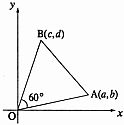
Let us translate this triangle such that one of its vertices lies on the origin \(\mathrm{O}\) of the \(xy\)-plane as shown in the figure. Let \(\mathrm{A}(a, b)\) and \(\mathrm{B}(c, d)\) be the other two vertices. Then, \(a, b, c\) and \(d\) should all be \(\fbox{\(\;(\beta)\;\)}\) numbers. Observe that point \(\mathrm{B}\) is equal to point \(\mathrm{A}\) rotated \(60°\) around the origin. Therefore
\(c=\dfrac{1}{2}a - \dfrac{\sqrt{3}}{2} b, \qquad d=\dfrac{\sqrt{3}}{2}a + \dfrac{1}{2} b \).
Here, if \(b\ne 0\) then \(c\) is \(\fbox{\(\;(\gamma)\;\)}\), and if \(b=0\) then \(a\ne 0\), thus \(d\) is \(\fbox{\(\;(\gamma)\;\)}\). This contradicts the premise.
In the proof above, what are appropriate for \((\alpha), (\beta)\) and \((\gamma)\) in this order? [2 points]
  1. rational, rational, irrational
  2. irrational, rational, irrational
  3. rational, irrational, rational
  4. rational, rational, rational
  5. irrational, rational, rational
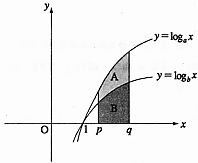
As the figure shows, there is a region enclosed by the \(x\)-axis, the curve \(y=\log_{a}x\), and the lines \(x=p\) and \(x=q\). The curve \(y=\log_{b}x\) divides this region into two parts, \(\mathrm{A}\) and \(\mathrm{B}\). Let \(\alpha\) and \(\beta\) be the area of \(\mathrm{A}\) and \(\mathrm{B}\) respectively. What is the value of \(\dfrac{\alpha}{\beta}\)?
(※ \(1<a<b, \:1<p<q\)) [3 points]
  1. \(\left(\!\dfrac{b}{a}-1\!\right)(q-p)\)
  2. \(\dfrac{a}{b}-1\)
  3. \(\log_{a}b - 1\)
  4. \(\log_{b}a - 1\)
  5. \((q-p)\log_{b}a\)
Let \(\{a_n\}\) be a sequence such that
\(a_1=1, a_2=2\) and
\(\,a_{n+2}=a_{n+1}+a_n \,(n=1,2,3,\cdots)\).
What is the value of \(\displaystyle\sum_{n\;\!=\;\!1}^{\infty}\dfrac{a_n}{a_{n+1}a_{n+2}}\)? [3 points]
  1. \(\dfrac{1}{2}\)
  2. \(1\)
  3. \(\dfrac{3}{2}\)
  4. \(2\)
  5. \(3\)

Mathematics·Studies (I)

Nat. Sciences
The following is a hypothetical model of artificial nuclear fission.
Each unstable nucleus splits into two nuclei, which can either be stable or unstable.
Afterwards, each unstable nucleus splits into two nuclei again, which continues until all remaining nuclei are stable.
Whenever an unstable nucleus splits, an energy of \(100\text{MeV}\) is produced.
Suppose an unstable nucleus has repeatedly split until all of the \(8\) remaining nuclei are stable. What is the total energy produced in this process, in \(\text{MeV}\)? [3 points]
  1. \(800\)
  2. \(700\)
  3. \(600\)
  4. \(500\)
  5. \(400\)
The biological index is an index used to scale the degree of water pollution. Given that \(\mathrm{X}\) is the number of colored organisms and \(\mathrm{Y}\) is the number of colorless organisms, the biological index is defined as
\(\dfrac{\mathrm{X}}{\mathrm{X+Y}} \times 100(\%).\)
Suppose the biological index of some lake was \(10(\%)\) in last month. When the water of this lake was examined in this month, the number of colored organisms was \(2\) times that of last month, and the number of colorless organisms was \(3\) times that of last month. What is the biological index of this lake in this month? [3 points]
  1. About \(14.3\%\)
  2. About \(15.2\%\)
  3. About \(16.4\%\)
  4. About \(17.1\%\)
  5. About \(18.5\%\)
Suppose the Korean government saves a part of its budget in every January \(1\)st starting from the year \(2001\), to prepare for unification costs after the reunification of Korea. To account for the economic growth rate, the amount to be saved every year will be increased by \(6\%\) compared to the previous year. Suppose the amount saved in January \(1\)st, \(2001\), is \(10\) trillion won. What is the total amount of the saved money and interest accumulated until December
\(31\)st, \(2010\), in trillion won?
(※ Assume an yearly compound interest of \(6\%\), and approximate \((1.06)^{10}\) as \(1.8\).) [4 points]
  1. \(160\)
  2. \(162\)
  3. \(180\)
  4. \(198\)
  5. \(220\)

Mathematics·Studies (I)

Nat. Sciences
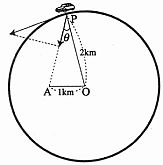
A car is moving at a constant speed of \(20\text{m/second}\) on a circular track with a radius of \(2\text{km}\). Let \(\mathrm{P}\) be the position of the car. There is a speed meter placed on point \(\mathrm{A}\), \(1\text{km}\) apart from the center of the circle \(\mathrm{O}\), which measures the component of the car's velocity in the direction from point \(\mathrm{P}\) toward point \(\mathrm{A}\). For \(\angle \mathrm{APO}=\theta\), the magnitude of this component is \(20 \sin\theta (\text{m/second})\). While the car goes around the track once, what is the maximum value recorded by this speed meter, in \(\text{m/second}\)? [3 points]
  1. \(8\)
  2. \(10\)
  3. \(10\sqrt{2}\)
  4. \(10\sqrt{3}\)
  5. \(20\)
Short Answers (25~30)
Let \(A= \begin{pmatrix} 0&1 \\ 2&3 \end{pmatrix}\). Compute the sum of all components of \(A^2\). [2 points]
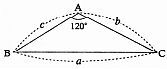
Given \(\triangle \mathrm{ABC}\) with \(b=8, c=7\) and \(\angle \mathrm{A}=120°\), compute \(a\). [3 points]
Consider the sphere \(x^2+y^2+z^2=1\). Let \(\alpha\) be the plane tangent to this sphere at point \(\left(\dfrac{4}{5}, \dfrac{3}{5}, 0\right)\).
Let \(\beta\) be the plane tangent to this sphere at point \(\left(0, \dfrac{3}{5}, \dfrac{4}{5}\right)\). Consider a triangle on plane \(\alpha\) with an area of \(100\). Compute the area of the projection of this triangle onto plane \(\beta\). [3 points]

Mathematics·Studies (I)

Nat. Sciences
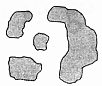
There are \(4\) islands as shown to the right. Compute the number of ways to build \(3\) bridges to make all \(4\) islands connected. [3 points]
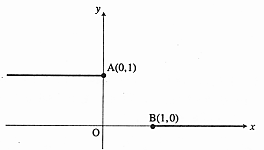
Figure below shows a portion of the graphs of functions \(y=1\) and \(y=0\). Suppose we connect the points \(\mathrm{A}(0,1)\) and \(\mathrm{B}(1,0)\) in this figure with a graph of the function \(y=ax^3+bx^2+cx+1\) defined on \(0\leq x\leq 1\). Let us choose the value of constants \(a, b\) and \(c\) such that the function representing the resulting graph is differentiable on \((-\infty, \infty)\). Compute \(a^2+b^2+c^2\). [4 points]
Let \(\mathrm{P_1}(0)\) and \(\mathrm{P_2}(80)\) be points on the number line. Let \(\mathrm{P_3}(x_3)\) be the midpoint of the line segment \(\mathrm{P_{1}P_{2}}\), let \(\mathrm{P_4}(x_4)\) be the midpoint of the line segment \(\mathrm{P_{2}P_{3}}\), \(\cdots\), let \(\mathrm{P}_{n+2}(x_{n+2})\) be the midpoint of the line segment \(\mathrm{P}_{n} \mathrm{P}_{n+1}\).
Compute \(\displaystyle\lim_{n\;\!\to\;\!\infty}x_n\) and round the result to the nearest hundredth. [3 points]