2013 College Scholastic Ability Test

Mathematics (Type Ga)

Multiple Choice Questions
For matrices \(A=\begin{pmatrix*}[r] 0 & 0 \\ 1 & 1 \end{pmatrix*}\) and \(B=\begin{pmatrix*}[r] 1 & 0 \\ 1 & 1 \end{pmatrix*}\), what is the sum of all of the elements in the matrix \(2A+B\)? [2 points]
  1. \(10\)
  2. \(9\)
  3. \(8\)
  4. \(7\)
  5. \(6\)
If \(\sin\theta = \dfrac{1}{3}\), what is the value of \(\sin 2\theta\)?
(※ Suppose \(0 < \theta < \dfrac{\pi}{2}\).) [2 points]
  1. \(\dfrac{7\sqrt{2}}{18}\)
  2. \(\dfrac{4\sqrt{2}}{9}\)
  3. \(\dfrac{\sqrt{2}}{2}\)
  4. \(\dfrac{5\sqrt{2}}{9}\)
  5. \(\dfrac{11\sqrt{2}}{18}\)
Consider points \(\mathrm{A}(a, 1, 3)\) and \(\mathrm{B}(a+6, 4, 12)\) in
\(3\)-dimensional space. Given that the point \((5, 2, b)\) internally divides the line segment \(\mathrm{AB}\) in the ratio \(1:2\), what is the value of \(a + b\)? [2 points]
  1. \(7\)
  2. \(8\)
  3. \(9\)
  4. \(10\)
  5. \(11\)
What is the product of all real solutions to the equation \(x^2 - 2x + 2\sqrt{x^2 - 2x} = 8\)? [3 points]
  1. \(-5\)
  2. \(-4\)
  3. \(-3\)
  4. \(-2\)
  5. \(-1\)

Mathematics (Type Ga)

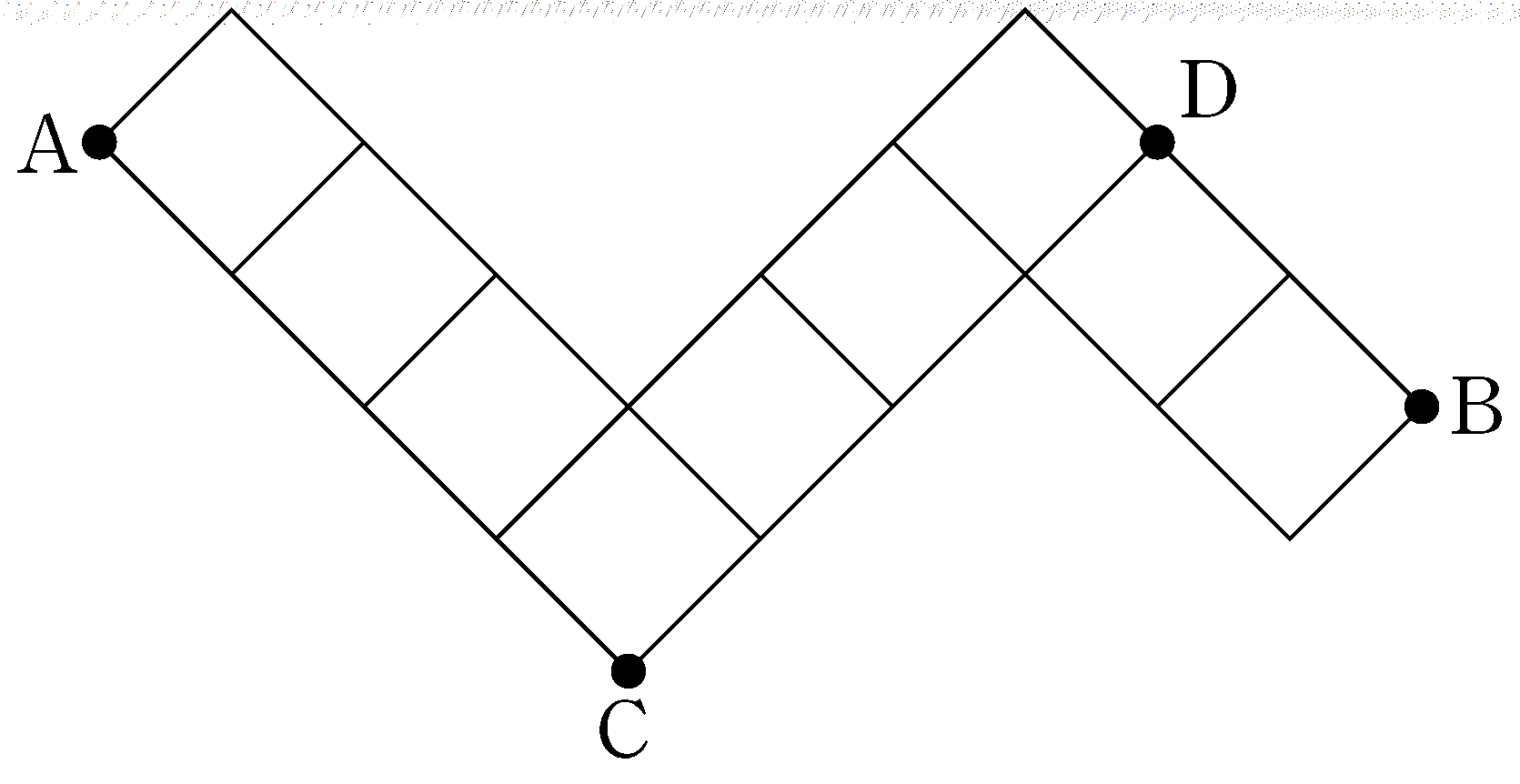
There is a network of roads connected in shapes of rhombuses as shown below. What is the number of ways to move from point \(\mathrm{A}\) to point \(\mathrm{B}\) along the shortest path on the network, while passing through neither point \(\mathrm{C}\) nor point \(\mathrm{D}\)? [3 points]
  1. \(26\)
  2. \(24\)
  3. \(22\)
  4. \(20\)
  5. \(18\)
Consider the tangent line to the hyperbola \(x^2 - 4y^2 = a\) at point \((b, 1)\) on the hyperbola. Given that this line is perpendicular to one of the asymptotes of the hyperbola, what is the value of \(a+b\)? (※ \(a\) and \(b\) are positive numbers.) [3 points]
  1. \(68\)
  2. \(77\)
  3. \(86\)
  4. \(95\)
  5. \(104\)
The temperature of a room on fire changes according to time. Let \(T_0\) (℃) be the initial temperature of the room, and \(T\) (℃) be the temperature of the room \(t\) minutes after the fire. Suppose that the following equation holds.
\(T = T_0 + k \log(8t + 1)\) (※ \(k\) is a constant.)
Consider a room with an initial temperature of \(20\)℃ on fire. The temperature of this room \(\dfrac{9}{8}\) minutes after the fire was \(365\)℃, and the temperature of this room \(a\) minutes after the fire was \(710\)℃.
What is the value of \(a\)? [3 points]
  1. \(\dfrac{99}{8}\)
  2. \(\dfrac{109}{8}\)
  3. \(\dfrac{119}{8}\)
  4. \(\dfrac{129}{8}\)
  5. \(\dfrac{139}{8}\)

Mathematics (Type Ga)

Among all students of some school, \(60\%\) rode the bus to school, and \(40\%\) walked to school. \(\dfrac{1}{20}\) of students who rode the bus to school were late, and \(\dfrac{1}{15}\) of students who walked to school were late. Suppose we randomly choose a student of this school. Given that the chosen student was late to school, what is the probability that the chosen student rode the bus to school? [3 points]
  1. \(\dfrac{3}{7}\)
  2. \(\dfrac{9}{20}\)
  3. \(\dfrac{9}{19}\)
  4. \(\dfrac{1}{2}\)
  5. \(\dfrac{9}{17}\)
On the \(xy\)-plane, let \(f\) be the transformation that rotates all points counterclockwise by \(\dfrac{\pi}{3}\) about the origin, and let \(g\) be the transformation that reflects all points about the line \(y=x\). The line \(x+2y+5=0\) transforms to the line \(ax+by+5=0\) by the transformation \(g^{-1} \circ f \circ g\). what is the value of \(a + 2b\)? (※ \(a\) and \(b\) are constants.) [3 points]
  1. \(\dfrac{1}{2}\)
  2. \(1\)
  3. \(\dfrac{3}{2}\)
  4. \(2\)
  5. \(\dfrac{5}{2}\)
Consider points \(\mathrm{A}\) and \(\mathrm{B}\), \(6\text{km}\) apart. We will travel from point \(\mathrm{A}\) to point \(\mathrm{B}\), and then back to point \(\mathrm{A}\) along a straight line. For the first \(1\text{km}\) of the travel we will walk at a constant speed, and for the next \(5\text{km}\) we will walk at twice the initial speed. While we walk back to point \(\mathrm{A}\), we will walk at a speed \(2\text{km/hour}\) faster than the initial speed. Suppose we want the entire travel to be \(2\) hours \(30\) minutes or less. What is the smallest possible value of the initial speed? (※ The unit of speed is \(\text{km/hour}\).) [3 points]
  1. \(\dfrac{12}{5}\)
  2. \(\dfrac{13}{5}\)
  3. \(\dfrac{14}{5}\)
  4. \(3\)
  5. \(\dfrac{16}{5}\)

Mathematics (Type Ga)

There is a sack containing \(4\) white balls and \(3\) black balls. Suppose \(2\) balls are randomly taken out of the sack at the same time. Suppose we throw a coin \(3\) times if the color of the \(2\) balls are different, and throw a coin \(2\) times if the color of the \(2\) balls are the same. During this process, what is the probability that the coin lands on heads exactly twice? [3 points]
  1. \(\dfrac{9}{28}\)
  2. \(\dfrac{19}{56}\)
  3. \(\dfrac{5}{14}\)
  4. \(\dfrac{3}{8}\)
  5. \(\dfrac{11}{28}\)
Let \(f(x)\) be a continuous function satisfying
\(f(x)=e^{x^2} + \displaystyle\int_{0}^{1}t f(t) dt\).
What is the value of \(\displaystyle\int_{0}^{1}x f(x) dx\)? [3 points]
  1. \(e-2\)
  2. \(\dfrac{e-1}{2}\)
  3. \(\dfrac{e}{2}\)
  4. \(e-1\)
  5. \(\dfrac{e+1}{2}\)

Mathematics (Type Ga)

Let \(X\) be a random variable following the normal distribution \(\mathrm{N}(m, \sigma ^2)\) satisfying the following conditions.
  1. \(\mathrm{P}(X \geq 64) = \mathrm{P}(X \leq 56)\)
  2. \(\mathrm{E}(X^2)=3616\)
What is the value of \(\mathrm{P}(X\leq 68)\) computed with the table to the right? [3 points]
  1. \(0.9104\)
  2. \(0.9332\)
  3. \(0.9544\)
  4. \(0.9772\)
  5. \(0.9938\)
\(x\) \(\mathrm{P}(m\!\leq\! X \!\leq\!x)\)
\(m + 1.5\sigma\) \(0.4332\)
\(m + 2\sigma\) \(0.4772\)
\(m + 2.5\sigma\) \(0.4938\)
As the figure shows, there is a circle \(\mathrm{O}\) with the line segment \(\mathrm{AB}\) as a diameter, whose length is \(2\). Let \(\mathrm{C}\) be one of the points where the circle meets a line passing through the center of circle \(\mathrm{O}\) perpendicular to line \(\mathrm{AB}\).
Consider a circle with center \(\mathrm{C}\) that passes through points \(\mathrm{A}\) and \(\mathrm{B}\). Obtain figure \(R_1\) by coloring the shape outside this circle inside circle \(\mathrm{O}\).
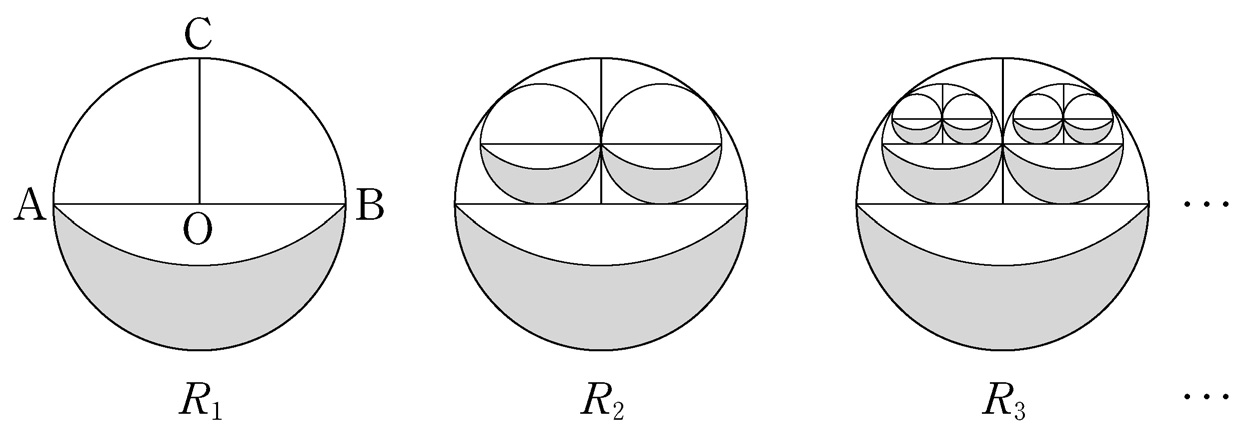
Starting from figure \(R_1\), bisect the ‘upper half(that does not contain the colored region)” of circle \(\mathrm{O}\). Draw two circles inscribed in each quarter of the circle. Apply the process of obtaining figure \(R_1\) to the newly drawn two circles respectively, and obtain figure \(R_2\) by coloring the two shapes.
Starting from figure \(R_2\), bisect the ‘upper half’ of each newly drawn circles. Draw four circles inscribed in each quarter of the two circles. Apply the process of obtaining figure \(R_1\) to the newly drawn four circles respectively, and obtain figure \(R_3\) by coloring the four shapes.
Continue this process, and let \(S_n\) be the area of the colored region in \(R_n\), the \(n\)th obtained figure. What is the value of \(\displaystyle\lim_{n\;\!\to\;\!\infty}S_n\)? [4 points]
  1. \(\dfrac{5+2\sqrt{2}}{7}\)
  2. \(\dfrac{5+3\sqrt{2}}{7}\)
  3. \(\dfrac{5+4\sqrt{2}}{7}\)
  4. \(\dfrac{5+5\sqrt{2}}{7}\)
  5. \(\dfrac{5+6\sqrt{2}}{7}\)

Mathematics (Type Ga)

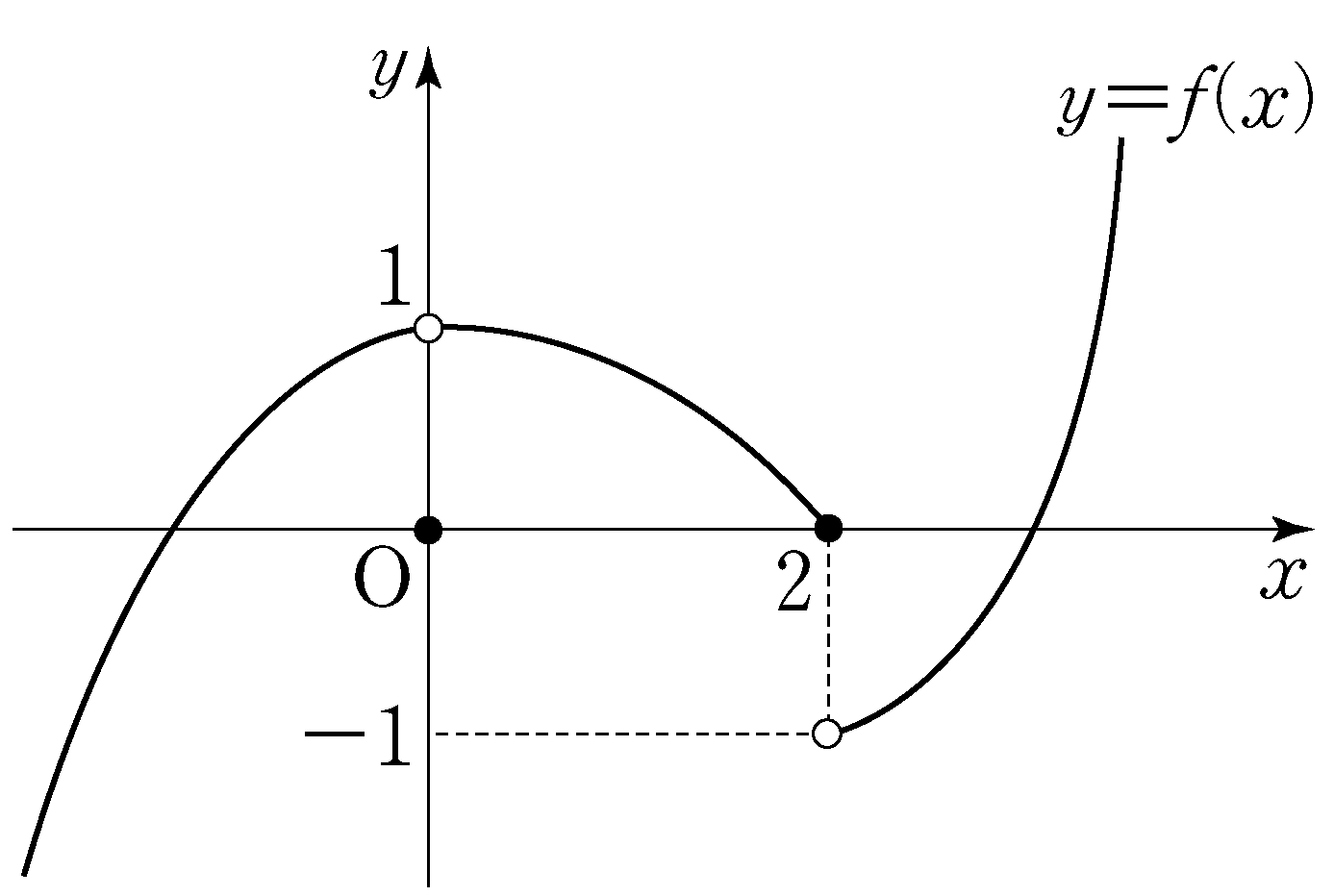
Let \(y=f(x)\) be a function defined on the set of all real numbers, whose graph is shown below. Let \(g(x)\) be a cubic function with a leading coefficient of \(1\), satisfying \(g(0)=3\). Given that the function \((g \circ f)(x)\) is continuous on the set of all real numbers, what is the value of \(g(3)\)? [4 points]
  1. \(31\)
  2. \(30\)
  3. \(29\)
  4. \(28\)
  5. \(27\)
Two square matrices \(A\) and \(B\) of order \(2\) satisfy
\(2A^2+AB=E\:\) and \(\:AB+BA=2A+E\).
What is the list of correct statements in the <List>? (※ \(E\) is the identity matrix.) [4 points]
  1. \(A^{-1}=2A+B\)
  2. \(B=2A+2E\)
  3. \((B-E)^2=O\) (※ \(O\) is the zero matrix.)
  1. b
  2. c
  3. a, b
  4. a, c
  5. a, b, c

Mathematics (Type Ga)

A sequence \(\{a_n\}\) satisfies \(a_1=4\) and
\(a_{n+1}=n\cdot 2^n + \displaystyle\sum_{k\;\!=\;\!1}^{n}\dfrac{a_k}{k} \;(n\geq 1)\).
The following is a process computing the general term \(a_n\).
From the given equation we have
\(a_n = (n-1) \cdot 2^{n-1} + \displaystyle\sum_{k\;\!=\;\!1}^{n-1} \dfrac{a_k}{k} \;(n\geq 2)\).
Thus for all integers \(n \geq 2\),
\(a_{n+1} - a_n = \fbox{\(\;(\alpha)\;\)} + \dfrac{a_n}{n}\).
Therefore
\(a_{n+1} = \dfrac{(n+1)a_n}{n} + \fbox{\(\;(\alpha)\;\)}\).
Let \(b_n = \dfrac{a_n}{n}\). Then
\(b_{n+1} = b_n + \dfrac{\fbox{\(\;(\alpha)\;\)}}{n+1} \;(n \geq 2)\)
and \(b_2 = 3\). So
\(b_n = \fbox{\(\;(\beta)\;\)} \;(n \geq 2)\).
Therefore
\(a_n = \begin{cases} 4 &\; (n = 1) \\ n \times \left(\fbox{\(\;(\beta)\;\)}\right) &\; (n \geq 2) \end{cases}\).
Let \(f(n)\) and \(g(n)\) be the correct expressions for \((\alpha)\) and \((\beta)\). What is the value of \(f(4) + g(7)\)? [4 points]
  1. \(90\)
  2. \(95\)
  3. \(100\)
  4. \(105\)
  5. \(110\)
For positive integers \(n\), consider the focus \(\mathrm{F}\) of the parabola \(y^2 = \dfrac{x}{n}\). Let \(\mathrm{P}\) and \(\mathrm{Q}\) be the two points where the parabola meets a line passing through point \(\mathrm{F}\), such that \(\overline{\mathrm{PF}} = 1\) and \(\overline{\mathrm{FQ}} = a_n\). What is the value of \(\displaystyle\sum_{n\;\!=\;\!1}^{10} \dfrac{1}{a_n}\)? [4 points]
  1. \(210\)
  2. \(205\)
  3. \(200\)
  4. \(195\)
  5. \(190\)

Mathematics (Type Ga)

Let \(f(x)\) be a cubic function such that \(f(0) > 0\).
Let \(g(x)\) be
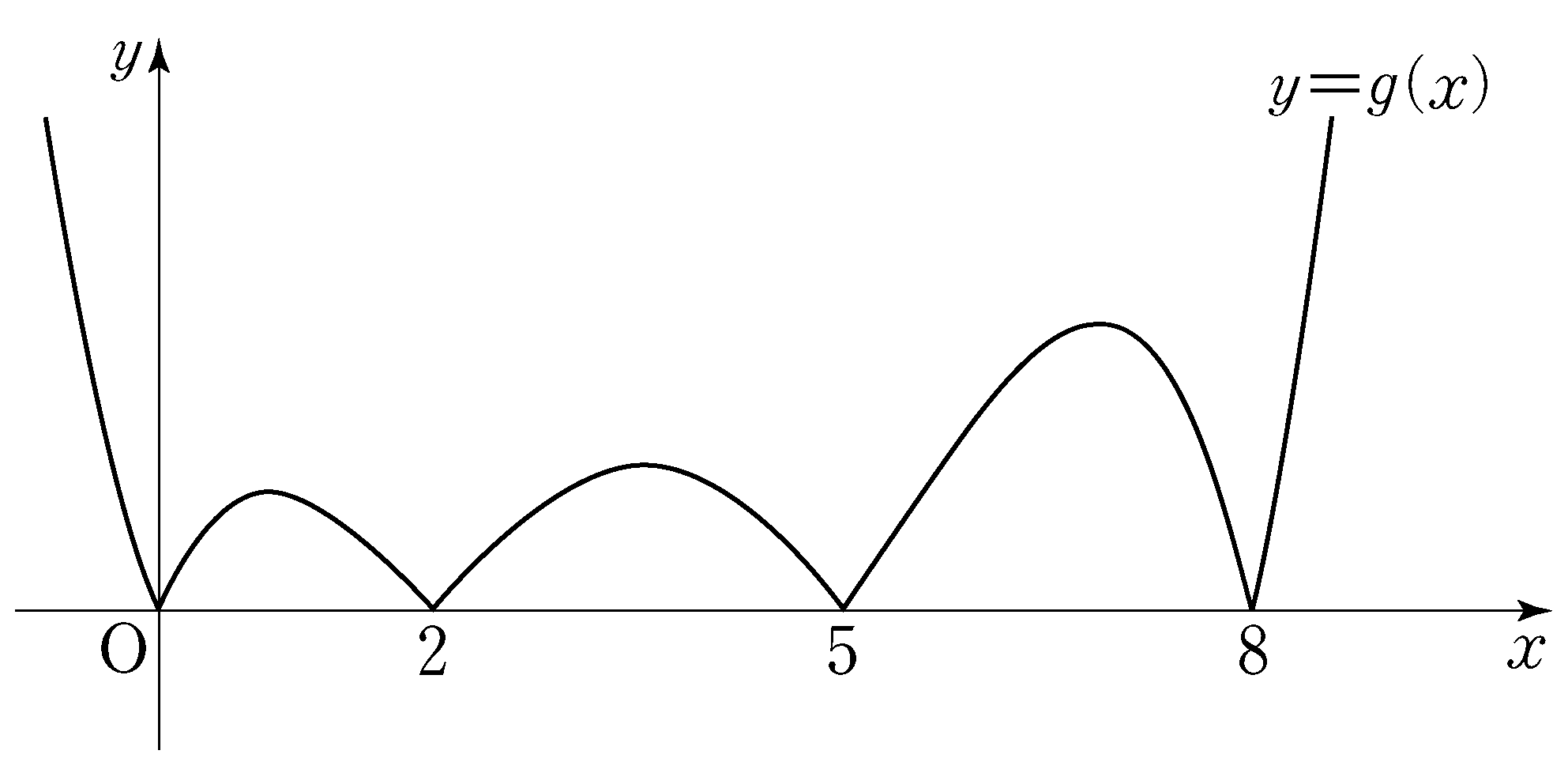
\(g(x) = \left|\displaystyle\int_{0}^{x} f(t) dt\right|\).
The graph of the function \(y=g(x)\) is as shown below.
What is the list of correct statements in the <List>? [4 points]
  1. The equation \(f(x)=0\) has \(3\) distinct real solutions.
  2. \(f'(0) < 0\)
  3. There are exactly \(3\) positive integers \(m\) that satisfy \(\displaystyle\int_{m}^{m+2} f(x)dx > 0\).
  1. b
  2. c
  3. a, b
  4. a, c
  5. a, b, c
Consider a regular tetrahedron \(\mathrm{ABCD}\) in
\(3\)-dimensional space, such that the face \(\mathrm{ABC}\) is on the plane \(2x-y+z=4\), and the vertex \(\mathrm{D}\) is on the plane \(x+y+z=3\). Given that the centroid of the triangle \(\mathrm{ABC}\) has coordinates \((1, 1, 3)\), what are the side lengths of the regular tetrahedron \(\mathrm{ABCD}\)? [4 points]
  1. \(2\sqrt{2}\)
  2. \(3\)
  3. \(2\sqrt{3}\)
  4. \(4\)
  5. \(3\sqrt{2}\)

Mathematics (Type Ga)

Let \(f(x)=kx^2 e^{-x} \; (k>0)\). For real numbers \(t\), consider the point \((t, f(t))\) on the curve \(y=f(x)\). Consider the distance from this point to the \(x\)-axis and the \(y\)-axis, and let \(g(t)\) be the smallest value between the two distances.
What is the maximum value of \(k\) for which the function \(g(t)\) is not differentiable at only one point? [4 points]
  1. \(\dfrac{1}{e}\)
  2. \(\dfrac{1}{\sqrt{e}}\)
  3. \(\dfrac{e}{2}\)
  4. \(\sqrt{e}\)
  5. \(e\)
Short Answer Questions
Let \(f(x)=x\ln x + 13x\). Compute \(f'(1)\). [3 points]
Let \(a\) be the maximum value of the function \(f(x)= 2\cos \left(x - \dfrac{\pi}{3}\right) + 2\sqrt{3} \sin x\:\). Compute \(a^2\). [3 points]

Mathematics (Type Ga)

Let \(A\) be the matrix representing the linear map \(f: (x, y) \to (2x-y, x-2y)\). The linear map represented by matrix \(A^4\) moves the point \((5, -1)\) into point \((a, b)\). Compute \(a + b\). [3 points]
Consider a population following a normal distribution with a standard deviation of \(\sigma\). Suppose a sample of size \(n\) was randomly sampled from this population. The \(95\%\) confidence interval for the population mean computed with this sample is \([100.4, 139.6]\). Compute the number of integers contained in the \(99\%\) confidence interval for the population mean computed with the same sample. (※ For a random variable \(Z\) that follows the standard normal distribution, suppose \(\mathrm{P}(0 \leq Z \leq 1.96) = 0.475\) and \(\mathrm{P}(0 \leq Z \leq 2.58) = 0.495\).) [3 points]
Consider an equilateral triangle \(\mathrm{ABC}\) with side lengths of \(2\). Let \(\mathrm{H}\) be the perpendicular foot from point \(\mathrm{A}\) to edge \(\mathrm{BC}\). Let \(\mathrm{P}\) be a point moving freely on the line segment \(\mathrm{AH}\). The maximum value of \(\big| \overrightarrow{\mathrm{PA}} \circ \overrightarrow{\mathrm{PB}}\big|\) is \(\dfrac{q}{p}\). compute \(p+q\). (※ \(p\) and \(q\) are positive integers that are coprime.) [4 points]

Mathematics (Type Ga)

For positive integers \(n\), let \(\mathrm{P}_n\) be a point on the
\(xy\)-plane such that the following is satisfied.
  1. The coordinates of points \(\mathrm{P}_1\), \(\mathrm{P}_2\) and \(\mathrm{P}_3\) are \((-1, 0)\), \((1, 0)\) and \((-1, 2)\), respectively.
  2. The midpoints of line segments \(\mathrm{P}_n \mathrm{P}_{n+1}\) and \(\mathrm{P}_{n+2}\, \mathrm{P}_{n+3}\) are the same.
For example, point \(\mathrm{P}_4\) has coordinates \((1, -2)\). Given that point \(\mathrm{P}_{25}\) has coordinates \((a, b)\), compute \(a + b\). [4 points]
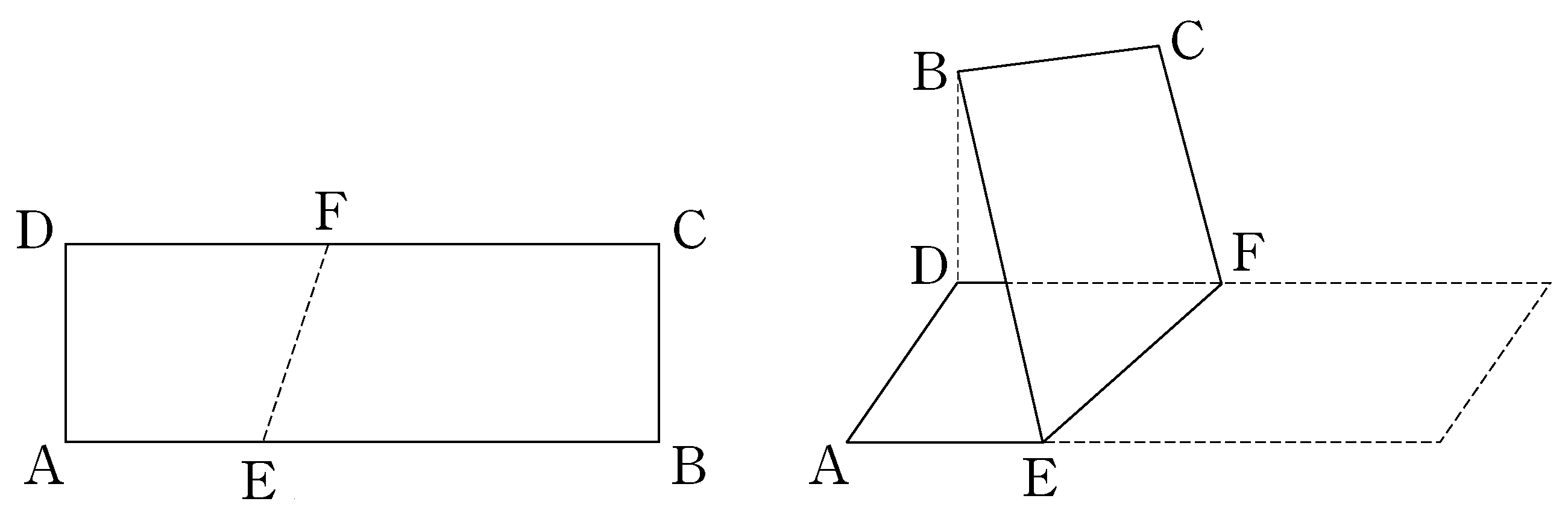
As the figure shows, there is a piece of paper in the shape of a rectangle \(\mathrm{ABCD}\) where \(\overline{\mathrm{AB}} = 9\) and \(\overline{\mathrm{AD}} = 3\). For a point \(\mathrm{E}\) on the line segment \(\mathrm{AB}\) and a point \(\mathrm{F}\) on the line segment \(\mathrm{DC}\), suppose the paper was folded along the line \(\mathrm{EF}\) such that the projection of point \(\mathrm{B}\) onto plane \(\mathrm{AEFD}\) is the point \(\mathrm{D}\). Given that \(\overline{\mathrm{AE}} = 3\), the angle between planes \(\mathrm{AEFD}\) and \(\mathrm{EFCB}\) is \(\theta\). Compute \(60 \cos \theta\). (※ \(0< \theta < \dfrac{\pi}{2}\). Ignore the thickness of the paper.) [4 points]

Mathematics (Type Ga)

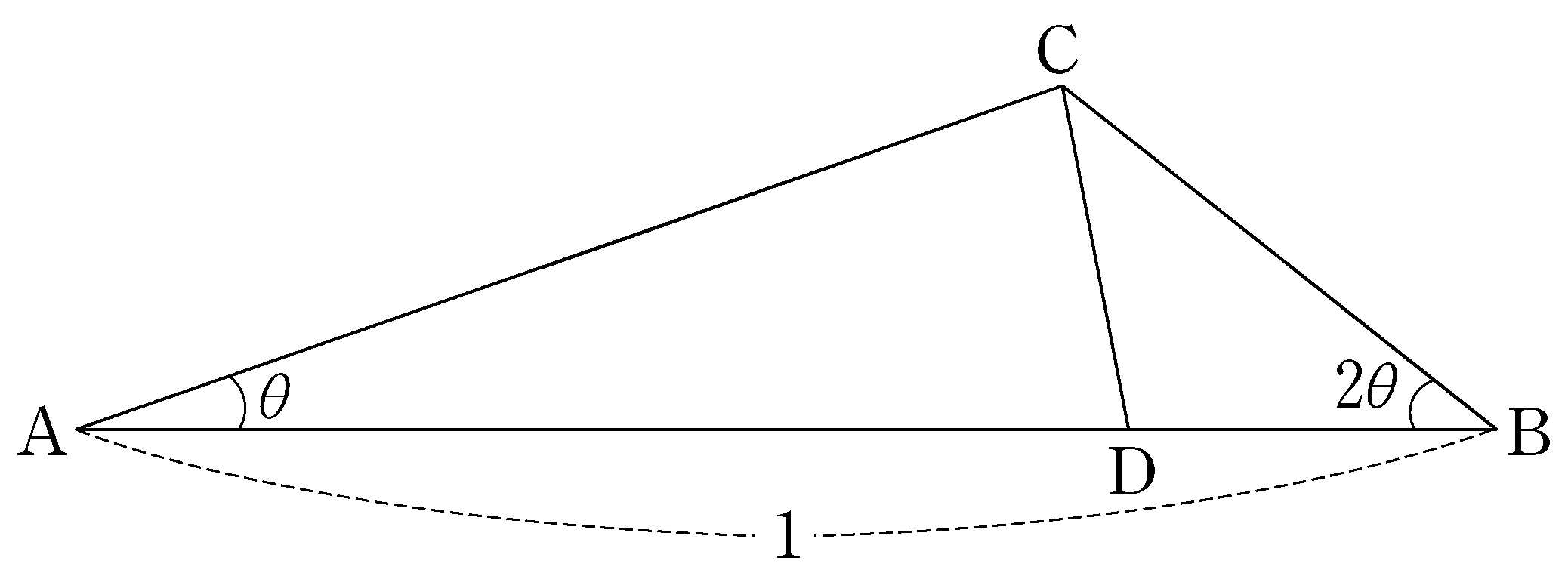
Consider a triangle \(\mathrm{ABC}\) with \(\overline{\mathrm{AB}} = 1\), \(\angle A = \theta\) and \(\angle B = 2\theta\). Let \(\mathrm{D}\) be a point on edge \(\mathrm{AB}\) such that \(\angle \mathrm{ACD} = 2 \angle \mathrm{BCD}\).
Given that \(\displaystyle\lim_{\theta\;\!\to\;\!0+} \dfrac{\overline{\mathrm{CD}}}{\theta} = a\), compute \(27 a^2\).
(※ \(0 < \theta < \dfrac{\pi}{4}\).) [4 points]
For positive integers \(n\), consider the region
\(\big\{ (x,y) \,\big|\, 2^x-n \leq y \leq \log_2 (x+n) \big\}\)
on the \(xy\)-plane. Let \(a_n\) be the number of points in this region that satisfy the following.
  1. The \(x\) coordinate is equal to the \(y\) coordinate.
  2. Both the \(x\) and \(y\) coordinates are integers.
For example, \(a_1 = 2\) and \(a_2 = 4\). Compute \(\displaystyle\sum_{n\;\!=\;\!1}^{30} a_n\). [4 points]