2013 College Scholastic Ability Test

Mathematics (Type Na)

Multiple Choice Questions
For matrices \(A=\begin{pmatrix*}[r] 0 & 0 \\ 1 & 1 \end{pmatrix*}\) and \(B=\begin{pmatrix*}[r] 1 & 0 \\ 1 & 1 \end{pmatrix*}\), what is the sum of all of the elements in the matrix \(2A+B\)? [2 points]
  1. \(10\)
  2. \(9\)
  3. \(8\)
  4. \(7\)
  5. \(6\)
What is the value of \(\log_2 40 - \log_2 5\)? [2 points]
  1. \(1\)
  2. \(2\)
  3. \(3\)
  4. \(4\)
  5. \(5\)
What is the value of \(\displaystyle\lim_{n\;\!\to\;\!\infty} \dfrac{5n^2+1}{3n^2-1}\)? [2 points]
  1. \(\dfrac{1}{3}\)
  2. \(\dfrac{2}{3}\)
  3. \(1\)
  4. \(\dfrac{4}{3}\)
  5. \(\dfrac{5}{3}\)
Consider the matrix that represents the adjacency between the vertices of the following graph. What is the sum of all of the elements in the matrix? [3 points]
  1. \(6\)
  2. \(8\)
  3. \(10\)
  4. \(12\)
  5. \(14\)

Mathematics (Type Na)

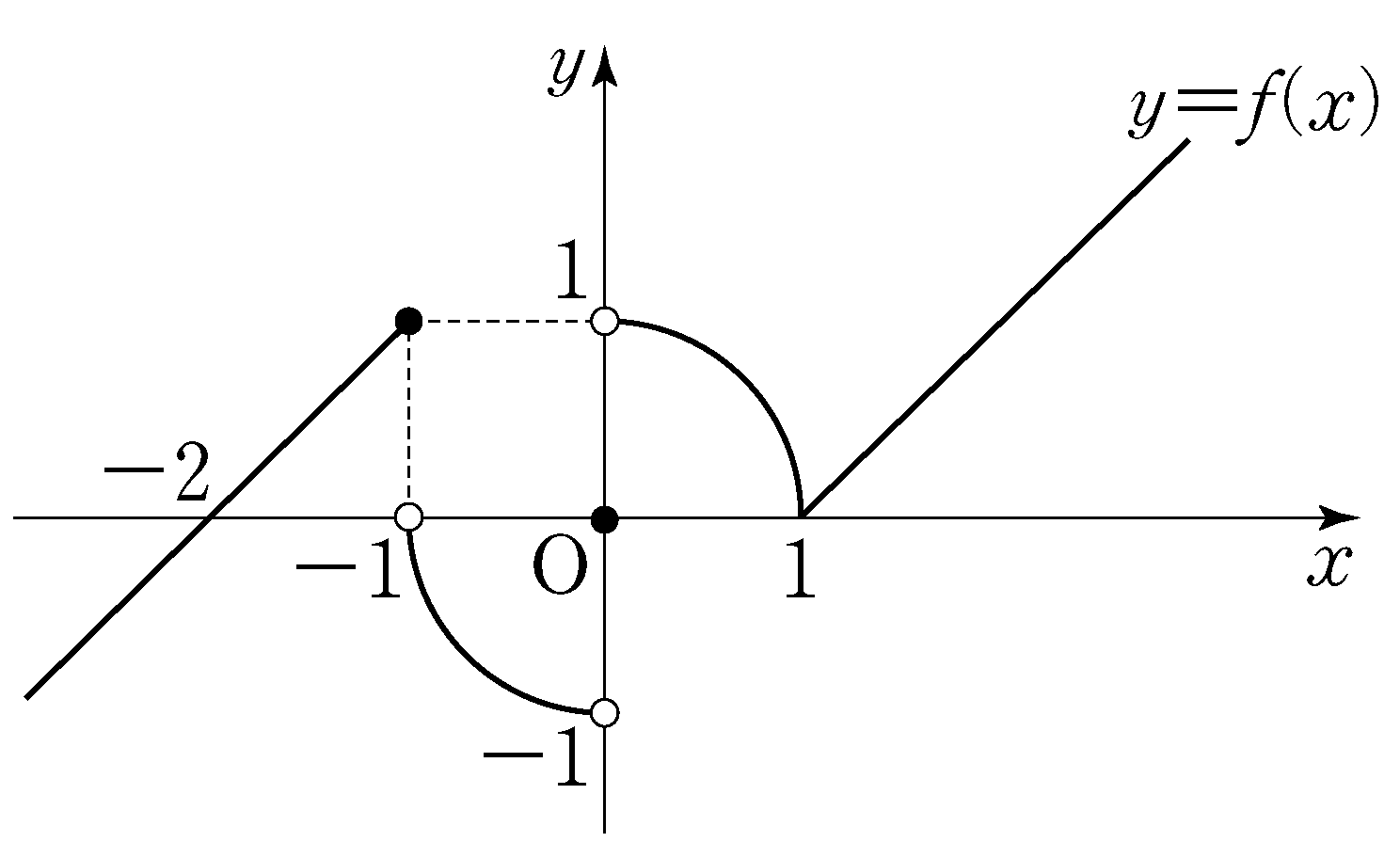
Figure below is the graph of the function \(y=f(x)\).
What is the value of \(\displaystyle\lim_{x\;\!\to\;\!-1-}f(x) + \displaystyle\lim_{x\;\!\to\;\!0+}f(x)\)? [3 points]
  1. \(-2\)
  2. \(-1\)
  3. \(0\)
  4. \(1\)
  5. \(2\)
Let \(\{a_n\}\) be a geometric progression whose terms are all positive, such that
\(\dfrac{a_1 a_2}{a_3} = 2\:\) and \(\:\dfrac{2 a_2}{a_1} + \dfrac{a_4}{a_2} = 8\).
What is the value of \(a_3\)? [3 points]
  1. \(16\)
  2. \(18\)
  3. \(20\)
  4. \(22\)
  5. \(24\)
The temperature of a room on fire changes according to time. Let \(T_0\) (℃) be the initial temperature of the room, and \(T\) (℃) be the temperature of the room \(t\) minutes after the fire. Suppose that the following equation holds.
\(T = T_0 + k \log(8t + 1)\) (※ \(k\) is a constant.)
Consider a room with an initial temperature of \(20\)℃ on fire. The temperature of this room \(\dfrac{9}{8}\) minutes after the fire was \(365\)℃, and the temperature of this room \(a\) minutes after the fire was \(710\)℃.
What is the value of \(a\)? [3 points]
  1. \(\dfrac{99}{8}\)
  2. \(\dfrac{109}{8}\)
  3. \(\dfrac{119}{8}\)
  4. \(\dfrac{129}{8}\)
  5. \(\dfrac{139}{8}\)

Mathematics (Type Na)

Let \(A\) and \(B\) be events such that
\(\mathrm{P}(A \cap B) = \dfrac{1}{8}\:\) and \(\: \mathrm{P}(B^C \,|\, A) = 2 \mathrm{P}(B \,|\, A)\).
What is the value of \(\mathrm{P}(A)\)?
(※ \(A^C\) is the complement of \(A\).) [3 points]
  1. \(\dfrac{5}{12}\)
  2. \(\dfrac{3}{8}\)
  3. \(\dfrac{1}{3}\)
  4. \(\dfrac{7}{24}\)
  5. \(\dfrac{1}{4}\)
Consider the following system of equations on \(x\) and \(y\).
\(\begin{pmatrix} a+1&a \\ 1&1 \end{pmatrix} \begin{pmatrix} x \\ y \end{pmatrix} = \begin{pmatrix} -4 \\ 1 \end{pmatrix}\)
The solution to this system of equations satisfies the equation \(x + 2y - 4a = 0\). What is the value of the constant \(a\)? [3 points]
  1. \(1\)
  2. \(2\)
  3. \(3\)
  4. \(4\)
  5. \(5\)
Let \(X\) be a random variable that follows the binomial distribution \(\mathrm{B}(n, p)\). Given that the random variable \(2X - 5\) has a mean of \(175\) and a standard deviation of \(12\), what is the value of \(n\)? [3 points]
  1. \(130\)
  2. \(135\)
  3. \(140\)
  4. \(145\)
  5. \(150\)

Mathematics (Type Na)

Let \(f(x)=x+1\). Given that
\(\displaystyle\int_{-1}^{1} \big\{f(x)\big\}^2 = k \left(\displaystyle\int_{-1}^{1} f(x)dx\right)^{\!2}\),
what is the value of the constant \(k\)? [3 points]
  1. \(\dfrac{1}{6}\)
  2. \(\dfrac{1}{3}\)
  3. \(\dfrac{1}{2}\)
  4. \(\dfrac{2}{3}\)
  5. \(\dfrac{5}{6}\)
Suppose we have \(4\) identical bottles of juice, \(2\) identical bottles of water, and \(1\) bottle of milk. What is the number of ways to give away all of the bottles to \(3\) people? (※ There can be a person who does not receive a single bottle.) [3 points]
  1. \(330\)
  2. \(315\)
  3. \(300\)
  4. \(285\)
  5. \(270\)

Mathematics (Type Na)

The test scores of students of some school follows a normal distribution with a mean of \(500\) points and a standard deviation of \(25\) points. Suppose we randomly select a student of this school.
What is the probability that the test score of this student is between \(475\) and \(550\) points (inclusive), computed with the standard normal table to the right? [3 points]
\(z\) \(\mathrm{P}(0\!\leq\! Z \!\leq\!z)\)
\(1.0\) \(0.3413\)
\(1.5\) \(0.4332\)
\(2.0\) \(0.4772\)
\(2.5\) \(0.4938\)
  1. \(0.7745\)
  2. \(0.8185\)
  3. \(0.9104\)
  4. \(0.9270\)
  5. \(0.9710\)
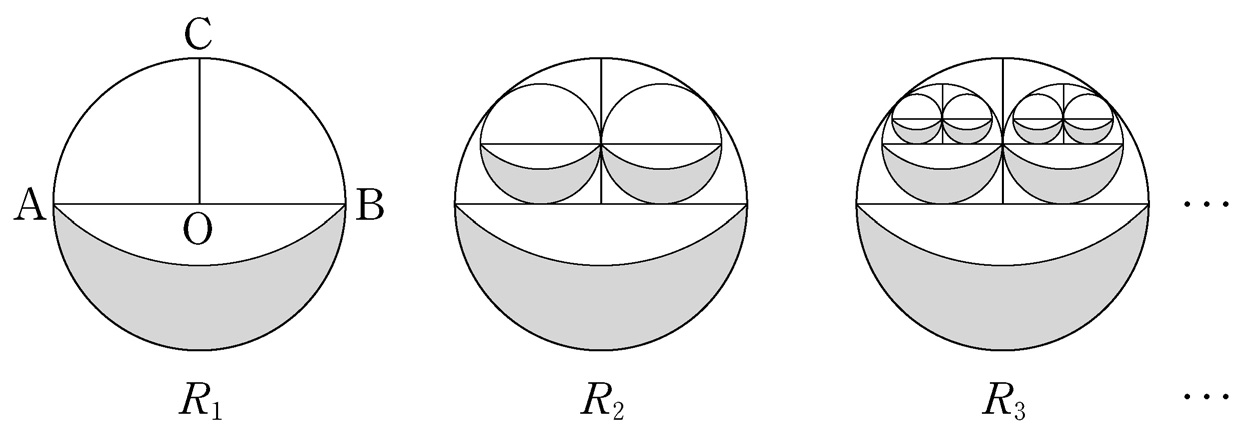
As the figure shows, there is a circle \(\mathrm{O}\) with the line segment \(\mathrm{AB}\) as a diameter, whose length is \(2\). Let \(\mathrm{C}\) be one of the points where the circle meets a line passing through the center of circle \(\mathrm{O}\) perpendicular to line \(\mathrm{AB}\).
Consider a circle with center \(\mathrm{C}\) that passes through points \(\mathrm{A}\) and \(\mathrm{B}\). Obtain figure \(R_1\) by coloring the shape outside this circle inside circle \(\mathrm{O}\).
Starting from figure \(R_1\), bisect the ‘upper half(that does not contain the colored region)” of circle \(\mathrm{O}\). Draw two circles inscribed in each quarter of the circle. Apply the process of obtaining figure \(R_1\) to the newly drawn two circles respectively, and obtain figure \(R_2\) by coloring the two shapes.
Starting from figure \(R_2\), bisect the ‘upper half’ of each newly drawn circles. Draw four circles inscribed in each quarter of the two circles. Apply the process of obtaining figure \(R_1\) to the newly drawn four circles respectively, and obtain figure \(R_3\) by coloring the four shapes.
Continue this process, and let \(S_n\) be the area of the colored region in \(R_n\), the \(n\)th obtained figure. What is the value of \(\displaystyle\lim_{n\;\!\to\;\!\infty}S_n\)? [4 points]
  1. \(\dfrac{5+2\sqrt{2}}{7}\)
  2. \(\dfrac{5+3\sqrt{2}}{7}\)
  3. \(\dfrac{5+4\sqrt{2}}{7}\)
  4. \(\dfrac{5+5\sqrt{2}}{7}\)
  5. \(\dfrac{5+6\sqrt{2}}{7}\)

Mathematics (Type Na)

Consider the point \((1, f(1))\) on the cubic function \(f(x) = x^3 + ax^2 + 9x + 3\). The tangent line to the graph of this function at this point is \(y = 2x+b\). What is the value of \(a+b\)? (※ \(a\) and \(b\) are constants.) [4 points]
  1. \(1\)
  2. \(2\)
  3. \(3\)
  4. \(4\)
  5. \(5\)
Two square matrices \(A\) and \(B\) of order \(2\) satisfy
\(2A^2+AB=E\:\) and \(\:AB+BA=2A+E\).
What is the list of correct statements in the <List>? (※ \(E\) is the identity matrix.) [4 points]
  1. \(A^{-1}=2A+B\)
  2. \(B=2A+2E\)
  3. \((B-E)^2=O\) (※ \(O\) is the zero matrix.)
  1. b
  2. c
  3. a, b
  4. a, c
  5. a, b, c

Mathematics (Type Na)

A sequence \(\{a_n\}\) satisfies \(a_1=4\) and
\(a_{n+1}=n\cdot 2^n + \displaystyle\sum_{k\;\!=\;\!1}^{n}\dfrac{a_k}{k} \;(n\geq 1)\).
The following is a process computing the general term \(a_n\).
From the given equation we have
\(a_n = (n-1) \cdot 2^{n-1} + \displaystyle\sum_{k\;\!=\;\!1}^{n-1} \dfrac{a_k}{k} \;(n\geq 2)\).
Thus for all integers \(n \geq 2\),
\(a_{n+1} - a_n = \fbox{\(\;(\alpha)\;\)} + \dfrac{a_n}{n}\).
Therefore
\(a_{n+1} = \dfrac{(n+1)a_n}{n} + \fbox{\(\;(\alpha)\;\)}\).
Let \(b_n = \dfrac{a_n}{n}\). Then
\(b_{n+1} = b_n + \dfrac{\fbox{\(\;(\alpha)\;\)}}{n+1} \;(n \geq 2)\)
and \(b_2 = 3\). So
\(b_n = \fbox{\(\;(\beta)\;\)} \;(n \geq 2)\).
Therefore
\(a_n = \begin{cases} 4 &\; (n = 1) \\ n \times \left(\fbox{\(\;(\beta)\;\)}\right) &\; (n \geq 2) \end{cases}\).

Let \(f(n)\) and \(g(n)\) be the correct expressions for \((\alpha)\) and \((\beta)\). What is the value of \(f(4) + g(7)\)? [4 points]
  1. \(90\)
  2. \(95\)
  3. \(100\)
  4. \(105\)
  5. \(110\)
Given that the function
\(f(x) = \begin{cases} x^3 + ax &\; (x < 1) \\ bx^2 + x + 1 &\; (x \geq 1) \end{cases}\)
is differentiable at \(x=1\), what is the value of \(a+b\)? (※ \(a\) and \(b\) are constants.) [4 points]
  1. \(5\)
  2. \(6\)
  3. \(7\)
  4. \(8\)
  5. \(9\)

Mathematics (Type Na)

Let \(\{a_n\}\) be a sequence such that
\(\displaystyle\sum_{n\;\!=\;\!1}^{\infty} \left(n a_n - \dfrac{n^2+1}{2n + 1}\right) = 3\).
What is the value of \(\displaystyle\lim_{n\;\!\to\;\!\infty} (a_n^2 + 2a_n + 2)\)? [4 points]
  1. \(\dfrac{13}{4}\)
  2. \(3\)
  3. \(\dfrac{11}{4}\)
  4. \(\dfrac{5}{2}\)
  5. \(\dfrac{9}{4}\)
For the functions
\(f(x) = \begin{cases} -1 &\; (|x| \geq 1) \\ \;\;\:1 &\; (|x| < 1) \end{cases}\)
and \(\:g(x) = \begin{cases} \;\;\:1 &\; (|x| \geq 1) \\ -x &\; (|x| < 1), \end{cases}\)
what is the list of correct statements in the <List>? [4 points]
  1. \(\displaystyle\lim_{x\;\!\to\;\!1} f(x)g(x) = -1\)
  2. The function \(g(x+1)\) is continuous at \(x=0\).
  3. The function \(f(x)g(x+1)\) is continuous at \(x=-1\).
  1. a
  2. b
  3. a, b
  4. a, c
  5. a, b, c

Mathematics (Type Na)

For positive numbers \(a\), let \(f(x)=x^3-3x+a\) and
\(F(x) = \displaystyle\int_{0}^{x}f(t)dt\).
What is the minimum value of the positive number \(a\) for which the function \(F(x)\) only has one local extremum? [4 points]
  1. \(1\)
  2. \(2\)
  3. \(3\)
  4. \(4\)
  5. \(5\)
Short Answer Questions
Compute \(\displaystyle\lim_{x\;\!\to\;\!2} \dfrac{(x-2)(x+3)}{x-2}\). [3 points]
Let \(\{a_n\}\) be an arithmetic progression such that
\(a_2 = 16\:\) and \(\:a_5 = 10\).
Compute the value of \(k\) that satisfies \(a_k = 0\). [3 points]

Mathematics (Type Na)

Let \(f(x) = x^3 + 9x + 2\). Compute \(\displaystyle\lim_{x\;\!\to\;\!1} \dfrac{f(x)-f(1)}{x-1}\). [3 points]
The lifespan of monitors produced by some company follows a normal distribution. Suppose a sample of size \(100\) was randomly sampled from this population, and the sample had a mean of \(\overline{x}\) and a standard deviation of \(500\). The \(95\%\) confidence interval for the mean of the lifespan of monitors produced by this company, computed with this sample, is \([\overline{x} - c, \overline{x} + c]\). Compute \(c\). (※ For a random variable \(Z\) that follows the standard normal distribution, suppose \(\mathrm{P}(0 \leq Z \leq 1.96) = 0.4750\).) [3 points]
Among integers \(n\) satisfying \(2\leq n \leq 100\), compute the number of values of \(n\) for which \(\big( \sqrt[3]{3^5} \big)^{\,\begin{array}{c}1\\\hline 2\end{array}}\) is the
\(n\)th root of some integer. [4 points]

Mathematics (Type Na)

For positive integers \(n\), let \(\mathrm{P}_n\) be a point on the
\(xy\)-plane such that the following is satisfied.
  1. The coordinates of points \(\mathrm{P}_1\), \(\mathrm{P}_2\) and \(\mathrm{P}_3\) are \((-1, 0)\), \((1, 0)\) and \((-1, 2)\), respectively.
  2. The midpoints of line segments \(\mathrm{P}_n \mathrm{P}_{n+1}\) and \(\mathrm{P}_{n+2}\, \mathrm{P}_{n+3}\) are the same.
For example, point \(\mathrm{P}_4\) has coordinates \((1, -2)\). Given that point \(\mathrm{P}_{25}\) has coordinates \((a, b)\), compute \(a + b\). [4 points]
Left \(f(x)\) be a quadratic function with a leading coefficient of \(1\) such that \(f(3)=0\) and
\(\displaystyle\int_{0}^{2013}f(x) dx = \displaystyle\int_{3}^{2013}f(x) dx\).
The region enclosed by the curve \(y=f(x)\) and the \(x\)-axis has an area of \(S\). Compute \(30S\). [4 points]

Mathematics (Type Na)

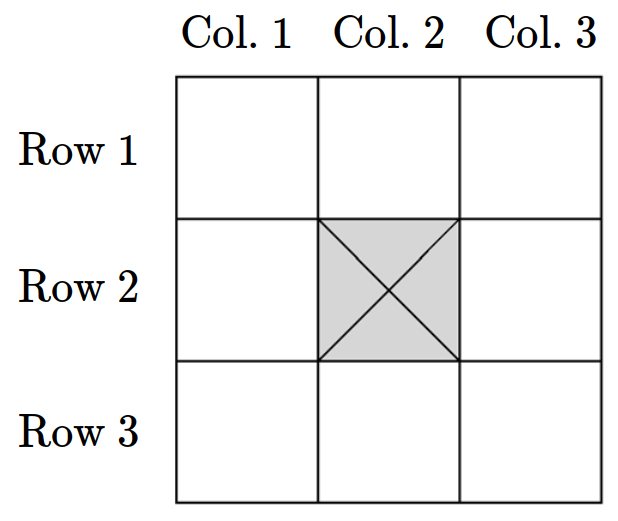
On the following seating chart, there are \(8\) available seats excluding the seat on row \(2\) column \(2\). Suppose we assign the seats to \(4\) female students and \(4\) male students, one seat each. The probability that at least \(2\) of the male students are assigned next to each other is \(p\). Compute \(70p\). (※ Two students are ‘next to each other’ if they are adjacent within the same row or the same column.) [4 points]
For positive integers \(n\), consider the region
\(\big\{ (x,y) \,\big|\, 2^x-n \leq y \leq \log_2 (x+n) \big\}\)
on the \(xy\)-plane. Let \(a_n\) be the number of points in this region that satisfy the following.
  1. The \(x\) coordinate is equal to the \(y\) coordinate.
  2. Both the \(x\) and \(y\) coordinates are integers.
For example, \(a_1 = 2\) and \(a_2 = 4\). Compute \(\displaystyle\sum_{n\;\!=\;\!1}^{30} a_n\). [4 points]