2017 College Scholastic Ability Test

Mathematics (Type Na)

Multiple Choice Questions
What is the value of \(8 \times 2^{-2}\)? [2 points]
  1. \(1\)
  2. \(2\)
  3. \(4\)
  4. \(8\)
  5. \(10\)
For sets
\(A=\{1,2,3,4,5\}\:\) and \(\:B=\{2,4,6,8,10\}\),
what is the value of \(n(A\cup B)\)? [2 points]
  1. \(6\)
  2. \(7\)
  3. \(8\)
  4. \(9\)
  5. \(10\)
What is the value of \(\log_{15}3+\log_{15}5\)? [2 points]
  1. \(1\)
  2. \(2\)
  3. \(3\)
  4. \(4\)
  5. \(5\)
Let \(A\) and \(B\) be events such that
\(\mathrm{P}(A\cap B)=\dfrac{1}{8}\:\) and \(\:\mathrm{P}(A\cap B^C)=\dfrac{3}{16}\).
What is the value of \(\mathrm{P}(A)\)?
(※ \(B^C\) is the complement of \(B\).) [3 points]
  1. \(\dfrac{3}{16}\)
  2. \(\dfrac{7}{32}\)
  3. \(\dfrac{1}{4}\)
  4. \(\dfrac{9}{32}\)
  5. \(\dfrac{5}{16}\)

Mathematics (Type Na)

Three numbers \(\dfrac{9}{4}, a\) and \(4\) form a geometric progression in this order. What is the value of the positive number \(a\)? [3 points]
  1. \(\dfrac{8}{3}\)
  2. \(3\)
  3. \(\dfrac{10}{3}\)
  4. \(\dfrac{11}{3}\)
  5. \(4\)
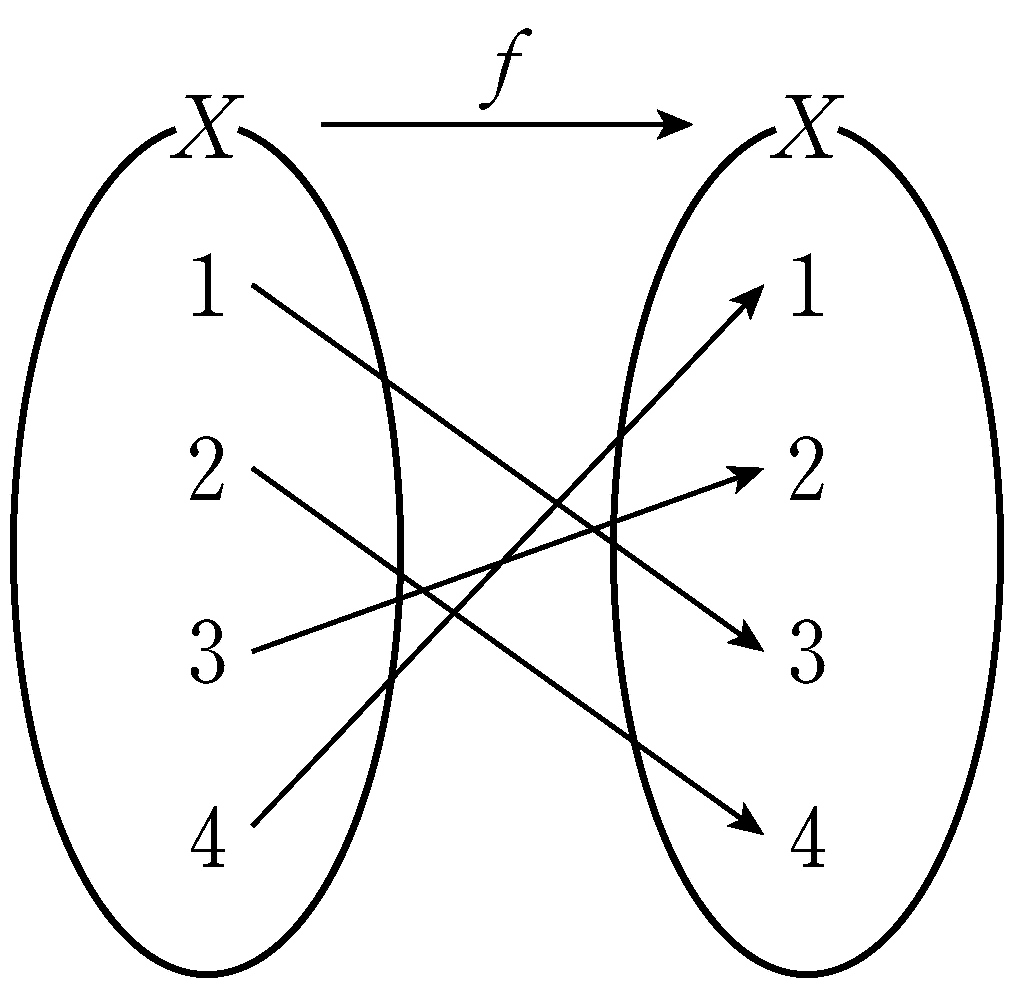
Figure below depicts a function \(f:X\;\!\to\;\!X\).
What is the value of \(f(2)+f^{-1}(2)\)? [3 points]
  1. \(3\)
  2. \(4\)
  3. \(5\)
  4. \(6\)
  5. \(7\)
Consider the following conditions on a real number \(x\).
\(p : |x-1|\leq 3\),
\(q : |x|\leq a\)
What is the minimum value of the integer \(a\) for which \(p\) is sufficient for \(q\)? [3 points]
  1. \(1\)
  2. \(2\)
  3. \(3\)
  4. \(4\)
  5. \(5\)

Mathematics (Type Na)

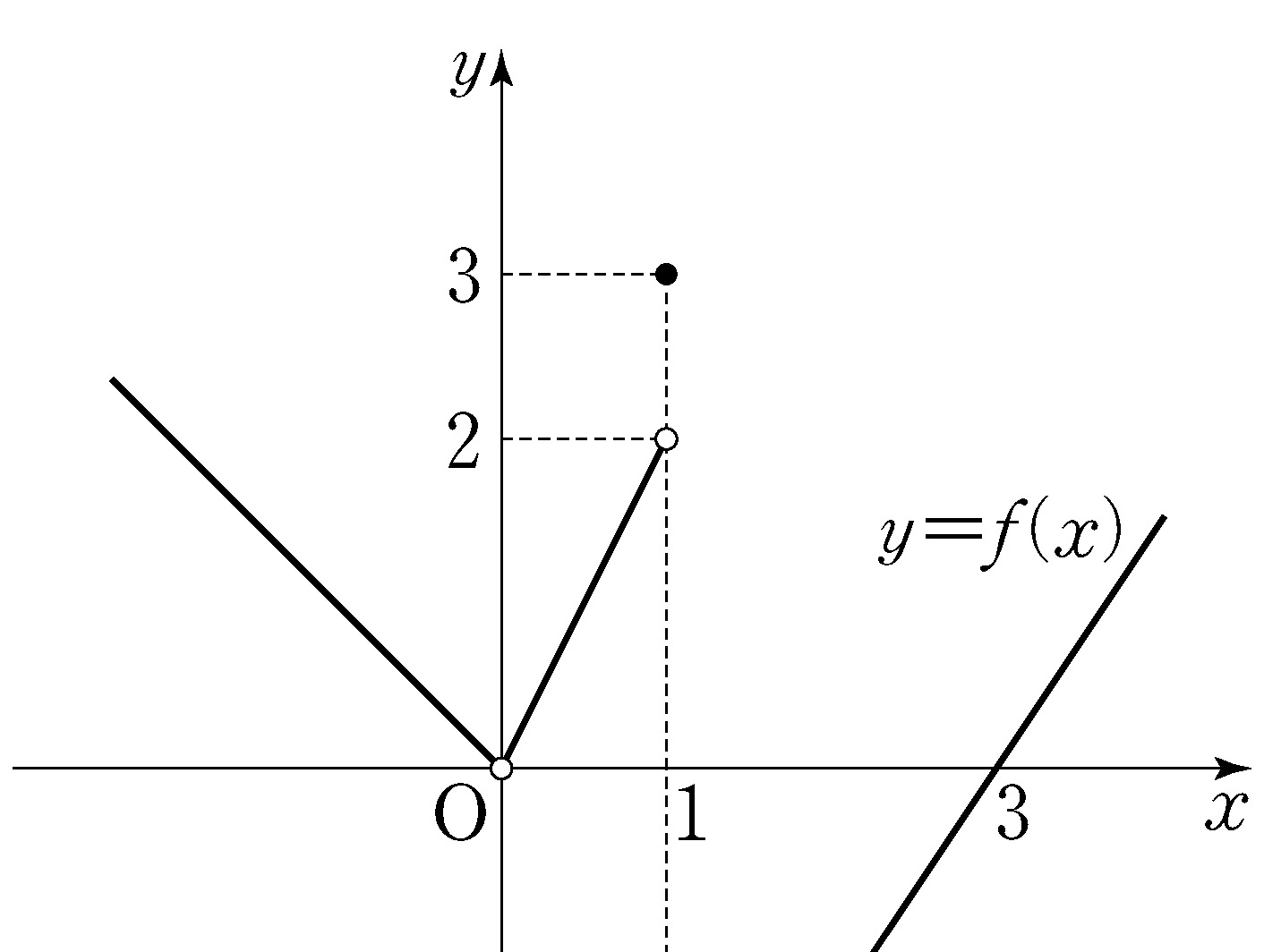
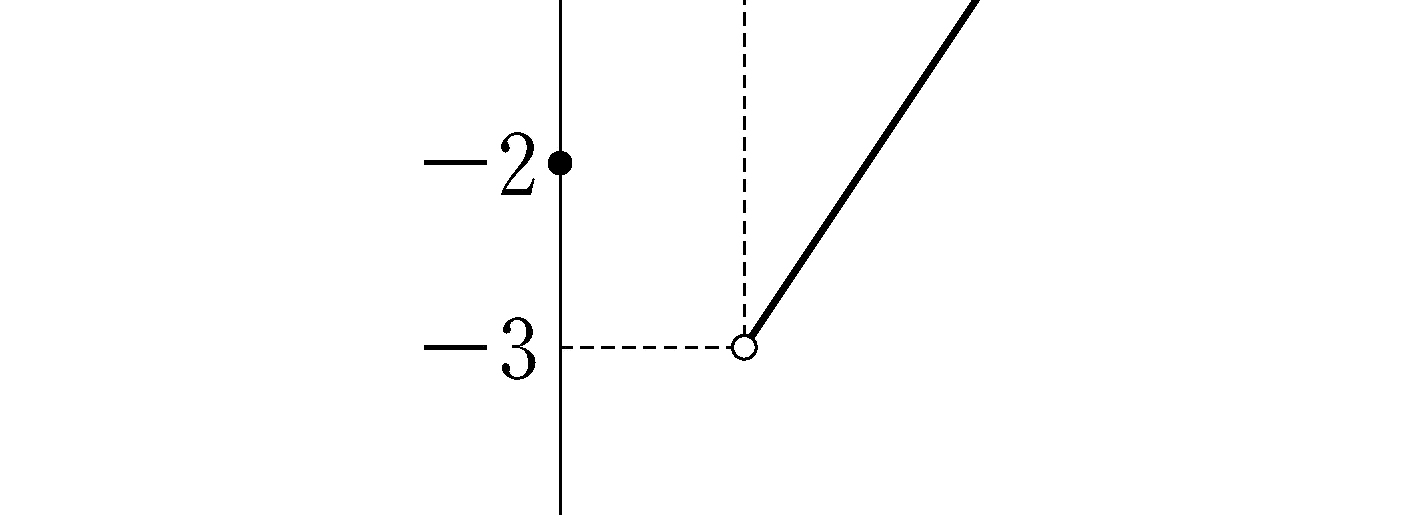
Figure below is the graph of the function \(y=f(x)\).
What is the value of \(\displaystyle\lim_{x\;\!\to\;\!\,0-}f(x) + \lim_{x\;\!\to\;\!\,1+}f(x)\)? [3 points]
  1. \(-1\)
  2. \(-2\)
  3. \(-3\)
  4. \(-4\)
  5. \(-5\)
What is the value of \(\displaystyle\int_{0}^{2}(6x^2-x)dx\)? [3 points]
  1. \(15\)
  2. \(14\)
  3. \(13\)
  4. \(12\)
  5. \(11\)
On the \(xy\)-plane, if the graph of the function \(y=\dfrac{3}{x-5}+k\) is symmetric about the line \(y=x\), what is the value of the constant \(k\)? [3 points]
  1. \(1\)
  2. \(2\)
  3. \(3\)
  4. \(4\)
  5. \(5\)

Mathematics (Type Na)

Suppose we throw a die \(3\) times. What is the probability that it lands on \(4\) exactly once? [3 points]
  1. \(\dfrac{25}{72}\)
  2. \(\dfrac{13}{36}\)
  3. \(\dfrac{3}{8}\)
  4. \(\dfrac{7}{18}\)
  5. \(\dfrac{29}{72}\)
Suppose a point \(\mathrm{P}\) is moving on the number line, and its velocity \(v(t)\) at time \(t\,(t\geq 0)\) is equal to
\(v(t)=-2t+4\).
What is the distance point \(\mathrm{P}\) travels from \(t=0\) to \(t=4\)? [3 points]
  1. \(8\)
  2. \(9\)
  3. \(10\)
  4. \(11\)
  5. \(12\)

Mathematics (Type Na)

Suppose the total number of students in some school is \(360\), and each student either chooses activity \(\mathrm{A}\) or activity \(\mathrm{B}\). Among the students of this school, \(90\) male students and \(70\) female students chose activity \(\mathrm{A}\). Suppose we randomly chose a student from the students in this school. Given that this student chose activity \(\mathrm{B}\), the probability that this student is male is \(\dfrac{2}{5}\). What is the number of female students in this school? [3 points]
  1. \(180\)
  2. \(185\)
  3. \(190\)
  4. \(195\)
  5. \(200\)
Consider the functions
\(f(x)=\begin{cases} x^2-4x+6 &\; (x < 2) \\\\ \qquad 1 &\; (x \geq 2) \end{cases}\)
and \(g(x)=ax+1\).
If the function \(\dfrac{g(x)}{f(x)}\) is continous on the set of all real numbers, what is the value of the constant \(a\)? [4 points]
  1. \(-\dfrac{5}{4}\)
  2. \(-1\)
  3. \(-\dfrac{3}{4}\)
  4. \(-\dfrac{1}{2}\)
  5. \(-\dfrac{1}{4}\)

Mathematics (Type Na)

An arithmetic progression \(\{a_n\}\) with a positive common difference satisfies the following. What is the value of \(a_2\)? [4 points]
  1. \(a_6+a_8=0\)
  2. \(\big|a_6\big|=\big|a_7\big|+3\)
  1. \(-15\)
  2. \(-13\)
  3. \(-11\)
  4. \(-9\)
  5. \(-7\)
The weight of a pomegranate produced in some farm follows a normal distribution with a mean of \(m\) and a standard deviation of \(40\). Suppose we took a random sample of size \(64\) from the pomegranates produced in this farm, and the sample mean was \(\overline{x}\). Using this result, the \(99\%\) confidence interval for the mean weight \(m\) of pomegranates produced in this farm is \(\overline{x}-c \leq m \leq \overline{x}+c\). What is the value of \(c\)?
(※ The unit of weight is \(\text{g}\). For a random variable \(Z\) that follows the standard normal distribution, suppose \(\mathrm{P}(0 \leq Z \leq 2.58) = 0.495\).) [4 points]
  1. \(25.8\)
  2. \(21.5\)
  3. \(17.2\)
  4. \(12.9\)
  5. \(8.6\)

Mathematics (Type Na)

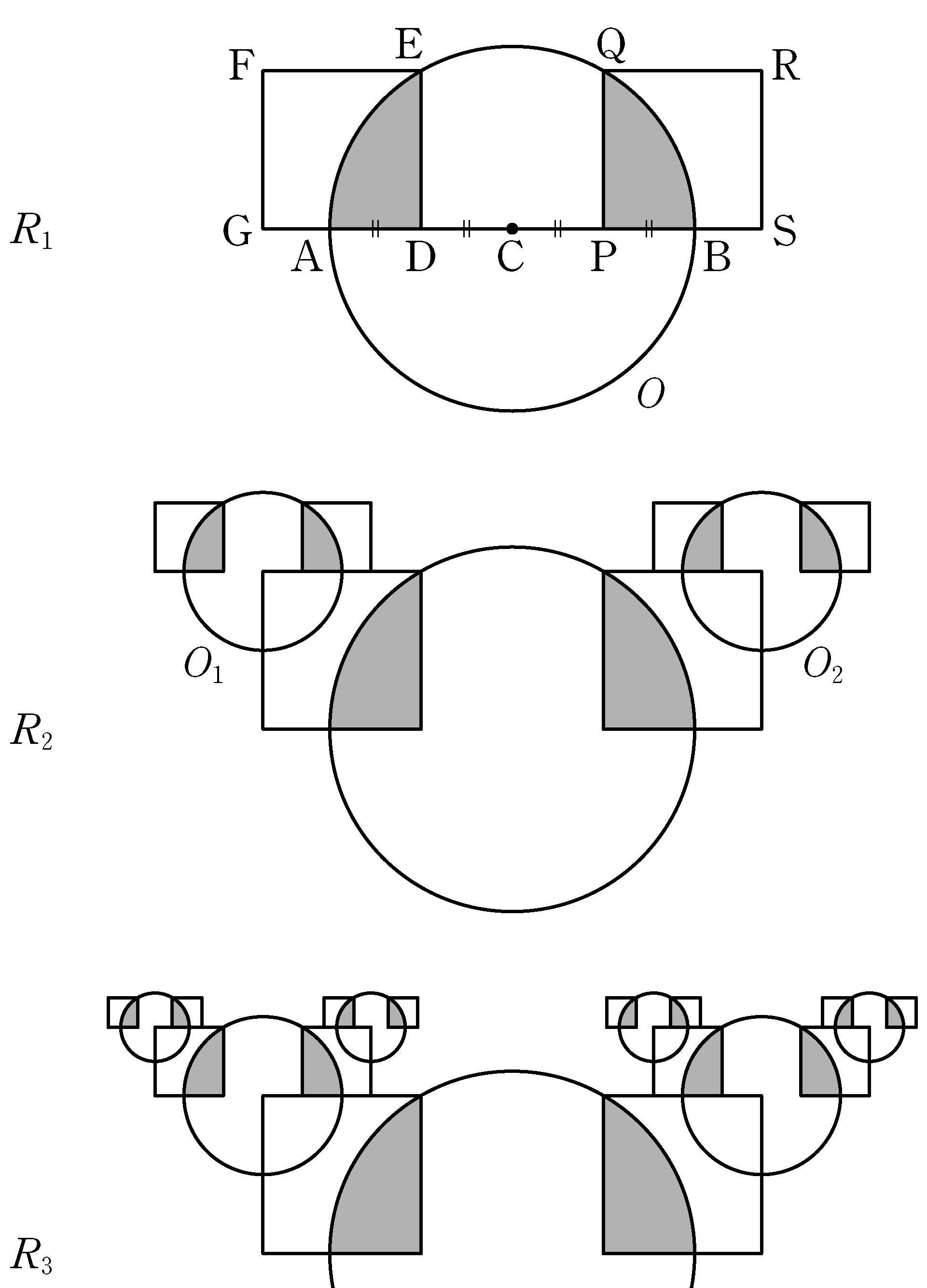
As the figure shows, there is a circle \(O\) whose diameter \(\mathrm{AB}\) has a length of \(4\). Let \(\mathrm{C}\) be the center of the circle, and let \(\mathrm{D}\) and \(\mathrm{P}\) be midpoints of line segments \(\mathrm{AC}\) and \(\mathrm{BC}\) respectively. Let \(\mathrm{E}\) and \(\mathrm{Q}\) be the points where the perpendicular bisectors of line segments \(\mathrm{AC}\) and \(\mathrm{BC}\) meets the upper half of circle \(O\) respectively. Draw a square \(\mathrm{DEFG}\) that meets circle \(O\) at point \(\mathrm{A}\), where the line segment \(\mathrm{DE}\) is an edge and the line segment \(\mathrm{DF}\) is a diagonal. Draw a square \(\mathrm{PQRS}\) that meets circle \(O\) at point \(\mathrm{B}\), where the line segment \(\mathrm{PQ}\) is an edge and the line segment \(\mathrm{PR}\) is a diagonal. Obtain figure \(R_1\) by coloring the common region inside circle \(O\) and square \(\mathrm{DEFG}\) with the shape, and the common region inside circle \(O\) and square \(\mathrm{PQRS}\) with the shape.
Starting from figure \(R_1\), draw a circle \(O_1\) with center \(\mathrm{F}\) and radius \(\dfrac{1}{2}\overline{\mathrm{DE}}\), and a circle \(O_2\) with center \(\mathrm{R}\) and radius \(\dfrac{1}{2}\overline{\mathrm{PQ}}\). Obtain figure \(R_2\) by applying the same process used to obtain figure \(R_1\) to circles \(O_1\) and \(O_2\) respectively, drawing and coloring \(2\) shapes and \(2\) shapes.
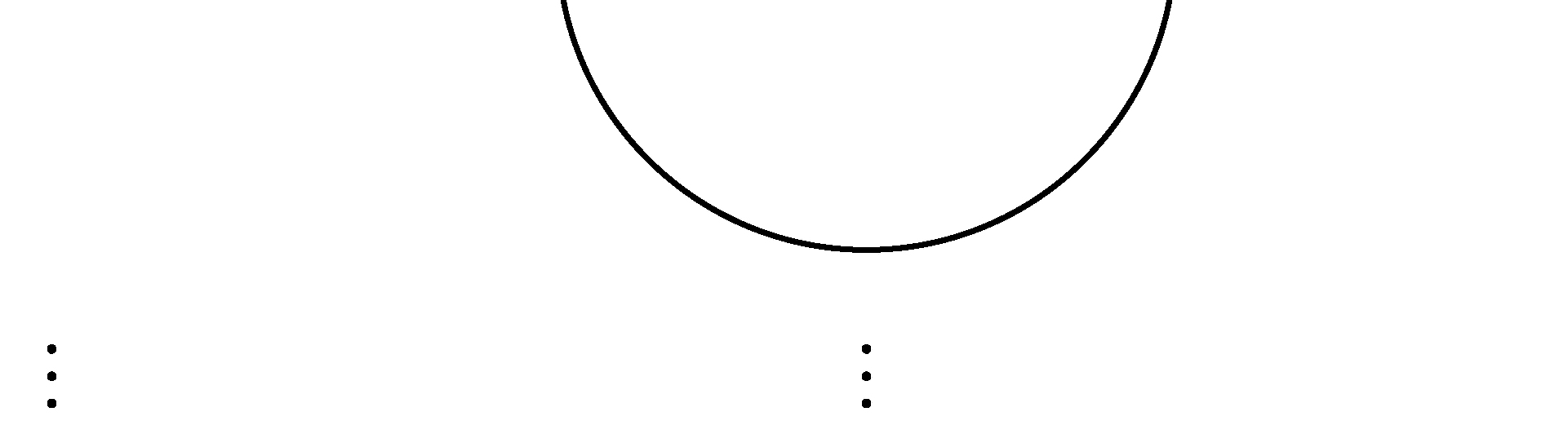
Continue this process, and let \(S_n\) be the area of the colored region in \(R_n\), the \(n\)th obtained figure.
What is the value of \(\displaystyle\lim_{n\;\!\to\;\!\infty} S_n\)? [4 points]
  1. \(\dfrac{12\pi-9\sqrt{3}}{10}\)
  2. \(\dfrac{8\pi-6\sqrt{3}}{5}\)
  3. \(\dfrac{32\pi-24\sqrt{3}}{15}\)
  4. \(\dfrac{28\pi-21\sqrt{3}}{10}\)
  5. \(\dfrac{16\pi-12\sqrt{3}}{5}\)
A quadratic function \(f(x)\) with a leading coefficient of \(1\) satisfies
\(\displaystyle\lim_{x\;\!\to\;\!\,a}\frac{f(x)-(x-a)}{f(x)+(x-a)}=\frac{3}{5}\).
Let \(\alpha\) and \(\beta\) be the two solutions to the equation \(f(x)=0\). What is the value of \(\big|\alpha-\beta\big|\)?
(※ \(a\) is a constant.) [4 points]
  1. \(1\)
  2. \(2\)
  3. \(3\)
  4. \(4\)
  5. \(5\)

Mathematics (Type Na)

On the \(xy\)-plane, a jump is defined as moving from a point \((x,y)\) to one of three points \((x+1,y)\), \((x,y+1)\), or \((x+1,y+1)\).
Suppose we move from point \((0,0)\) to point \((4,3)\) by performing jumps repeatedly. Among all possible cases of doing such, let the random variable \(X\) be the number of jumps in a randomly selected case. The following is a process computing \(\mathrm{E}(X)\). (※ The probability of selecting each case is the same.)
Let \(N\) be the number of all cases of moving from point \((0,0)\) to point \((4,3)\) by performing jumps repeatedly. Let \(k\) be the smallest value that the random variable \(X\) can have. Then \(k=\fbox{\(\;(\alpha)\;\)}\), and the greatest value that can be taken is \(k+3\).
\(\mathrm{P}(X=k)=\dfrac{1}{N}\times \dfrac{4!}{3!}=\dfrac{4}{N}\)
\(\mathrm{P}(X=k+1)=\dfrac{1}{N}\times \dfrac{5!}{2!2!}=\dfrac{30}{N}\) \(\mathrm{P}(X=k+2)=\dfrac{1}{N}\times \fbox{\(\;(\beta)\;\)}\) \(\mathrm{P}(X=k+3)=\dfrac{1}{N}\times \dfrac{7!}{3!4!}=\dfrac{35}{N}\)
and
\(\displaystyle\sum_{i\;\!=\;\!k}^{k+3}\mathrm{P}(X=i)=1\),
therefore \(N=\fbox{\(\;(\gamma)\;\)}\).
Therefore the mean of the random variable \(X\) is
\(\mathrm{E}(X)=\displaystyle\sum_{i\;\!=\;\!k}^{k+3}\{i\times \mathrm{P}(X=i)\}=\dfrac{257}{43}\).
Let \(a\), \(b\) and \(c\) be the correct numbers for \((\alpha), (\beta)\) and \((\gamma)\) respectively. What is the value of \(a+b+c\)? [4 points]
  1. \(190\)
  2. \(193\)
  3. \(196\)
  4. \(199\)
  5. \(202\)
A cubic function \(f(x)\) with a positive leading coefficient satisfies the following.
  1. The function \(f(x)\) has a local maximum at \(x=0\), and a local minimum at \(x=k\).
    (※ \(k\) is a constant.)
  2. For all real numbers \(t\) greater than \(1\), \(\displaystyle\int_{0}^{t}\!\big|f'(x)\big|dx=f(t)+f(0)\).
What is the list of correct statements in the <List>? [4 points]
  1. \(\displaystyle\int_{0}^{k}f'(x)dx<0\)
  2. \(0<k\leq 1\)
  3. \(f(x)\) has a local minimum value of \(0\).
  1. a
  2. c
  3. a, b
  4. b, c
  5. a, b, c

Mathematics (Type Na)

On the \(xy\)-plane, for the function
\(f(x)=\begin{cases} -x+10 &\; (x < 10) \\\\ (x-10)^2 &\; (x \geq 10) \end{cases}\)
and a positive integer \(n\), let \(O_n\) be a circle with radius \(3\) with point \((n,f(n))\) as the center. Among all points whose \(x\)-coordinates and \(y\)-coordinates are integers, let \(A_n\) be the number of points inside circle \(O_n\) below the graph of the function \(y=f(x)\), and let \(B_n\) be the number of points inside circle \(O_n\) above the graph of the function \(y=f(x)\). What is the value of \(\displaystyle\sum_{n\;\!=\;\!1}^{20}(A_n-B_n)\)? [4 points]
  1. \(19\)
  2. \(21\)
  3. \(23\)
  4. \(25\)
  5. \(27\)
Short Answer Questions
Compute \(_5\mathrm{P}_2+_5\mathrm{C}_2\). [3 points]
For the function \(f(x)=x^3+3x^2+3\), compute \(f'(2)\). [3 points]

Mathematics (Type Na)

Consider the universe \(\,U=\{x\,|\,x\) is a positive integer not greater than \(9\}\) and its two subsets
\(A=\{3,6,7\}\:\) and \(\:B=\{a-4,8,9\}\).
It is given that
\(A\cap B^{\,C}=\{6,7\}\).
Compute the value of the positive integer \(a\). [3 points]
Let \(f(x)=\dfrac{1}{2}x+2\). Compute \(\displaystyle\sum_{k\;\!=\;\!1}^{15}f(2k)\). [3 points]
A line with slope \(-\dfrac{1}{2}\) is perpendicular to the tangent line to the curve \(y=x^3-ax+b\) at point \((1,1)\). For constants \(a\) and \(b\), compute \(a+b\). [4 points]

Mathematics (Type Na)

Compute the number of all \(3\)-tuples \((a,b,c)\) where \(a,b\) and \(c\) are nonnegative integers that satisfy the following. [4 points]
  1. \(a+b+c=7\)
  2. \(2^a\times 4^b\) is a multiple of \(8\).
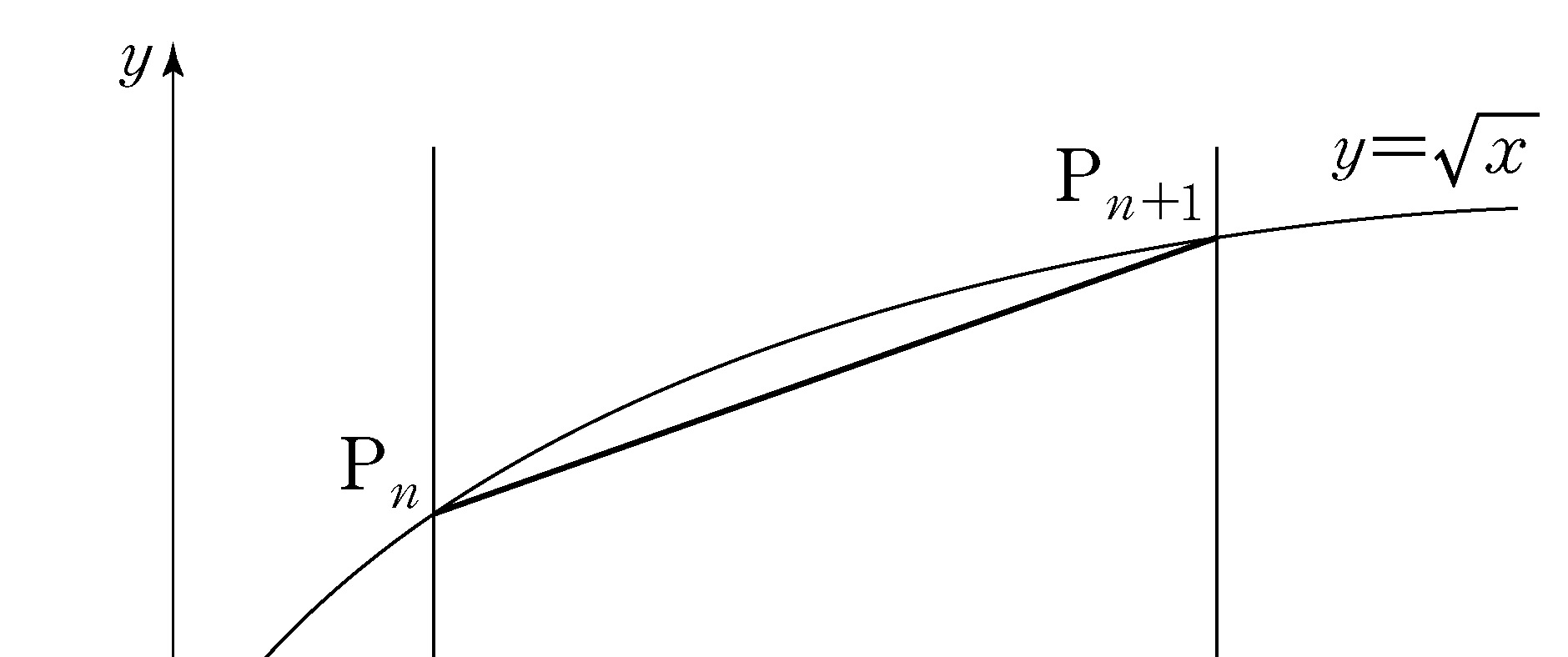
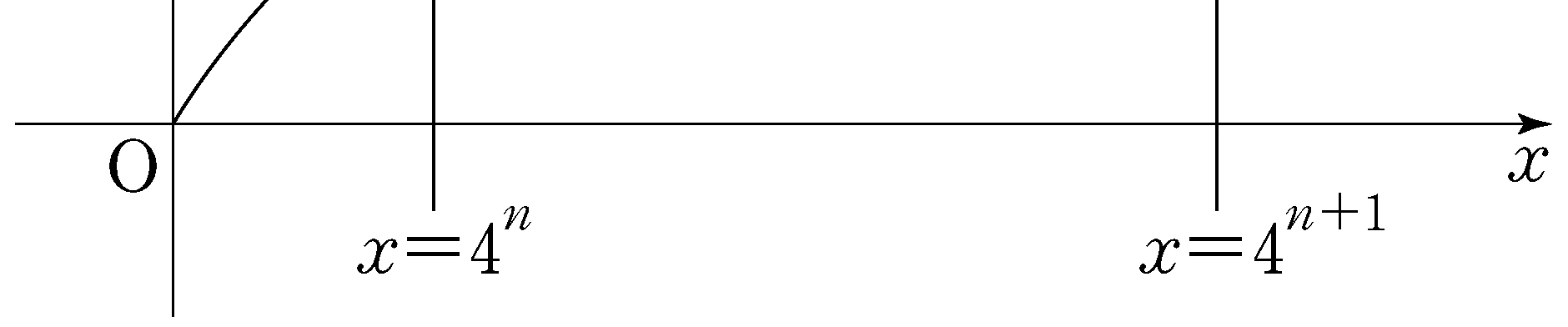
For positive integers \(n\), let \(\mathrm{P}_n\) be the point where the line \(x=4^n\) meets the curve \(y=\sqrt{x}\). Let \(L_n\) be the length of the line segment \(\mathrm{P}_n \mathrm{P}_{n+1}\). Compute \(\displaystyle\lim_{n\;\!\to\;\!\infty}\left(\!\frac{L_{n+1}}{L_n}\!\right)^{\!2}\). [4 points]

Mathematics (Type Na)

A random variable \(X\) follows a normal distribution with a mean of \(m\) and a standard deviation of \(5\), and its probability density function \(f(x)\) satisfies the following.
  1. \(f(10)>f(20)\)
  2. \(f(4)<f(22)\)
Given that \(m\) is an integer, \(\mathrm{P}(17\leq X\leq 18)=a\). Compute \(1000a\) using the standard normal table to the right. [4 points]
\(z\) \(\mathrm{P}(0\!\leq\! Z \!\leq\!z)\)
\(0.6\) \(0.226\)
\(0.8\) \(0.288\)
\(1.0\) \(0.341\)
\(1.2\) \(0.385\)
\(1.4\) \(0.419\)
Let \(g(x)\) be the inverse of the function \(f(x)=x^3-3x^2+6x+k\) for some real number \(k\). Given that the equation \(4f'(x)+12x-18=(f'\circ g)(x)\) has a real solution on the closed interval \([0,1]\), the minimum value of \(k\) is \(m\) and the maximum value of \(k\) is \(M\). Compute \(m^2+M^2\). [4 points]