2019 College Scholastic Ability Test

Mathematics (Type Na)

Multiple Choice Questions
What is the value of \(2^{-1} \times 16^{\,\begin{array}{c}1 \\\hline 2\end{array}}\)? [2 points]
  1. \(1\)
  2. \(2\)
  3. \(3\)
  4. \(4\)
  5. \(5\)
Consider two sets
\(A = \{3,5,7,9\} \) and \(B = \{3,7\} \).
If \(A - B = \{a,9\} \), what is the value of \(a\)? [2 points]
  1. \(1\)
  2. \(2\)
  3. \(3\)
  4. \(4\)
  5. \(5\)
What is the value of \(\displaystyle\lim_{n\;\!\to\;\!\infty}\! \dfrac{6n^2 - 3}{2n^2 + 5n} \)? [2 points]
  1. \(5\)
  2. \(4\)
  3. \(3\)
  4. \(2\)
  5. \(1\)
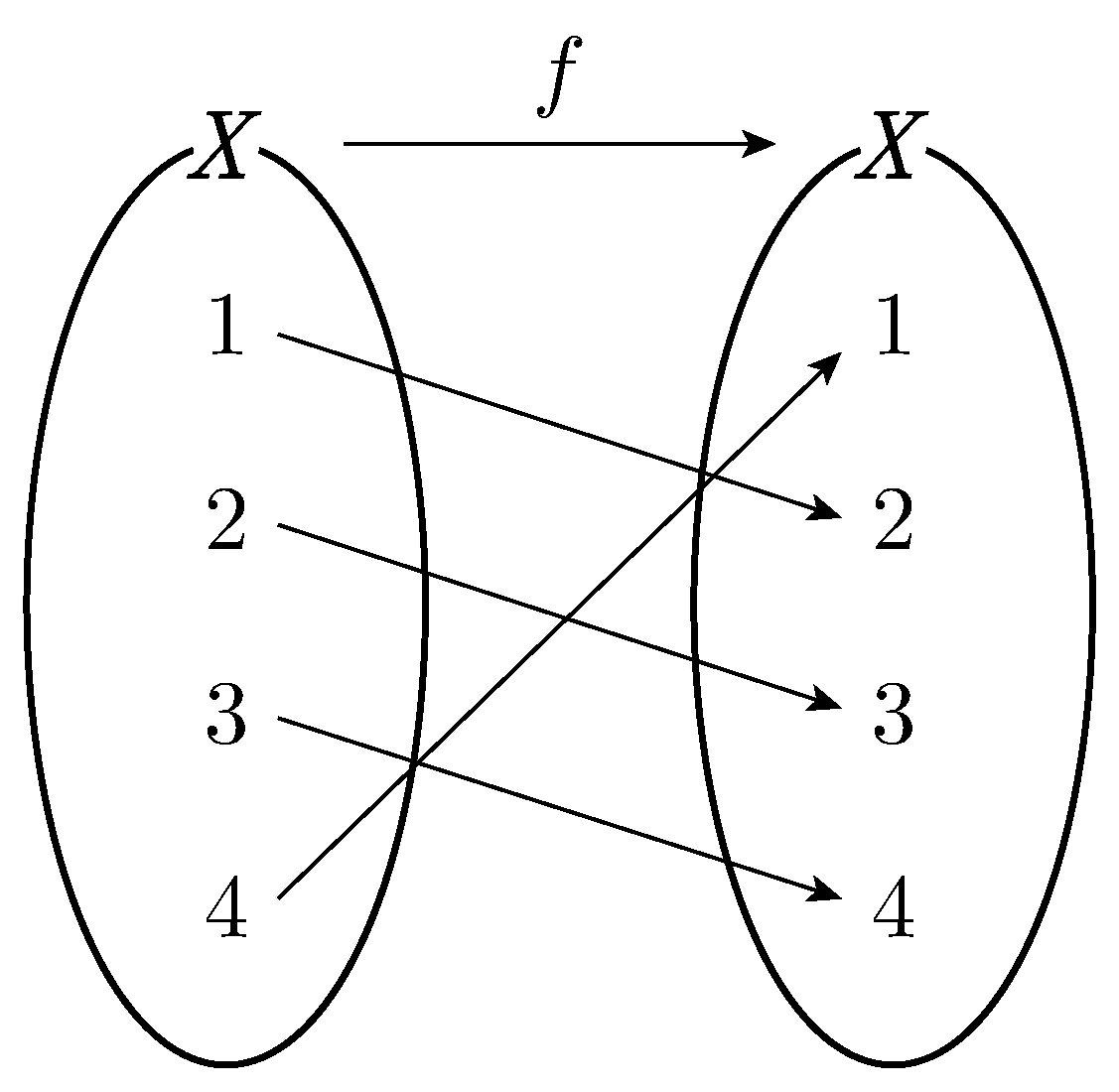
Figure below depicts a function \(f: X \;\!\to\;\!X\).
What is the value of \(f(4) + (f \circ f)(2)\)? [3 points]
  1. \(3\)
  2. \(4\)
  3. \(5\)
  4. \(6\)
  5. \(7\)

Mathematics (Type Na)

Let \(\{a_n\}\) be an arithmetic progression with an initial term of \(4\) such that
\(a_{10} - a_7 = 6\).
What is the value of \(a_4\)? [3 points]
  1. \(10\)
  2. \(11\)
  3. \(12\)
  4. \(13\)
  5. \(14\)
In the expansion of the polynomial \((1+x)^7\),
what is the coefficient of \(x^4\)? [3 points]
  1. \(42\)
  2. \(35\)
  3. \(28\)
  4. \(21\)
  5. \(14\)
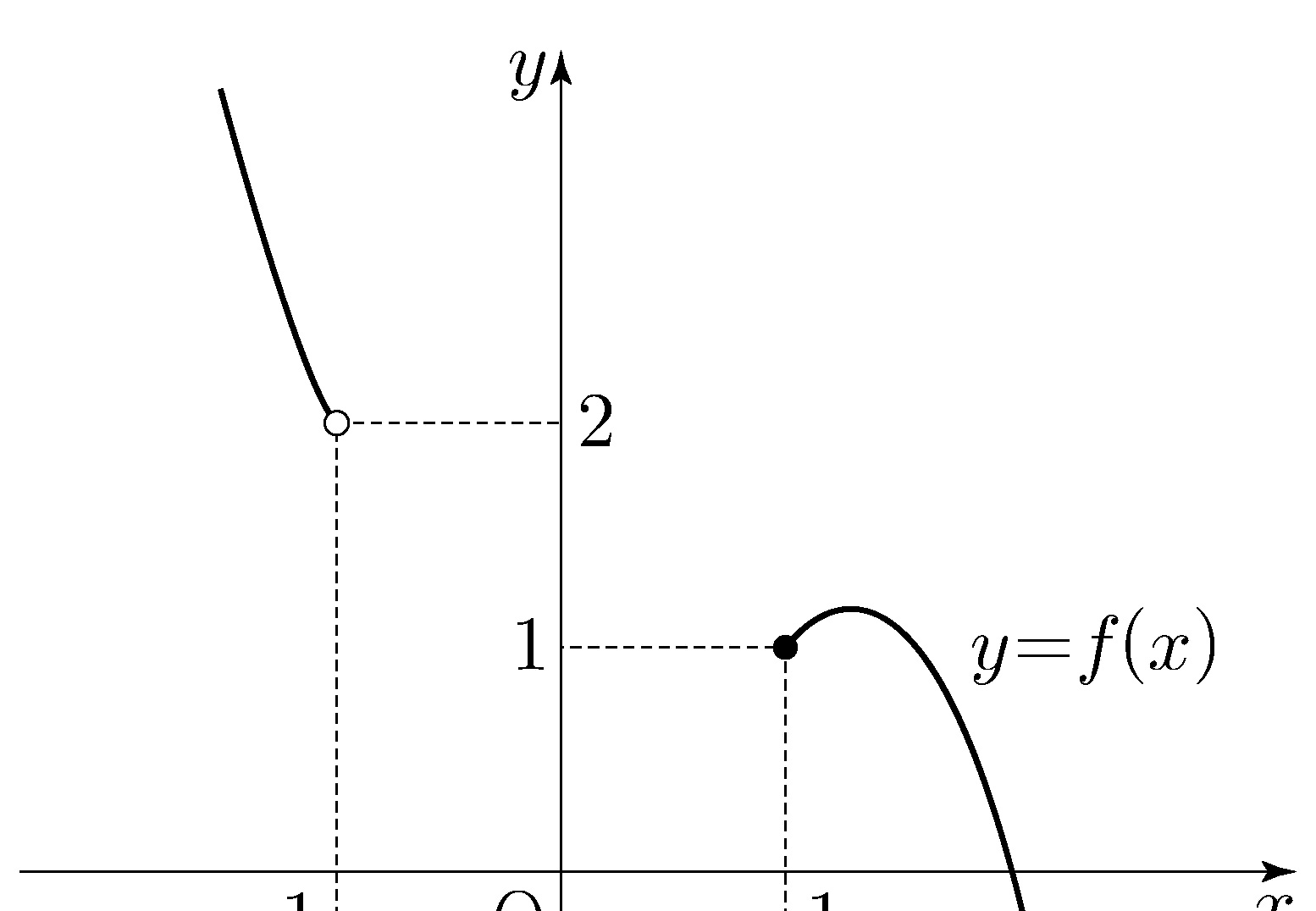
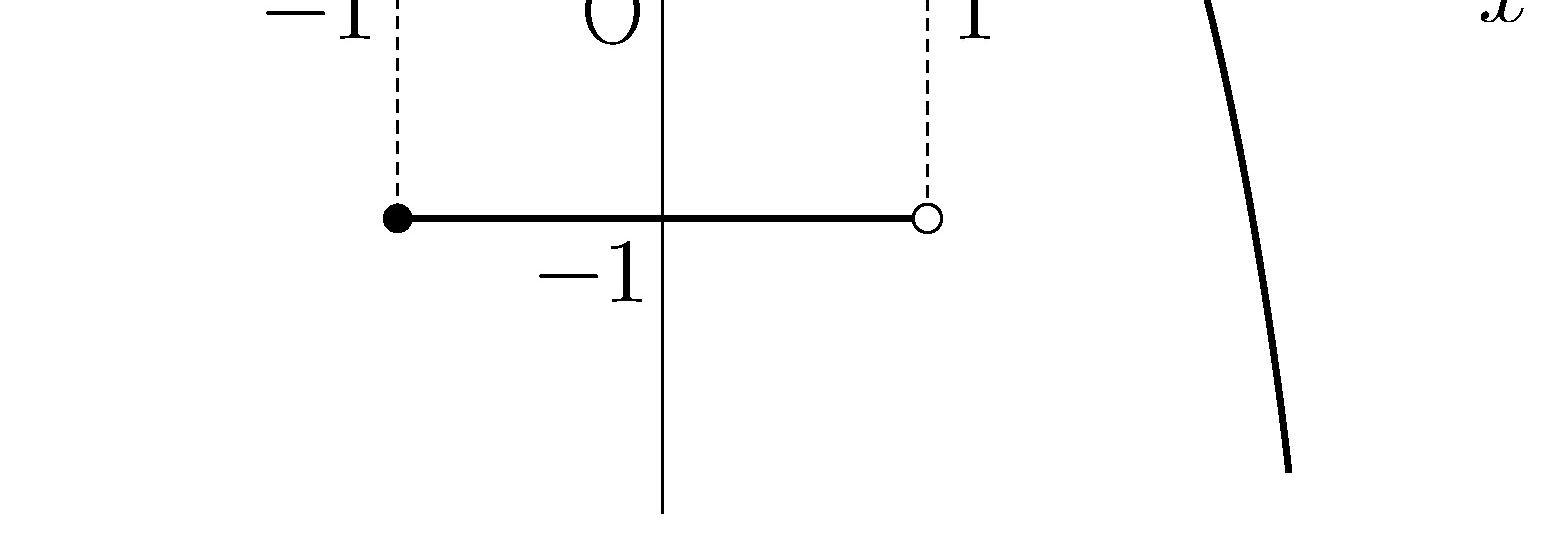
Figure below is the graph of a function \(y=f(x)\).
What is the value of \(\displaystyle\lim_{x\;\!\to\;\!-1-} \!\! f(x) - \lim_{x\;\!\to\;\!1+} \! f(x)\)? [3 points]
  1. \(-2\)
  2. \(-1\)
  3. \(0\)
  4. \(1\)
  5. \(2\)

Mathematics (Type Na)

Let \(A\) and \(B\) be events such that \(A\) and \(B\,^C\) are mutually exclusive, and
\(\mathrm{P}(A) = \dfrac{1}{3}\, \) and \(\, \mathrm{P}(A^C \cap B) = \dfrac{1}{6}\).
What is the value of \(\mathrm{P}(B)\)?
(※ \(A^C\) is the complement of \(A\).) [3 points]
  1. \(\dfrac{5}{12}\)
  2. \(\dfrac{1}{2}\)
  3. \(\dfrac{7}{12}\)
  4. \(\dfrac{2}{3}\)
  5. \(\dfrac{3}{4}\)
The function \(f(x) = x^3 - 3x + a\) has a local maximum value of \(7\). What is the value of \(a\)? [3 points]
  1. \(1\)
  2. \(2\)
  3. \(3\)
  4. \(4\)
  5. \(5\)
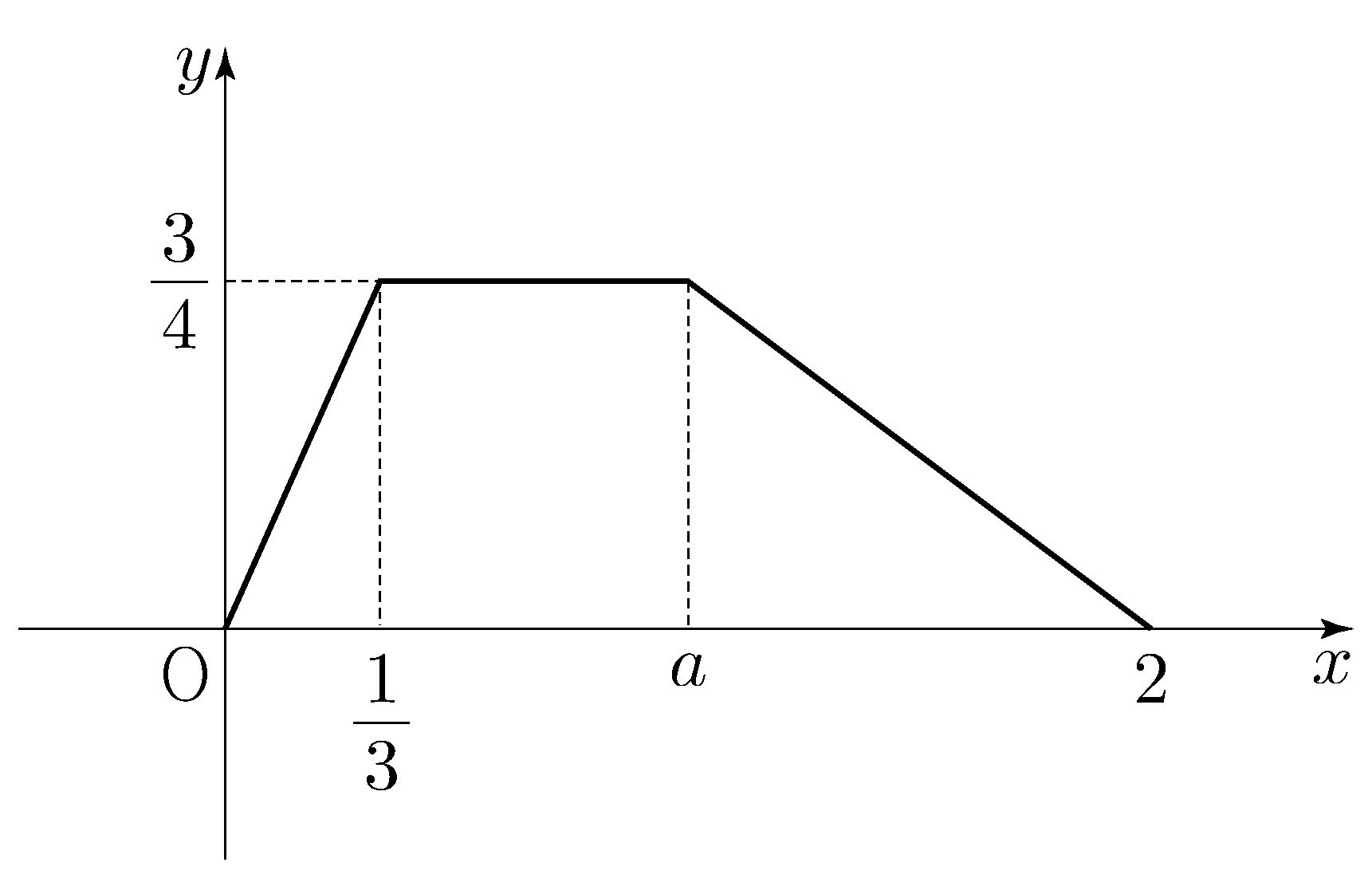
An absolutely continuous random variable \(X\)
takes the value of \(0 \leq X \leq 2 \). If the graph of the probability density function of \(X\) is as the figure below, what is the value of \(\mathrm{P} \!\left(\!\dfrac{1}{3} \leq X \leq a \!\right)\)?
(※ \(a\) is a constant.) [3 points]
  1. \(\dfrac{11}{16}\)
  2. \(\dfrac{5}{8}\)
  3. \(\dfrac{9}{16}\)
  4. \(\dfrac{1}{2}\)
  5. \(\dfrac{7}{16}\)

Mathematics (Type Na)

Consider the following conditions on a real number \(x\).
\(p : x^2 - 4x + 3 > 0\),
\(q : x \leq a\)
What is the minimum value of the real number \(a\) for which \(\neg p\) is sufficient for \(q\)? [3 points]
  1. \(5\)
  2. \(4\)
  3. \(3\)
  4. \(2\)
  5. \(1\)
The weight of watermelons harvested in some town follows a normal distribution with a mean of
\(m\)kg and a standard deviation of \(1.4\)kg. Suppose 49 watermelons harvested in this town were randomly sampled. Using the sample mean, the \(95\%\) confidence interval for \(m\), the mean weight of watermelons harvested in this town, was computed to be \(a \leq m \leq 7.992\). What is the value of \(a\)?
(※ For a random variable \(Z\) that follows the standard normal distribution, suppose \(\mathrm{P}(|Z| \leq 1.96) = 0.95\).) [3 points]
  1. \(7.198\)
  2. \(7.208\)
  3. \(7.218\)
  4. \(7.228\)
  5. \(7.238\)

Mathematics (Type Na)

Consider a sequence \(\{a_n\}\) where \(a_1 = 2\), and the following is true for all positive integers \(n\).
\( a_{n+1} = \begin{cases} \dfrac{a_n}{2-3a_n} &\; (\text{if } n \text{ is odd})\\ \\ 1+a_n &\; (\text{if } n \text{ is even}) \end{cases} \)
What is the value of \(\displaystyle\sum_{n = 1}^{40} a_n\)? [3 points]
  1. \(30\)
  2. \(35\)
  3. \(40\)
  4. \(45\)
  5. \(50\)
A polynomial function \(f(x)\) satisfies
\(\displaystyle\int_1^x \! \left\{\!\dfrac{d}{dt} f(t)\!\right\}dt = x^3 + ax^2 - 2\)
for all real numbers \(x\). What is the value of \(f'(a)\)?
(※ \(a\) is a constant.) [4 points]
  1. \(1\)
  2. \(2\)
  3. \(3\)
  4. \(4\)
  5. \(5\)

Mathematics (Type Na)

Among integers \(n \geq 2\), what is the sum of all values of \(n\) for which \(5\log_n 2\) is a positive integer? [4 points]
  1. \(34\)
  2. \(38\)
  3. \(42\)
  4. \(46\)
  5. \(50\)
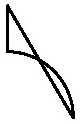
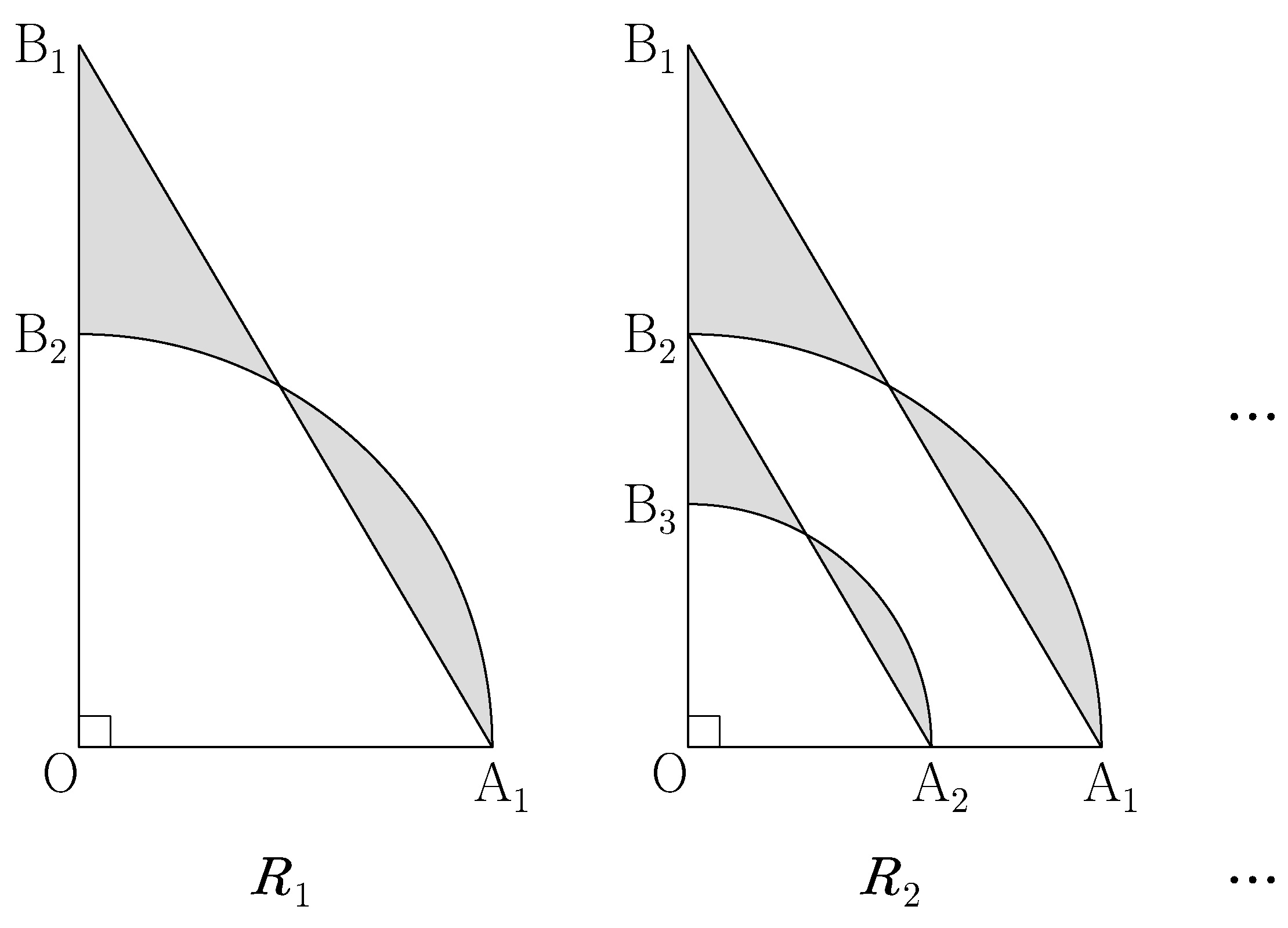
As the figure shows, a right triangle \(\mathrm{OA_1B_1}\) satisfies \(\overline{\mathrm{OA_1}} = 4\) and \(\overline{\mathrm{OB_1}} = 4\sqrt3\). Let \(\mathrm{B_2}\) be the point where the line segment \(\mathrm{OB_1}\) meets a circle with center \(\mathrm{O}\) and radius \(\overline{\mathrm{OA_1}}\). Obtain figure \(R_1\) by coloring the shape inside the triangle \(\mathrm{OA_1B_1}\) and the sector \(\mathrm{OA_1B_2}\) except the overlapping parts. Starting from figure \(R_1\), let \(\mathrm{A_2}\) be the point where the line \(\mathrm{OA_1}\) meets a line passing through point \(\mathrm{B_2}\) parallel to line \(\mathrm{A_1B_1}\). Let \(\mathrm{B_3}\) be the point where the line segment \(\mathrm{OB_2}\) meets a circle with center \(\mathrm{O}\) and radius \(\overline{\mathrm{OA_2}}\). Obtain figure \(R_2\) by coloring the shape inside the triangle \(\mathrm{OA_2B_2}\) and the sector \(\mathrm{OA_2B_3}\) except the overlapping parts. Continue this process, and let \(S_n\) be the area of the colored region in \(R_n\), the \(n\)th obtained figure.
What is the value of \(\displaystyle\lim_{n\;\!\to\;\!\infty} S_n\)? [4 points]
  1. \(\dfrac{3}{2}\pi\)
  2. \(\dfrac{5}{3}\pi\)
  3. \(\dfrac{11}{6}\pi\)
  4. \(2\pi\)
  5. \(\dfrac{13}{6}\pi\)

Mathematics (Type Na)

A strictly increasing function \(f(x)\), continuous on the set of all real numbers, satisfies the following.
  1. \(f(x) = f(x-3) + 4\) for all real numbers \(x\).
  2. \(\displaystyle\int_0^6 f(x)dx = 0\)
What is the area of the region enclosed by the graph of the function \(y=f(x)\), the \(x\)-axis, and the two lines \(x=6\) and \(x=9\)? [4 points]
  1. \(9\)
  2. \(12\)
  3. \(15\)
  4. \(18\)
  5. \(21\)
Suppose point \(\mathrm{A}\) is on the origin of an \(xy\)-plane. Let us perform the following trial using a coin.
Toss the coin once.
If it lands on heads, move point \(\mathrm{A}\) by \(1\) towards
the positive direction of the \(x\)-axis.
If it lands on tails, move point \(\mathrm{A}\) by \(1\) towards
the positive direction of the \(y\)-axis.
Let us repeat the trial above, and stop when the
\(x\)-coordinate or the \(y\)-coordinate of point \(\mathrm{A}\) becomes \(3\) for the first time. Given that the \(y\)-coordinate of point \(\mathrm{A}\) became \(3\) first, what is the probability that the \(x\)-coordinate of point \(\mathrm{A}\) is equal to \(1\)? [4 points]
  1. \(\dfrac{1}{4}\)
  2. \(\dfrac{5}{16}\)
  3. \(\dfrac{3}{8}\)
  4. \(\dfrac{7}{16}\)
  5. \(\dfrac{1}{2}\)

Mathematics (Type Na)

Consider the set \(X = \{1,2,3,4,5,6\}\) and a function \(f: X \;\!\to\;\!X\). The following passage computes the number of functions \(f\) for which the image of the composite function \(f \circ f\) has \(5\) elements.
Let \(A\) and \(B\) be the image of \(f\) and \(f \circ f\) respectively.
If \(n(A) = 6\), then \(f\) is bijective and \(f \circ f\) is also bijective, so \(n(B) = 6\).
If \(n(A) \leq 4\) then \(n(B) \leq 4\) since \(B \subseteq A\).
Therefore it should be that \(n(A) = 5\) and \(B = A\).
  1. There are \(\fbox{\(\;(\alpha)\;\)}\) ways to select a subset \(A\) of \(X\) where \(n(A) = 5\).
  2. For the set \(A\) selected in (i), let \(k\) be the element of \(X\) that is not in \(A\). Since \(n(A) = 5\), there are \(\fbox{\(\;(\beta)\;\)}\) ways to select \(f(k)\) from \(A\).
  3. For \(A=\{a_1,a_2,a_3,a_4,a_5\}\) selected in (i) and \(f(k)\) selected in (ii),
    since \(f(k) \in A\) and \(A = B\), it should be that \(A=\{f(a_1),f(a_2),f(a_3),f(a_4),f(a_5)\}\).
    The number of cases where this holds is equal to the number of bijections from \(A\) to \(A\), which is \(\fbox{\(\;(\gamma)\;\)}\).
By (i), (ii) and (iii), the number of functions \(f\) to compute is \(\fbox{\(\;(\alpha)\;\)}\times\fbox{\(\;(\beta)\;\)}\times\fbox{\(\;(\gamma)\;\)}\).
Let \(p\), \(q\) and \(r\) be the correct numbers for \((\alpha)\), \((\beta)\) and \((\gamma)\) respectively. What is the value of \(p + q + r\)? [4 points]
  1. \(131\)
  2. \(136\)
  3. \(141\)
  4. \(146\)
  5. \(151\)
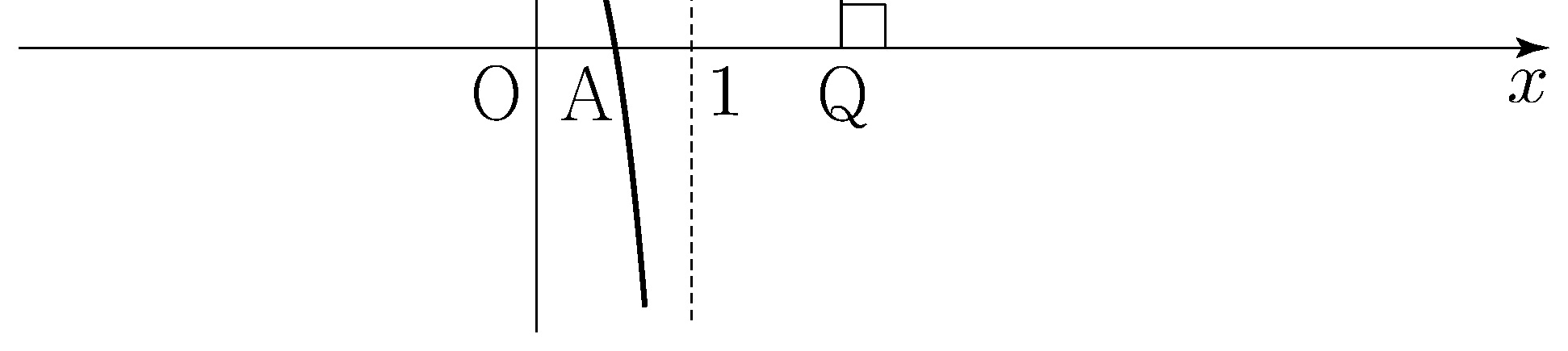
As the figure shows, \(\mathrm{A}\) and \(\mathrm{B}\) are the points where the graph \({y=\dfrac{k}{x-1}+3}\) meets the \(x\)-axis and the
\(y\)-axis, respectively.
Consider the line passing through point \(\mathrm{B}\) and the intersection of the two asymptotes of this graph. Let \(\mathrm{P}\) be the point where this line meets the graph again \((\mathrm{P} \ne \mathrm{B})\). Let \(\mathrm{Q}\) be the perpendicular foot from point \(\mathrm{P}\) to the \(x\)-axis. What is the list of correct statements in the <List>? [4 points]
  1. If \(k=1\), the coordinates of \(\mathrm{P}\) are \((2, 4)\).
  2. For \(0<k<3\), the slope of line \(\mathrm{AB}\) and the slope of line \(\mathrm{AP}\) add up to \(0\).
  3. If the area of the quadrilateral \(\mathrm{PBAQ}\) is an integer, the slope of line \(\mathrm{BP}\) is between \(0\) and \(1\).
  1. a
  2. a, b
  3. a, c
  4. b, c
  5. a, b, c

Mathematics (Type Na)

A cubic function \(f(x)\) with a leading coefficient of \(1\), and a function \(g(x)\) which is continuous on the set of all real numbers, satisfies the following.
  1. \(f(x)g(x) = x(x+3)\) for all real numbers \(x\).
  2. \(g(0) = 1\)
Given that \(f(1)\) is a positive integer, what is the minimum value of \(g(2)\)? [4 points]
  1. \(\dfrac{5}{13}\)
  2. \(\dfrac{5}{14}\)
  3. \(\dfrac{1}{3}\)
  4. \(\dfrac{5}{16}\)
  5. \(\dfrac{5}{17}\)
Short Answer Questions
Compute \(_6\mathrm{P}_2 - \,_6\mathrm{C}_2\). [3 points]
Let \(f(x) = x^4 - 3x^2 + 8\). Compute \(f'(2)\). [3 points]

Mathematics (Type Na)

Consider a geometric progression \(\{a_n\}\) with \(7\) as the initial term. Let \(S_n\) be the sum of the first \(n\) terms of \(\{a_n\}\). Given that
\(\dfrac{S_9 - S_5}{S_6 - S_2} = 3\),
compute \(a_7\). [3 points]
Compute \(\displaystyle\int_1^4 \! \left(x + |x-3|\right)dx\). [3 points]
Compute the maximum value of \(k\) for which the graph of the function \(y=\sqrt{x+3}\) meets the graph of the function \(y=\sqrt{1-x}+k\). [4 points]

Mathematics (Type Na)

Suppose a point \(\mathrm{P}\) is moving on the number line, and its position \(x\) at time \(t\) \((t \geq 0)\) is equal to
\(x = -\dfrac{1}{3}t^3 + 3t^2 + k\).  (\(k\) is a constant)
It is given that when the acceleration of point \(\mathrm{P}\) is equal to \(0\), its position is equal to \(40\). Compute \(k\). [4 points]
There are \(4\) white balls marked with numbers \(1,2,3\) and \(4\) respectively, and \(3\) black balls marked with numbers \(4,5\) and \(6\) respectively.
If we randomly arrange all the balls in a line, the probability that no two balls marked with the same number are adjacent, is equal to \(\dfrac{q}{p}\). Compute \(p+q\). (※ \(p\) and \(q\) are positive integers that are coprime.) [4 points]

Mathematics (Type Na)

Let \(\{a_n\}\) be an arithmetic progression whose initial term is a positive integer and whose common difference is a negative integer. Let \(\{b_n\}\) be a geometric progression whose initial term is a positive integer and whose common ratio is a negative integer. Given that the following conditions are satisfied, compute \(a_7 + b_7\). [4 points]
  1. \(\displaystyle{\sum_{n\;\!=\;\!1}^5 \left(a_n + b_n \right) = 27}\)
  2. \(\displaystyle{\sum_{n\;\!=\;\!1}^5 \left(a_n + |b_n| \right) = 67}\)
  3. \(\displaystyle{\sum_{n\;\!=\;\!1}^5 \left(|a_n| + |b_n| \right) = 81}\)
A cubic function \(f(x)\) with a leading coefficient of \(1\), and a quadratic function \(g(x)\) with a leading coefficient of \(-1\), satisfy the following.
  1. The tangent line to the curve \(y=f(x)\)
    at point \((0,0)\) on the curve,
    and the tangent line to the curve \(y=g(x)\)
    at point \((2,0)\) on the curve,
    are both the \(x\)-axis.
  2. Exactly \(2\) tangent lines to the curve \(y=f(x)\) pass through the point \((2,0)\).
  3. The equation \(f(x)=g(x)\) only has \(1\) real solution.
Consider a real number \(k\) that satisfies
\(g(x) \leq kx-2 \leq f(x)\)
for all real numbers \(x > 0\). Let \(\alpha\) and \(\beta\) be the maximum and minimum value of \(k\), respectively. Given that \(\alpha - \beta = a + b\sqrt{2}\), compute \(a^2 + b^2\).
(※ \(a\) and \(b\) are rational numbers.) [4 points]