2020 College Scholastic Ability Test

Mathematics (Type Ga)

Multiple Choice Questions
For vectors \(\vec{a}=(3,1)\) and \(\vec{b}=(-2,4)\), what is the sum of all components of the vector \(\vec{a}+\dfrac{1}{2}\vec{b}\)? [2 points]
  1. \(1\)
  2. \(2\)
  3. \(3\)
  4. \(4\)
  5. \(5\)
What is the value of \(\displaystyle\lim_{x\;\!\to\;\!0} \dfrac{6x}{e^{4x}-e^{2x}}\)? [2 points]
  1. \(1\)
  2. \(2\)
  3. \(3\)
  4. \(4\)
  5. \(5\)
Consider a point on the \(y\)-axis whose distance to points \(\mathrm{A}(2,0,1)\) and \(\mathrm{B}(3,2,0)\) are equal. Given that this point has coordinates \((0,a,0)\), what is the value of \(a\)? [2 points]
  1. \(1\)
  2. \(2\)
  3. \(3\)
  4. \(4\)
  5. \(5\)
In the expansion of \(\left(\!2x+\dfrac{1}{x^2}\!\right)^{\!4}\), what is the coefficient of \(x\)? [3 points]
  1. \(16\)
  2. \(20\)
  3. \(24\)
  4. \(28\)
  5. \(32\)

Mathematics (Type Ga)

Consider the tangent line to the curve \(x^2-3xy+y^2=x\), at point \((1,0)\) on the curve. What is the slope of this tangent line? [3 points]
  1. \(\dfrac{1}{12}\)
  2. \(\dfrac{1}{6}\)
  3. \(\dfrac{1}{4}\)
  4. \(\dfrac{1}{3}\)
  5. \(\dfrac{5}{12}\)
There is a sack containing \(3\) white balls and \(4\) black balls. Suppose four balls are randomly taken out from this sack at the same time. What is the probability that \(2\) white balls and \(2\) black balls are taken out? [3 points]
  1. \(\dfrac{2}{5}\)
  2. \(\dfrac{16}{35}\)
  3. \(\dfrac{18}{35}\)
  4. \(\dfrac{4}{7}\)
  5. \(\dfrac{22}{35}\)
Given that \(0<x<2\pi\), what is the sum of all values of \(x\) that satisfy the equation \(4\cos^2 x-1=0\) and the inequality \(\sin x\cos x<0\) at the same time? [3 points]
  1. \(2\pi\)
  2. \(\dfrac{7}{3}\pi\)
  3. \(\dfrac{8}{3}\pi\)
  4. \(3\pi\)
  5. \(\dfrac{10}{3}\pi\)

Mathematics (Type Ga)

What is the value of \(\displaystyle\int_e^{e^2}\frac{\ln x-1}{x^2}dx\)? [3 points]
  1. \(\dfrac{e+2}{e^2}\)
  2. \(\dfrac{e+1}{e^2}\)
  3. \(\dfrac{1}{e}\)
  4. \(\dfrac{e-1}{e^2}\)
  5. \(\dfrac{e-2}{e^2}\)
Suppose a point \(\mathrm{P}\) is moving on the \(xy\)-plane and its position \((x,y)\) at time \(t\,\left(\!0< t<\dfrac{\pi}{2}\!\right)\) is
\(x=t+\sin t\cos t\:\) and \(\:y=\tan t\).
What is the minimum value of the speed of point \(\mathrm{P}\) between \(0< t<\dfrac{\pi}{2}\)? [3 points]
  1. \(1\)
  2. \(\sqrt{3}\)
  3. \(2\)
  4. \(2\sqrt{2}\)
  5. \(2\sqrt{3}\)
Consider an isosceles triangle \(\mathrm{ABC}\) where \(\overline{\mathrm{AB}}=\overline{\mathrm{AC}}\). Let \(\angle\mathrm{A}=\alpha\) and \(\angle\mathrm{B}=\beta\). If \(\tan(\alpha+\beta)=-\dfrac{3}{2}\), what is the value of \(\tan\alpha\)? [3 points]
  1. \(\dfrac{21}{10}\)
  2. \(\dfrac{11}{5}\)
  3. \(\dfrac{23}{10}\)
  4. \(\dfrac{12}{5}\)
  5. \(\dfrac{5}{2}\)

Mathematics (Type Ga)

What is the number of integers \(a\) for which the curve \(y=ax^2-2\sin2x\) has an inflection point? [3 points]
  1. \(4\)
  2. \(5\)
  3. \(6\)
  4. \(7\)
  5. \(8\)
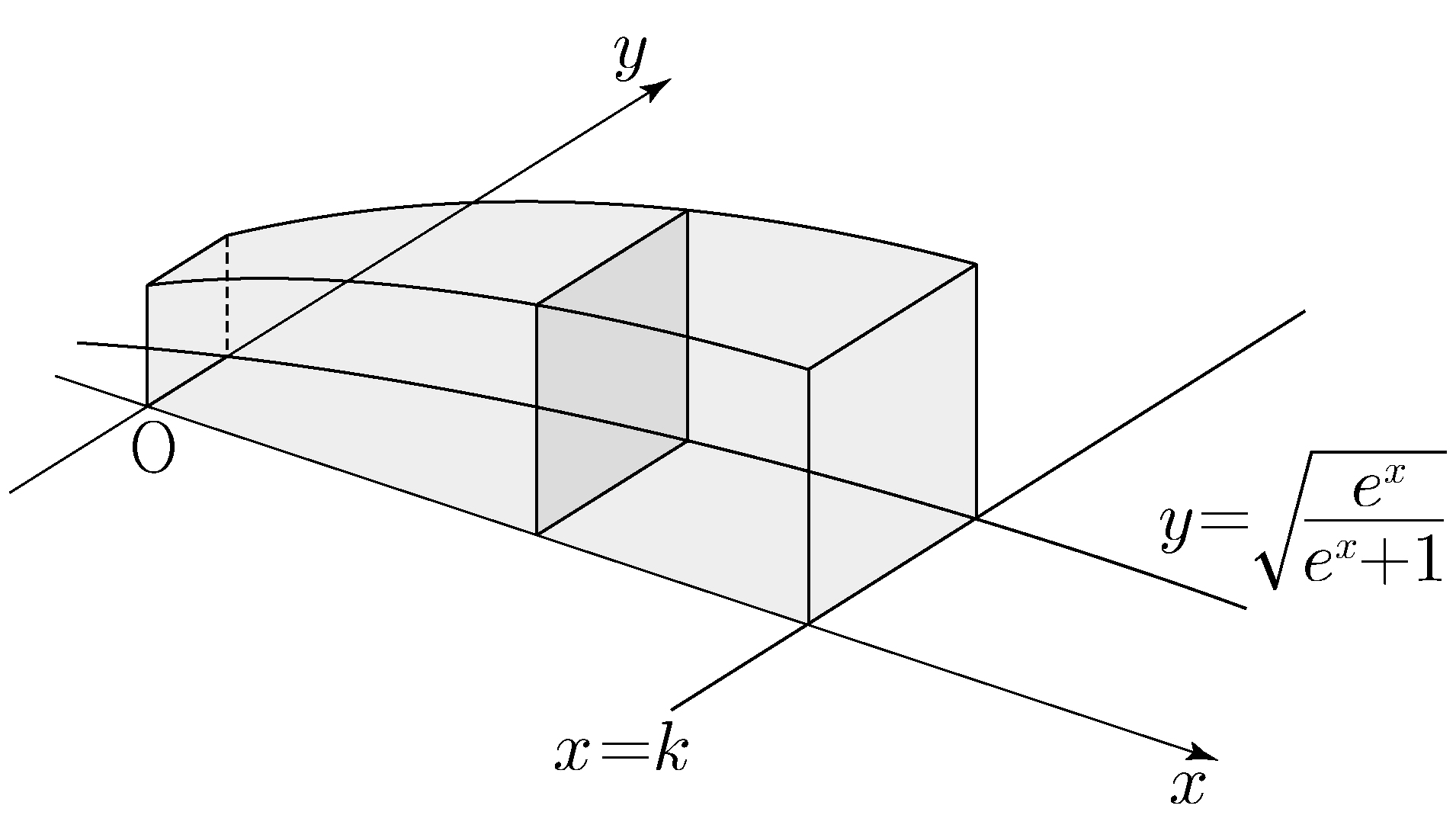
As the figure shows, for a positive number \(k\), there is a \(3\)-dimensional solid where one of its faces is the region enclosed by the curve \(y=\sqrt{\dfrac{e^x}{e^x+1}}\), the
\(x\)-axis, the \(y\)-axis, and the line \(x=k\). Suppose a cross section of this solid and any plane perpendicular to the \(x\)-axis is always a square. If the volume of this solid is \(\ln 7\), what is the value of \(k\)? [3 points]
  1. \(\ln11\)
  2. \(\ln13\)
  3. \(\ln15\)
  4. \(\ln17\)
  5. \(\ln19\)

Mathematics (Type Ga)

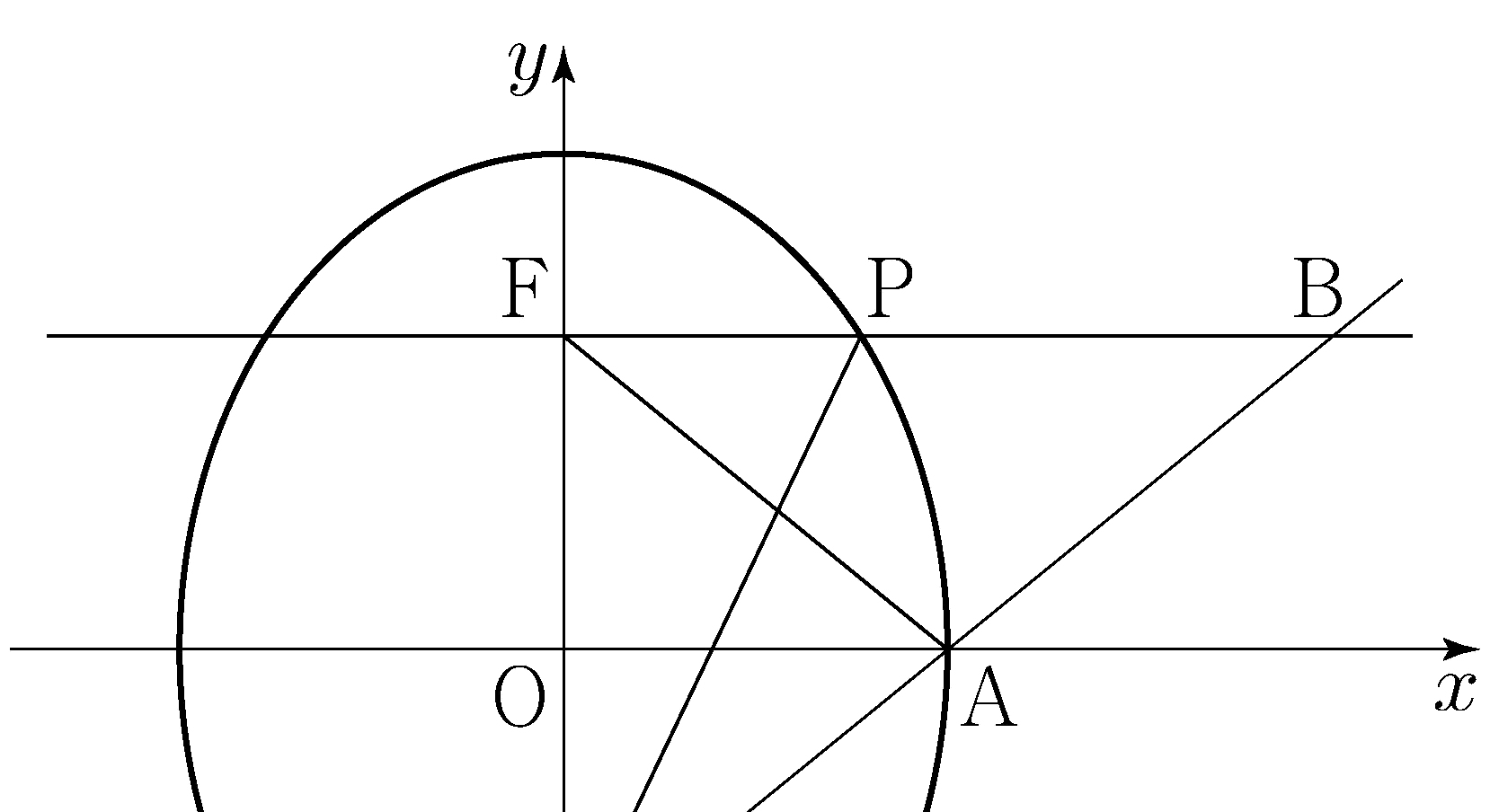
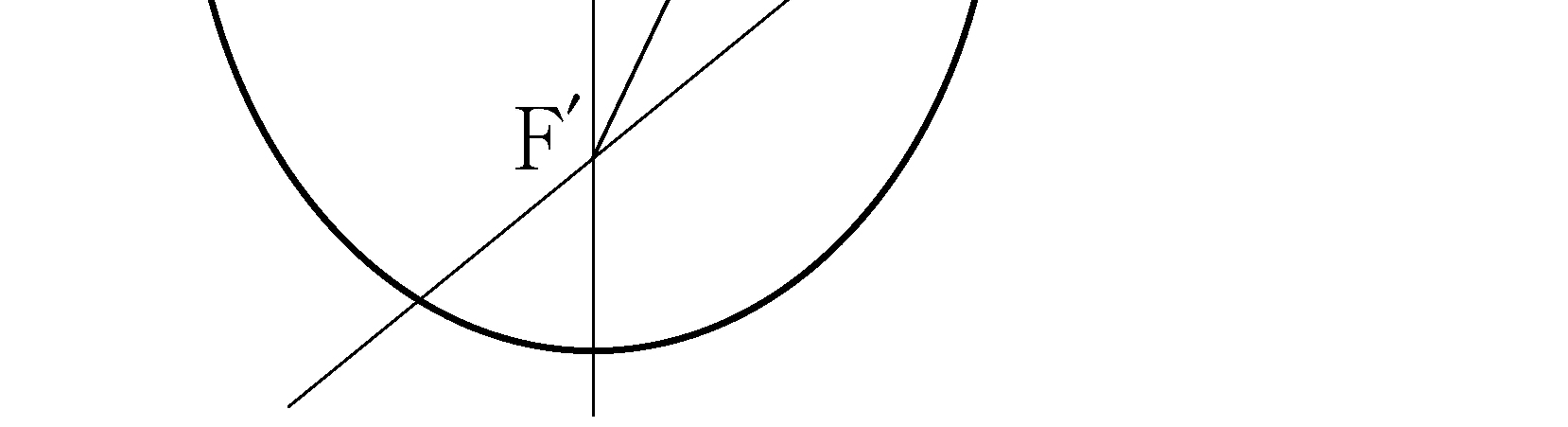
As the figure shows, consider the ellipse \(\dfrac{x^2}{a^2}+\dfrac{y^2}{25}=1\) with two foci \(\mathrm{F}(0,c)\) and \(\mathrm{F'}(0,-c)\).
Let \(\mathrm{A}\) be the point with a positive \(x\)-coordinate where this ellipse meets the \(x\)-axis. Let \(\mathrm{B}\) be the intersection between line \(y=c\) and line \(\mathrm{AF'}\). Let \(\mathrm{P}\) be the point with a positive \(x\)-coordinate where the line \(y=c\) meets the ellipse. It is given that the difference between the perimeters of triangles \(\mathrm{BPF'}\) and \(\mathrm{BFA}\) is \(4\). What is the area of triangle \(\mathrm{AFF'}\)?
(※ \(0<a<5\) and \(c>0\).) [3 points]
  1. \(5\sqrt{6}\)
  2. \(\dfrac{9\sqrt{6}}{2}\)
  3. \(4\sqrt{6}\)
  4. \(\dfrac{7\sqrt{6}}{2}\)
  5. \(3\sqrt{6}\)
There is a sack containing \(10\) balls marked with the number \(1\), \(20\) balls marked with the number \(2\), and \(30\) balls marked with the number \(3\). Let us randomly take out a ball from this sack, check the number marked on it, and put it back in. Let the random variable \(Y\) be the sum of the \(10\) checked numbers after this trial is repeated \(10\) times. The process below computes the mean \(\mathrm{E}(Y)\) and variance \(\mathrm{V}(Y)\) of the random variable \(Y\).
Consider the \(60\) balls in the sack as the population. Let the random variable \(X\) be the number marked on a ball randomly taken out from this population. The distribution of \(X\), which is the distribution of the population, is as the table below.
\(X\) \(1\) \(2\) \(3\) Total
\(\mathrm{P}(X=x)\) \(\dfrac{1}{6}\) \(\dfrac{1}{3}\) \(\dfrac{1}{2}\) \(1\)
Therefore the mean \(m\) and variance \(\sigma^2\) of the population are
\(m=\mathrm{E}(X)=\dfrac{7}{3}\:\) and \(\:\sigma^2=\mathrm{V}(X)=\fbox{\(\;(\alpha)\;\)}\).
Let \(\overline{X}\) be the mean of a random sample of size \(10\) from this population. Then,
\(\mathrm{E}(\overline{X})=\dfrac{7}{3}\:\) and \(\:\mathrm{V}(\overline{X})=\fbox{\(\;(\beta)\;\)}\).
Let \(X_n\) be the number marked on the \(n\:\!\)th ball taken out from the sack. Then,
\(\displaystyle Y=\sum_{n\;\!=\;\!1}^{10}X_n=10\overline{X}\).
Therefore
\(\mathrm{E}(Y)=\dfrac{70}{3}\:\) and \(\:\mathrm{V}(Y)=\fbox{\(\;(\gamma)\;\)}\).
Let \(p\), \(q\) and \(r\) be the correct numbers for \((\alpha)\), \((\beta)\) and \((\gamma)\) respectively. What is the value of \(p+q+r\)? [4 points]
  1. \(\dfrac{31}{6}\)
  2. \(\dfrac{11}{2}\)
  3. \(\dfrac{35}{6}\)
  4. \(\dfrac{37}{6}\)
  5. \(\dfrac{13}{2}\)

Mathematics (Type Ga)

Let \(\mathrm{A}\) be the point where the graph of the exponential function \(y=a^x\,(a>1)\) meets the line \(y=\sqrt{3}\). For the point \(\mathrm{B}(4,0)\), what is the product of all values of \(a\) for which the lines \(\mathrm{OA}\) and \(\mathrm{AB}\) are perpendicular? (※ \(\mathrm{O}\) is the origin.) [4 points]
  1. \(3^{\,\begin{array}{c}1 \\\hline 3\end{array}}\)
  2. \(3^{\,\begin{array}{c}2 \\\hline 3\end{array}}\)
  3. \(3\)
  4. \(3^{\,\begin{array}{c}4 \\\hline 3\end{array}}\)
  5. \(3^{\,\begin{array}{c}5 \\\hline 3\end{array}}\)
What is the number of \(4\)-tuples \((a,b,c,d)\) where \(a,b,c\) and \(d\) are nonnegative integers that satisfy the following? [4 points]
  1. \(a+b+c-d=9\)
  2. \(d\leq4\) and \(c\geq d\).
  1. \(265\)
  2. \(270\)
  3. \(275\)
  4. \(280\)
  5. \(285\)

Mathematics (Type Ga)

Consider an equilateral triangle \(\mathrm{ABC}\) with side lengths of \(10\) on a plane. Let \(\mathrm{P}\) be a point satisfying \(\overline{\mathrm{PB}}-\overline{\mathrm{PC}}=2\), with the shortest possible length of the line segment \(\mathrm{PA}\). What is the area of the triangle \(\mathrm{PBC}\)? [4 points]
  1. \(20\sqrt{3}\)
  2. \(21\sqrt{3}\)
  3. \(22\sqrt{3}\)
  4. \(23\sqrt{3}\)
  5. \(24\sqrt{3}\)
A random variable \(X\) follows the normal distribution \(\mathrm{N}(10,2^2)\), and a random variable \(Y\) follows the normal distribution \(\mathrm{N}(m,2^2)\). The probability density functions of \(X\) and \(Y\) are \(f(x)\) and \(g(x)\) respectively.
For values of \(m\) that satisfy
\(f(12)\leq g(20)\),
what is the maximum value of \(\mathrm{P}(21\leq Y\leq 24)\) computed with the standard normal table to the right? [4 points]
\(z\) \(\mathrm{P}(0\!\leq\! Z \!\leq\!z)\)
\(0.5\) \(0.1915\)
\(1.0\) \(0.3413\)
\(1.5\) \(0.4332\)
\(2.0\) \(0.4772\)
  1. \(0.5328\)
  2. \(0.6247\)
  3. \(0.7745\)
  4. \(0.8185\)
  5. \(0.9104\)

Mathematics (Type Ga)

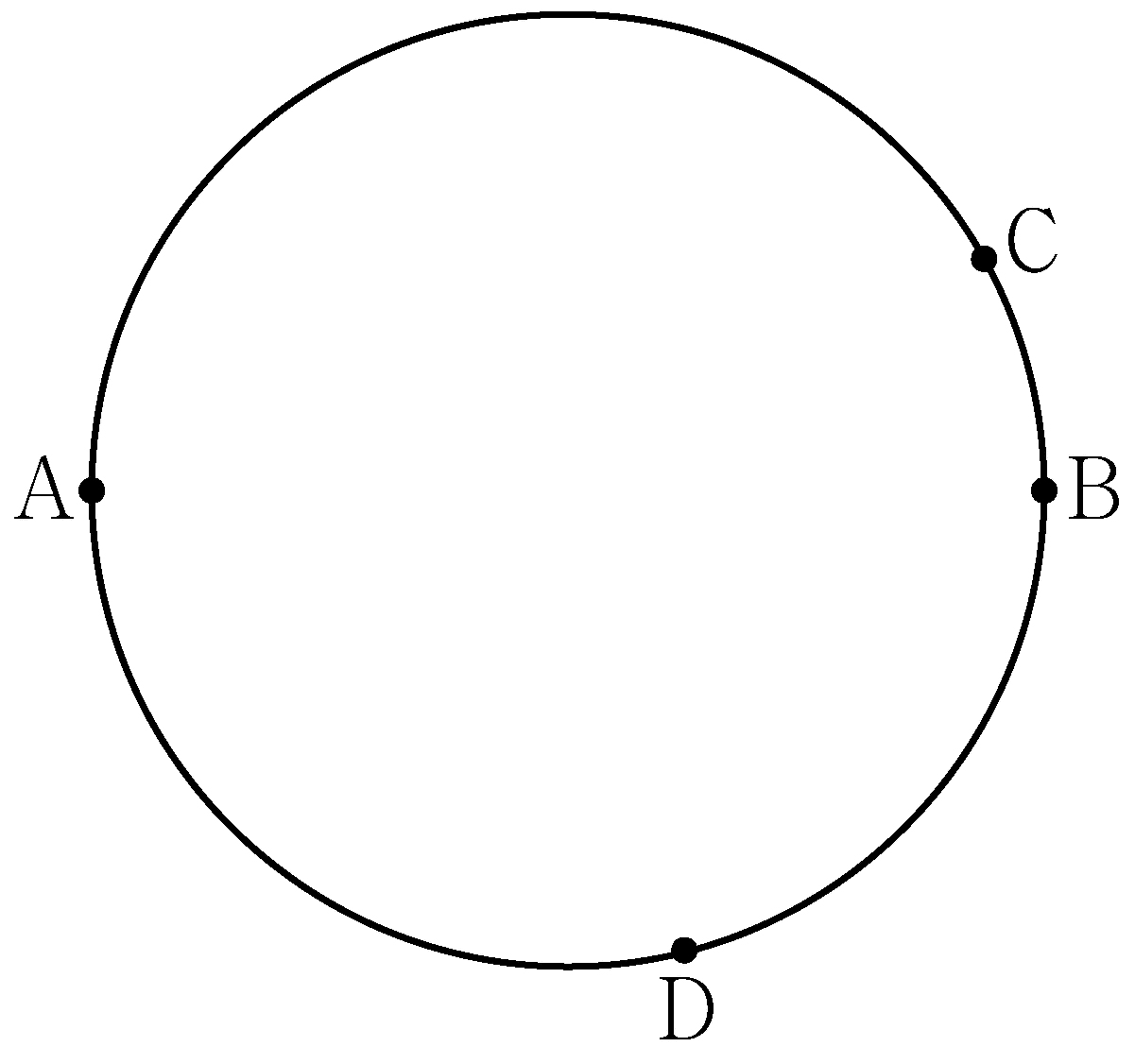
Let \(\mathrm{A,B,C}\) and \(\mathrm{D}\) be four distinct points on a circle that satisfy the following. What is the value of \(\big|\overrightarrow{\mathrm{AD}}\big|^2\)? [4 points]
  1. \(\big|\overrightarrow{\mathrm{AB}}\big|=8\:\) and \(\:\overrightarrow{\mathrm{AC}}\cdot\overrightarrow{\mathrm{BC}}=0\).
  2. \(\overrightarrow{\mathrm{AD}}= \dfrac{1}{2}\overrightarrow{\mathrm{AB}}-2\overrightarrow{\mathrm{BC}}\)
  1. \(32\)
  2. \(34\)
  3. \(36\)
  4. \(38\)
  5. \(40\)
Let us throw a coin \(7\) times. What is the probability that the following is satisfied? [4 points]
  1. The coin lands on heads at least \(3\) times.
  2. There exists an occasion where the coin consecutively lands on heads.
  1. \(\dfrac{11}{16}\)
  2. \(\dfrac{23}{32}\)
  3. \(\dfrac{3}{4}\)
  4. \(\dfrac{25}{32}\)
  5. \(\dfrac{13}{16}\)

Mathematics (Type Ga)

For real numbers \(t\), let \(y=f(x)\) be the equation of the tangent line to the curve \(y=e^x\) at point \(\big(t,e^t\big)\). Let \(g(t)\) be the minimum value of a real number \(k\) for which the function \(y=|f(x)+k-\ln x|\) is differentiable on the set of all positive numbers.
For real numbers \(a\) and \(b\,(a<b)\), let \(\displaystyle\int_a^b g(t)dt=m\). What is the list of correct statements in the <List>? [4 points]
  1. There exist numbers \(a\) and \(b\,(a<b)\) that satisfy \(m<0\).
  2. If \(g(c)=0\) for some real number \(c\), then \(g(-c)=0\).
  3. Suppose \(m\) is the smallest when \(a=\alpha\) and \(b=\beta\,(\alpha<\beta)\). Then \(\dfrac{1+g'(\beta)}{1+g'(\alpha)}<-e^2\).
  1. a
  2. b
  3. a, b
  4. a, c
  5. a, b, c
Short Answer Questions
Let \(f(x)=x^3\ln x\). Compute \(\dfrac{f'(e)}{e^2}\). [3 points]
Let \(X\) be a random variable following the binominal distribution \(\mathrm{B}(80,p)\) such that \(\mathrm{E}(X)=20\). Compute \(\mathrm{V}(X)\). [3 points]

Mathematics (Type Ga)

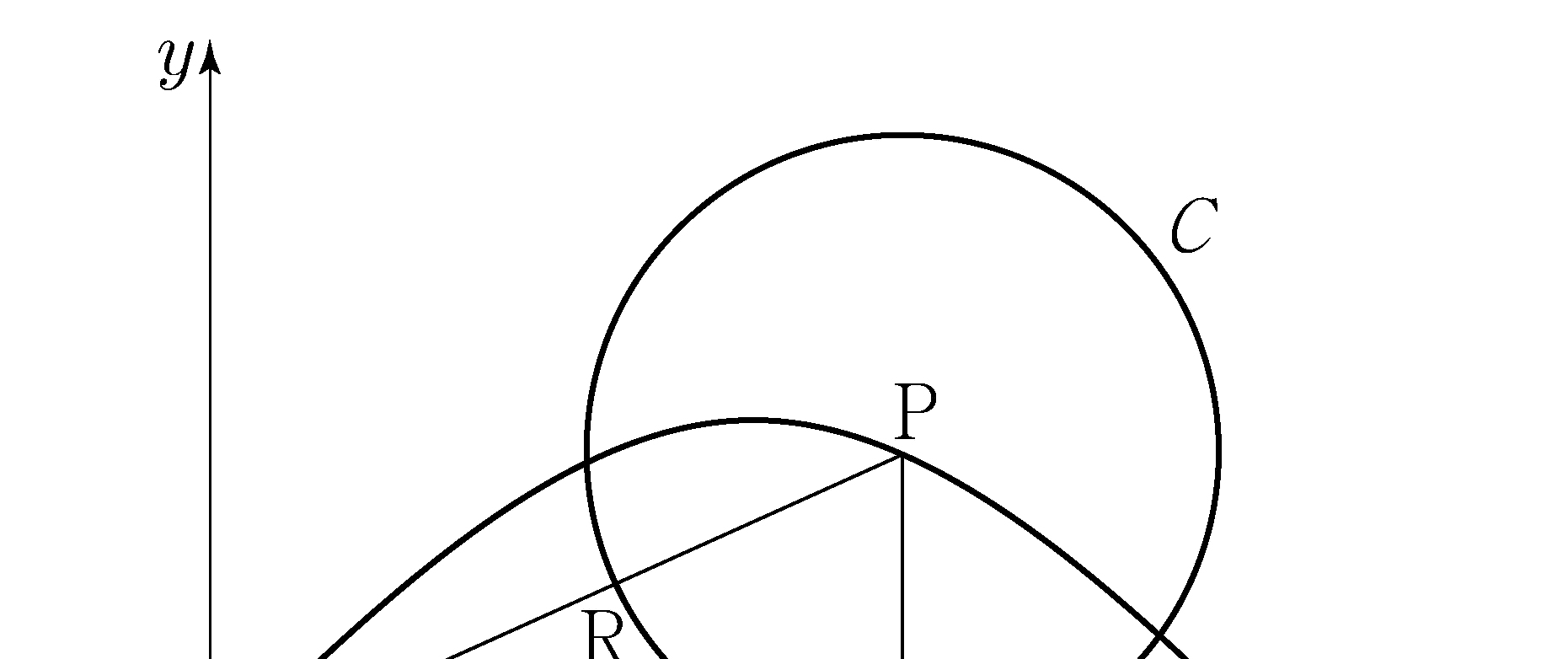
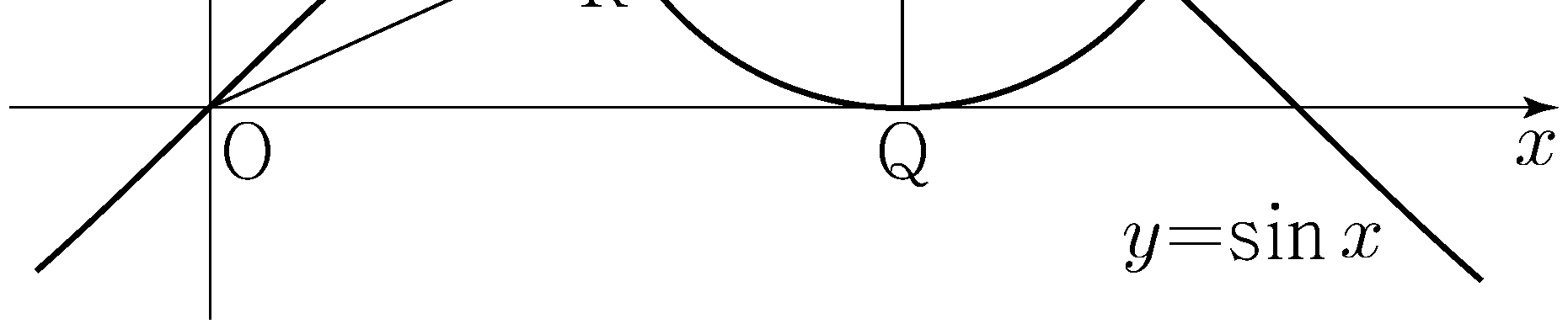
On the \(xy\)-plane, consider a point \(\mathrm{P}(t,\sin t)\) on the curve \(y=\sin x\,(0<t<\pi)\). Let \(C\) be a circle tangent to the \(x\)-axis with center \(\mathrm{P}\). Let \(\mathrm{Q}\) and \(\mathrm{R}\) be points where the circle \(C\) meets the \(x\)-axis and the line segment \(\mathrm{OP}\) respectively. Given that \(\displaystyle\lim_{t\;\!\to\;\!0+}\frac{\overline{\mathrm{OQ}}}{\overline{\mathrm{OR}}}=a+b\sqrt{2}\), compute \(a+b\).
(※ \(\mathrm{O}\) is the origin. \(a\) and \(b\) are integers.) [3 points]
Let us throw a die \(5\) times, and let \(a\) be the number of times it lands on an odd number. Let us throw a coin \(4\) times, and let \(b\) be the number of times it lands on heads. The probability that \(a-b\) equals \(3\) is \(\dfrac{q}{p}\). Compute \(p+q\). (※ \(p\) and \(q\) are positive integers that are coprime.) [3 points]
For the function \(f(x)=(x^2+2)e^{-x}\), let \(g(x)\) be a differentiable function such that
\(g\!\left(\!\dfrac{x+8}{10}\!\right)=f^{-1}(x)\:\) and \(\:g(1)=0\).
Compute \(\big|g'(1)\big|\). [4 points]

Mathematics (Type Ga)

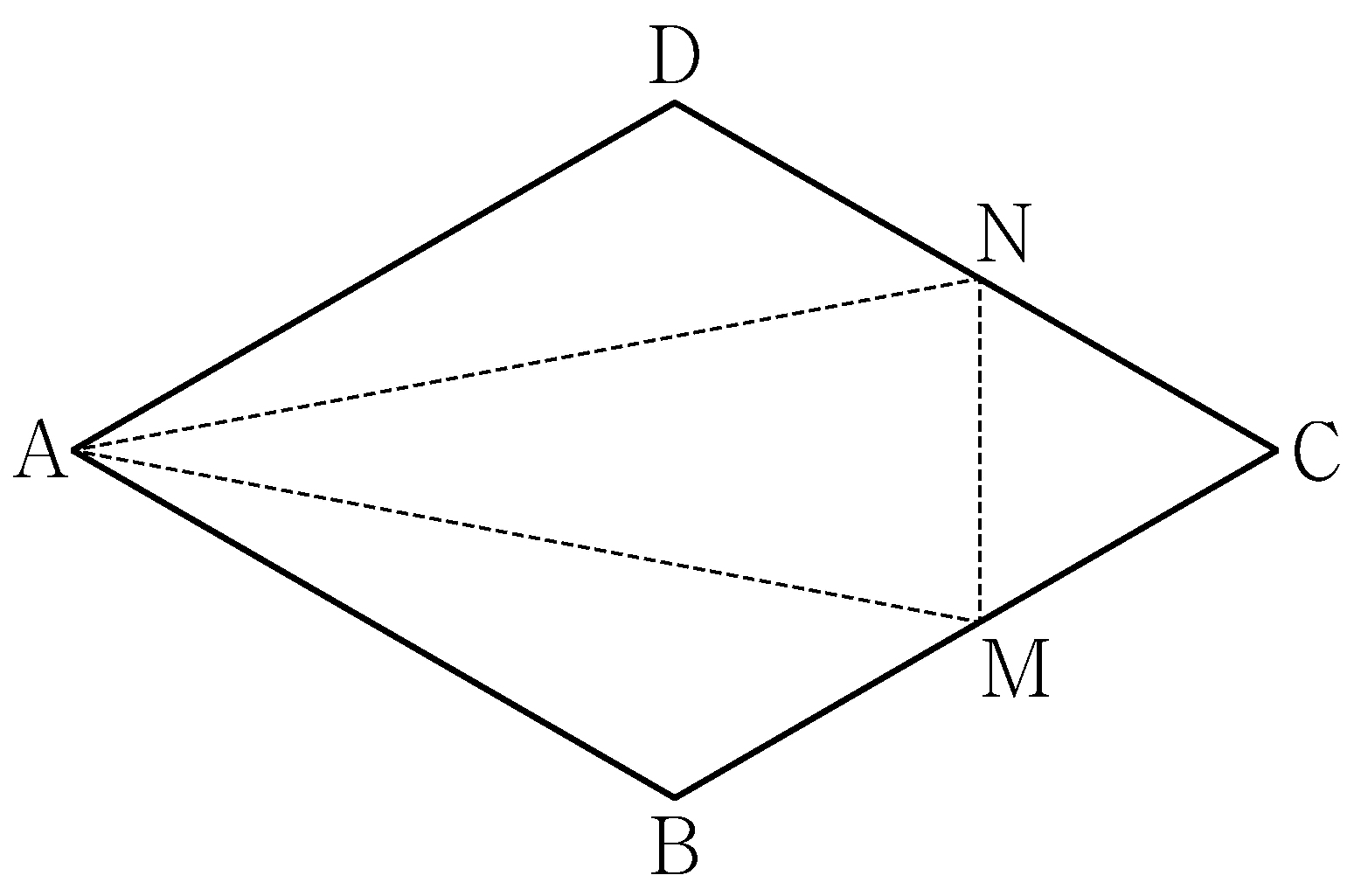
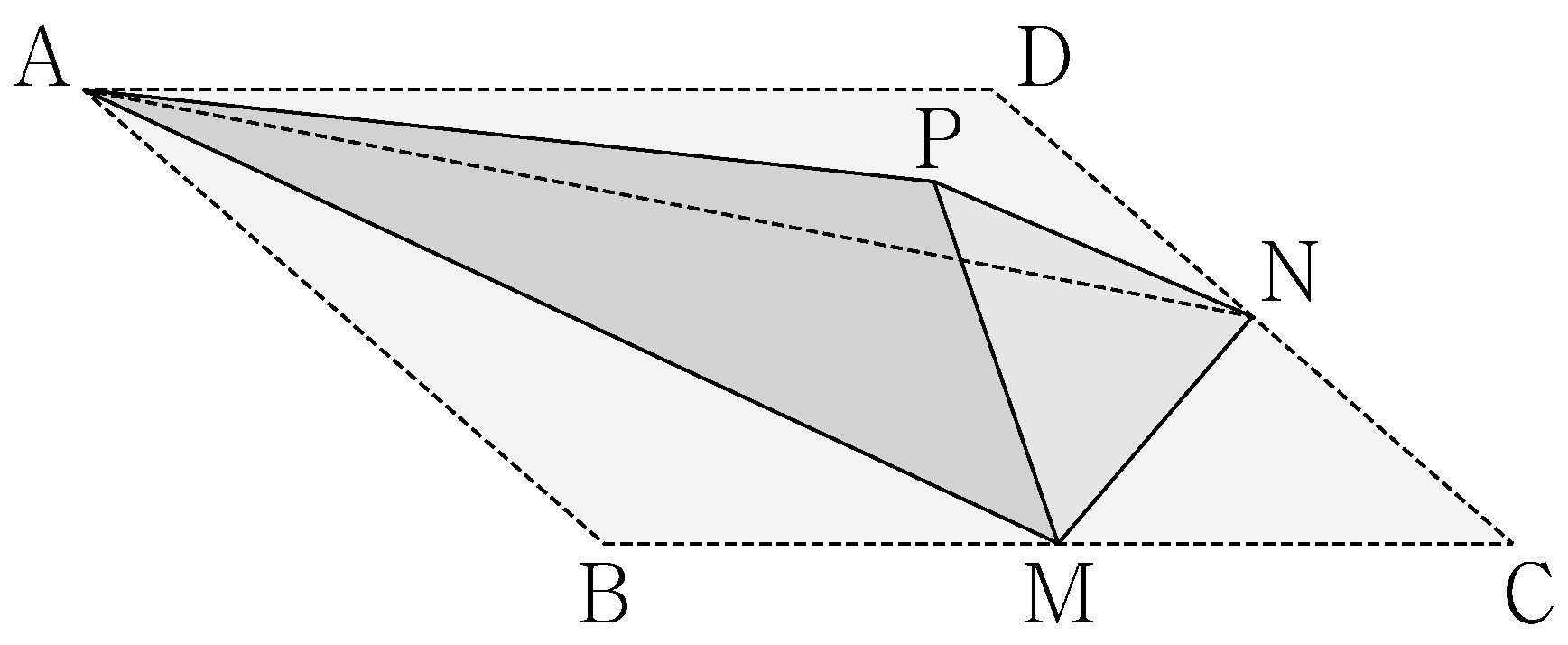
As the figure shows, there is a piece of paper in the shape of a rhombus \(\mathrm{ABCD}\) with side lengths of \(4\) where \(\angle\mathrm{BAD}=\dfrac{\pi}{3}\). Let \(\mathrm{M}\) and \(\mathrm{N}\) be the midpoints of edges \(\mathrm{BC}\) and \(\mathrm{CD}\) respectively. Suppose we fold the paper along the line segments \(\mathrm{AM}, \mathrm{AN}\) and \(\mathrm{MN}\) to create the tetrahedron \(\mathrm{PAMN}\). The projection of the triangle \(\mathrm{AMN}\) onto plane \(\mathrm{PAM}\) has an area of \(\dfrac{q}{p}\sqrt{3}\). Compute \(p+q\). (※ Ignore the thickness of the paper. Point \(\mathrm{P}\) is where the three points \(\mathrm{B, C}\) and \(\mathrm{D}\) meet when the paper is folded. \(p\) and \(q\) are positive integers that are coprime.) [4 points]

Let us select five numbers among numbers \(1,2,3,4,5\) and \(6\), and arrange them in a line to make a \(5\)-digit integer. Each number may be selected multiple times, and the following should be satisfied. Compute the number of all \(5\)-digit integers that can be made. [4 points]
  1. Each odd number is either not selected or selected exactly once.
  2. Each odd number is either not selected or selected exactly twice.

Mathematics (Type Ga)

Consider points \(\mathrm{A}(3,-3,3)\) and \(\mathrm{B}(-2,7,-2)\) in
\(3\)-dimensional space. Let \(\alpha\) and \(\beta\) be the two planes tangent to the sphere \(x^2+y^2+z^2=1\) that contain the line \(\mathrm{AB}\). Let \(\mathrm{C}\) and \(\mathrm{D}\) be the point of tangency between the sphere \(x^2+y^2+z^2=1\) and the planes \(\alpha\) and \(\beta\), respectively. The tetrahedron \(\mathrm{ABCD}\) has a volume of \(\dfrac{q}{p}\sqrt{3}\). Compute \(p+q\). (※ \(p\) and \(q\) are positive integers that are coprime.) [4 points]
For positive real numbers \(t\), let \(f(t)\) be the value of the real number \(a\) for which the curve \(y=t^3\ln(x-t)\) and the curve \(y=2e^{x-a}\) meet at exactly one point. Compute \(\left\{\!f'\!\left(\!\dfrac{1}{3}\!\right)\!\right\}^{\!2}\). [4 points]