2020 College Scholastic Ability Test

Mathematics (Type Na)

Multiple Choice Questions
What is the value of \(16 \times 2^{-3}\)? [2 points]
  1. \(1\)
  2. \(2\)
  3. \(4\)
  4. \(8\)
  5. \(16\)
Let \(A=\{a+2,6\}\) and \(B=\{3,b-1\}\) be sets such that \(A=B\). What is the value of \(a+b\)?
(※ \(a\) and \(b\) are real numbers.) [2 points]
  1. \(5\)
  2. \(6\)
  3. \(7\)
  4. \(8\)
  5. \(9\)
What is the value of \(\displaystyle\lim_{n\;\!\to\;\!\infty}\! \dfrac{\sqrt{9n^2+4}}{5n-2}\)? [2 points]
  1. \(\dfrac{1}{5}\)
  2. \(\dfrac{2}{5}\)
  3. \(\dfrac{3}{5}\)
  4. \(\dfrac{4}{5}\)
  5. \(1\)
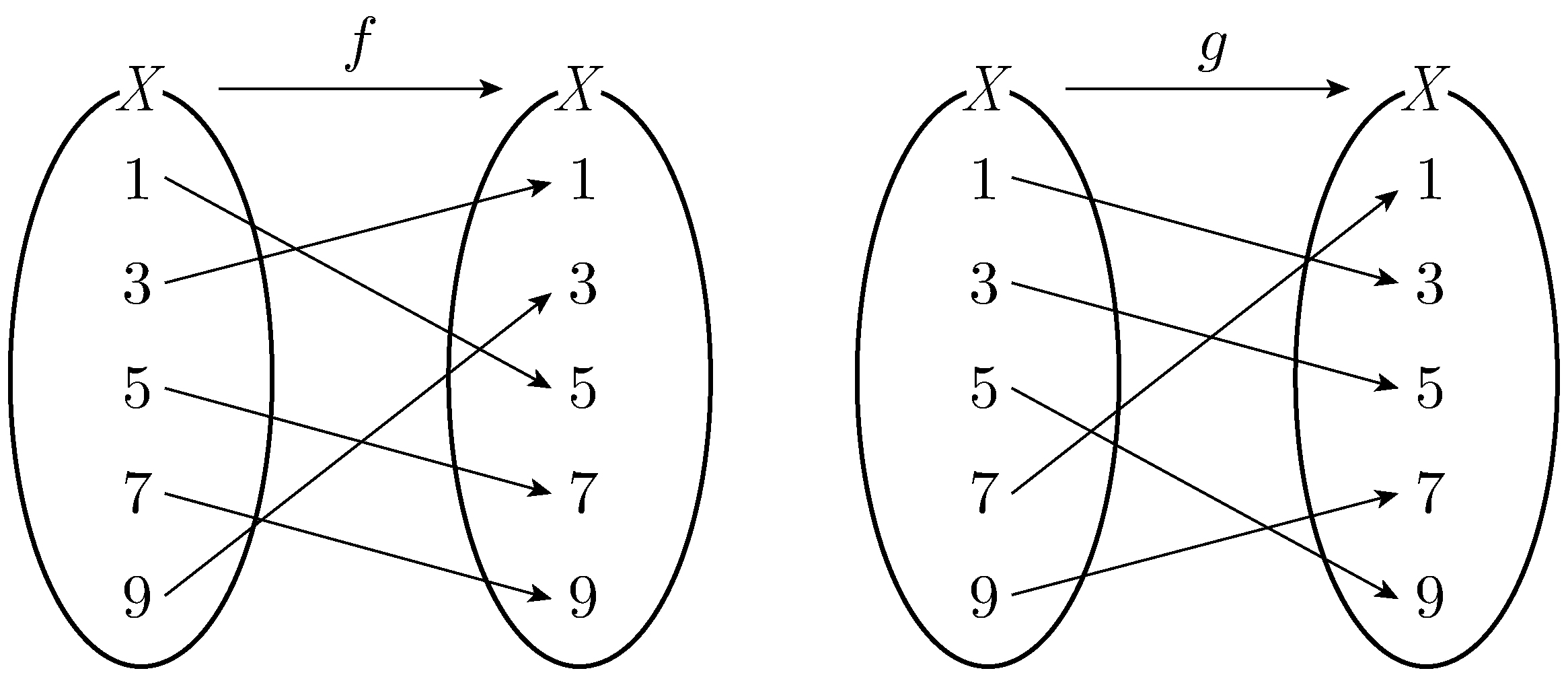
Figure below depicts two functions \(f:X\;\!\to\;\!X\) and \(g:X\;\!\to\;\!X\).
What is the value of \((g\circ f)(1)\)? [3 points]
  1. \(1\)
  2. \(3\)
  3. \(5\)
  4. \(7\)
  5. \(9\)

Mathematics (Type Na)

Let \(A\) and \(B\) be events such that
\(\mathrm{P}(A^C)=\dfrac{2}{3}\:\) and \(\:\mathrm{P}(A^C\cap B)=\dfrac{1}{4}\).
What is the value of \(\mathrm{P}(A\cup B)\)?
(※ \(A^C\) is the complement of \(A\).) [3 points]
  1. \(\dfrac{1}{2}\)
  2. \(\dfrac{7}{12}\)
  3. \(\dfrac{2}{3}\)
  4. \(\dfrac{3}{4}\)
  5. \(\dfrac{5}{6}\)
Consider the following two conditions on a real number \(x\).
\(p : x=a\),
\(q : 3x^2-ax-32=0\)
What is the value of the positive number \(a\) such that \(p\) is sufficient for \(q\)? [3 points]
  1. \(1\)
  2. \(2\)
  3. \(3\)
  4. \(4\)
  5. \(5\)
If a function \(f(x)=\dfrac{k}{x-3}+1\) satisfies \(f^{-1}(7)=4\), what is the value of the constant \(k\)? (※ \(k\ne 0\)) [3 points]
  1. \(2\)
  2. \(4\)
  3. \(6\)
  4. \(8\)
  5. \(10\)

Mathematics (Type Na)

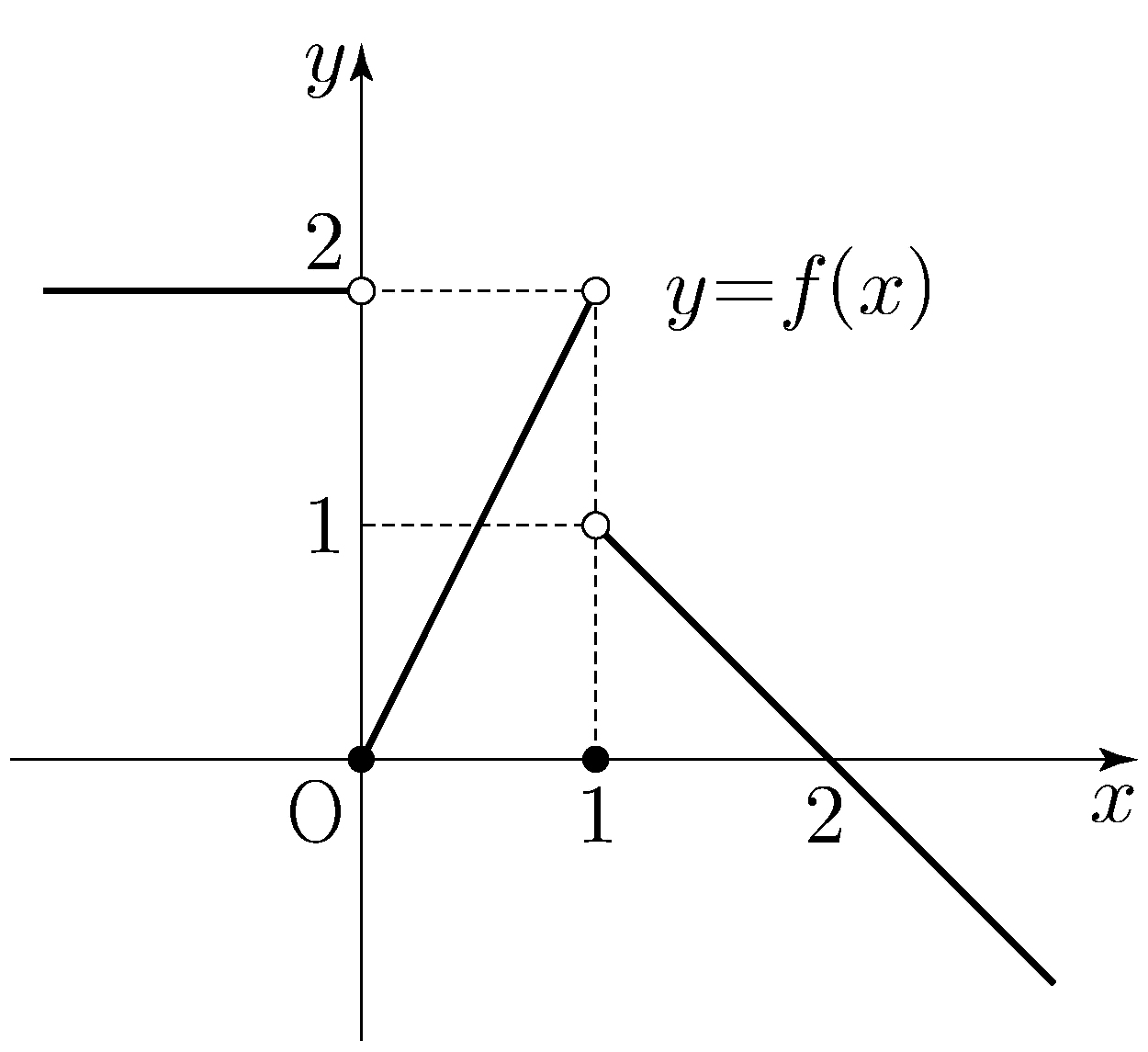
Figure below is the graph of the function \(y=f(x)\).
What is the value of \(\displaystyle\lim_{x\;\!\to\;\!0+}\!f(x)-\lim_{x\;\!\to\;\!1-}\!f(x)\)? [3 points]
  1. \(-2\)
  2. \(-1\)
  3. \(0\)
  4. \(1\)
  5. \(2\)
A survey was conducted on \(200\) students of some school about which experiential activity they preferred. Each student in the survey chose either activities on culture or biology. The number of students that chose each activity is shown below.
(Unit: people)
Culture Biology Total
Male \(40\) \(60\) \(100\)
Female \(50\) \(50\) \(100\)
Total \(90\) \(110\) \(200\)
Suppose a student is randomly chosen out of the \(200\) students in this survey. Given that this student had chosen the activity on biology, what is the probability that this student is female? [3 points]
  1. \(\dfrac{5}{11}\)
  2. \(\dfrac{1}{2}\)
  3. \(\dfrac{6}{11}\)
  4. \(\dfrac{5}{9}\)
  5. \(\dfrac{3}{5}\)
What is the minimum value of the real number \(k\) for which the graph of the inverse of the function \(y=\sqrt{4-2x}+3\) meets the line \(y=-x+k\) at two distinct points? [3 points]
  1. \(1\)
  2. \(3\)
  3. \(5\)
  4. \(7\)
  5. \(9\)

Mathematics (Type Na)

Let \(f(x)=4x^3+x\). What is the value of \(\displaystyle\lim_{n\;\!\to\;\!\infty}\sum_{k\;\!=\;\!1}^n\frac{1}{n} f\!\left(\!\frac{2k}{n}\!\right)\)? [3 points]
  1. \(6\)
  2. \(7\)
  3. \(8\)
  4. \(9\)
  5. \(10\)
Given that the function \(f(x)=-x^4+8a^2x^2-1\) has a local maximum at \(x=b\) and \(x=2-2b\), what is the value of \(a+b\)? (※ \(a\) and \(b\) are constants where \(a>0\) and \(b>1\).) [3 points]
  1. \(3\)
  2. \(5\)
  3. \(7\)
  4. \(9\)
  5. \(11\)

Mathematics (Type Na)

The weight of a bell pepper harvested in some farm follows a normal distribution with a mean of \(180\text{g}\) and a standard deviation of \(20\text{g}\). What is the probability that a bell pepper randomly chosen from
the bell peppers harvested in this farm weighs between \(190\text{g}\) and \(210\text{g}\), computed with the standard normal table to the right? [3 points]
\(z\) \(\mathrm{P}(0\!\leq\! Z \!\leq\!z)\)
\(0.5\) \(0.1915\)
\(1.0\) \(0.3413\)
\(1.5\) \(0.4332\)
\(2.0\) \(0.4772\)
  1. \(0.0440\)
  2. \(0.0919\)
  3. \(0.1359\)
  4. \(0.1498\)
  5. \(0.2417\)
Let \(f(x)\) and \(g(x)\) be polynomial functions whose constant terms and coefficients are all integers, that satisfy the following conditions. What is the maximum value of \(f(2)\)? [4 points]
  1. \(\displaystyle\lim_{x\;\!\to\;\!\infty}\frac{f(x)g(x)}{x^3}=2\)
  2. \(\displaystyle\lim_{x\;\!\to\;\!0}\frac{f(x)g(x)}{x^2}=-4\)
  1. \(4\)
  2. \(6\)
  3. \(8\)
  4. \(10\)
  5. \(12\)

Mathematics (Type Na)

Let \(S_n\) be the sum of the first \(n\) terms of an arithmetic progression with an initial term of \(50\) and a common difference of \(-4\). What is the value of the positive integer \(m\) that maximizes the value of \(\displaystyle\sum_{k\;\!=\;\!m}^{m+4}S_k\)? [4 points]
  1. \(8\)
  2. \(9\)
  3. \(10\)
  4. \(11\)
  5. \(12\)
There is a sack containing \(10\) balls marked with the number \(1\), \(20\) balls marked with the number \(2\), and \(30\) balls marked with the number \(3\). Let us randomly take out a ball from this sack, check the number marked on it, and put it back in. Let the random variable \(Y\) be the sum of the \(10\) checked numbers after this trial is repeated \(10\) times. The process below computes the mean \(\mathrm{E}(Y)\) and variance \(\mathrm{V}(Y)\) of the random variable \(Y\).
Consider the \(60\) balls in the sack as the population. Let the random variable \(X\) be the number marked on a ball randomly taken out from this population. The distribution of \(X\), which is the distribution of the population, is as the table below.
\(X\) \(1\) \(2\) \(3\) Total
\(\mathrm{P}(X=x)\) \(\dfrac{1}{6}\) \(\dfrac{1}{3}\) \(\dfrac{1}{2}\) \(1\)
Therefore the mean \(m\) and variance \(\sigma^2\) of the population are
\(m=\mathrm{E}(X)=\dfrac{7}{3}\:\) and \(\:\sigma^2=\mathrm{V}(X)=\fbox{\(\;(\alpha)\;\)}\).
Let \(\overline{X}\) be the mean of a random sample of size \(10\) from this population. Then,
\(\mathrm{E}(\overline{X})=\dfrac{7}{3}\:\) and \(\:\mathrm{V}(\overline{X})=\fbox{\(\;(\beta)\;\)}\).
Let \(X_n\) be the number marked on the \(n\:\!\)th ball taken out from the sack. Then,
\(\displaystyle Y=\sum_{n\;\!=\;\!1}^{10}X_n=10\overline{X}\).
Therefore
\(\mathrm{E}(Y)=\dfrac{70}{3}\:\) and \(\:\mathrm{V}(Y)=\fbox{\(\;(\gamma)\;\)}\).
Let \(p\), \(q\) and \(r\) be the correct numbers for \((\alpha)\), \((\beta)\) and \((\gamma)\) respectively. What is the value of \(p+q+r\)? [4 points]
  1. \(\dfrac{31}{6}\)
  2. \(\dfrac{11}{2}\)
  3. \(\dfrac{35}{6}\)
  4. \(\dfrac{37}{6}\)
  5. \(\dfrac{13}{2}\)

Mathematics (Type Na)

Let \(f(n)\) be the number of positive divisors of the positive integer \(n\). Let \(a_1, a_2, a_3, \cdots, a_9\) be the list of all positive divisors of \(36\). What is the value of \(\displaystyle\sum_{k\;\!=\;\!1}^9\left\{(-1)^{f(a_k)}\times\log a_k\right\}\)? [4 points]
  1. \(\log2+\log3\)
  2. \(2\log2+\log3\)
  3. \(\log2+2\log3\)
  4. \(2\log2+2\log3\)
  5. \(3\log2+2\log3\)
As the figure shows, on the square \(\mathrm{ABCD}\) with side lengths of \(5\), draw a sector \(\mathrm{ABD}\) with center \(\mathrm{A}\) and central angle \(90°\). Let \(\mathrm{A_1}\) be the point internally dividing the line segment \(\mathrm{AD}\) in the ratio \(3:2\). Let \(\mathrm{B_1}\) be the point where a line passing point \(\mathrm{A_1}\) parallel to line \(\mathrm{AB}\,\), meets the arc \(\mathrm{BD}\). Draw a square \(\mathrm{A_1B_1C_1D_1}\) that meets line \(\mathrm{DC}\), using the line segment \(\mathrm{A_1B_1}\) as an edge. Draw a sector \(\mathrm{D_1A_1C_1}\) with center \(\mathrm{D_1}\) and central angle \(90°\). Let \(\mathrm{E_1}\) and \(\mathrm{F_1}\) be points where the line \(\mathrm{DC}\) meets arc \(\mathrm{A_1C_1}\) and line \(\mathrm{B_1C_1}\) respectively. Obtain figure \(R_1\) by coloring the shape consisting of the region enclosed by arc \(\mathrm{A_1E_1}\) and lines \(\mathrm{DA_1}\) and \(\mathrm{DE_1}\), and the region enclosed by arc \(\mathrm{E_1C_1}\) and lines \(\mathrm{E_1F_1}\) and \(\mathrm{F_1C_1}\).
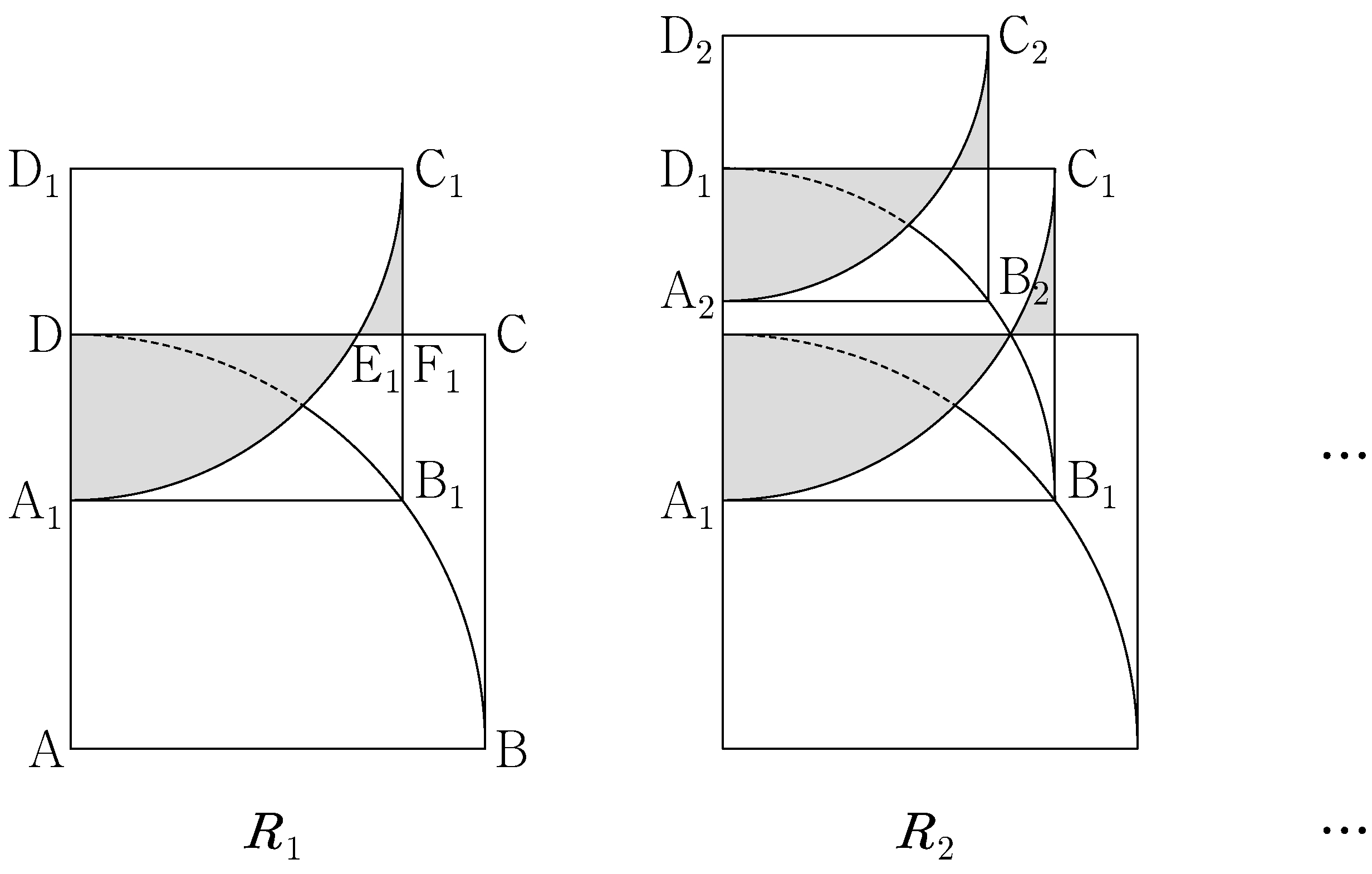
Starting from figure \(R_1\), on square \(\mathrm{A_1B_1C_1D_1}\), draw a sector \(\mathrm{A_1B_1D_1}\) with center \(\mathrm{A_1}\) and central angle \(90°\). Let \(\mathrm{A_2}\) be the point internally dividing the line segment \(\mathrm{A_1D_1}\) in the ratio \(3:2\). Let \(\mathrm{B_2}\) be the point where a line passing point \(\mathrm{A_2}\) parallel to line \(\mathrm{A_1B_1}\), meets the arc \(\mathrm{B_1D_1}\). Draw a square \(\mathrm{A_2B_2C_2D_2}\) that meets line \(\mathrm{D_1C_1}\), using the line segment \(\mathrm{A_2B_2}\) as an edge. Then, using the same process as figure \(R_1\), obtain figure \(R_2\) by drawing the shape on square \(\mathrm{A_2B_2C_2D_2}\) and coloring it.
Continue this process, and let \(S_n\) be the area of the colored region in \(R_n\), the \(n\)th obtained figure.
What is the value of \(\displaystyle\lim_{n\;\!\to\;\!\infty} S_n\)? [4 points]
  1. \(\dfrac{50}{3}\left(\!3-\sqrt{3}+\dfrac{\pi}{6}\!\right)\)
  2. \(\dfrac{100}{9}\left(\!3-\sqrt{3}+\dfrac{\pi}{3}\!\right)\)
  3. \(\dfrac{50}{3}\left(\!2-\sqrt{3}+\dfrac{\pi}{3}\!\right)\)
  4. \(\dfrac{100}{9}\left(\!3-\sqrt{3}+\dfrac{\pi}{6}\!\right)\)
  5. \(\dfrac{100}{9}\left(\!2-\sqrt{3}+\dfrac{\pi}{3}\!\right)\)

Mathematics (Type Na)

Let us select five numbers among numbers \(1,2,3,4,5\) and \(6\), and arrange them in a line to make a \(5\)-digit integer. Each number may be selected multiple times, and the following should be satisfied. What is the number of all \(5\)-digit integers that can be made? [4 points]
  1. Each odd number is either not selected or selected exactly once.
  2. Each odd number is either not selected or selected exactly twice.
  1. \(450\)
  2. \(445\)
  3. \(440\)
  4. \(435\)
  5. \(430\)
Consider the function
\(f(x)=\begin{cases} -x &\; (x\leq0)\\ x-1 &\; (0<x\leq2)\\ 2x-3 &\; (x>2) \end{cases}\)
and a polynomial function \(p(x)\) which is not a constant function. What is the list of correct statements in the <List>? [4 points]
  1. If the function \(p(x)f(x)\) is continuous on the set of all real numbers, then \(p(0)=0\).
  2. If the function \(p(x)f(x)\) is differentiable on the set of all real numbers, then \(p(2)=0\).
  3. If the function \(p(x)\{f(x)\}^2\) is differentiable on the set of all real numbers, then \(p(x)\) is divisible by \(x^2(x-2)^2\).
  1. a
  2. a, b
  3. a, c
  4. b, c
  5. a, b, c

Mathematics (Type Na)

Let \(\{a_n\}\) be a sequence that satisfies the following for all positive integers \(n\).
  1. \(a_{2n}=a_n-1\)
  2. \(a_{2n+1}=2a_n+1\)
If \(a_{20}=1\), what is the value of \(\displaystyle\sum_{n\;\!=\;\!1}^{63}a_n\)? [4 points]
  1. \(704\)
  2. \(712\)
  3. \(720\)
  4. \(728\)
  5. \(736\)
Short Answer Questions
Compute \(_7\mathrm{P}_2\;\!+\;\!_7\mathrm{C}_2\). [3 points]
Let \(\{a_n\}\) be a geometric progression whose terms are all positive numbers, such that
\(\dfrac{a_{16}}{a_{14}}+\dfrac{a_8}{a_7}=12\).
Compute \(\dfrac{a_3}{a_1}+\dfrac{a_6}{a_3}\). [3 points]

Mathematics (Type Na)

Let \(X\) be a random variable following the binominal distribution \(\mathrm{B}(80,p)\) such that \(\mathrm{E}(X)=20\). Compute \(\mathrm{V}(X)\). [3 points]
For positive integers \(n\), let \(a_n\) be the remainder of the division of the polynomial \(2x^2-3x+1\) by \(x-n\). Compute \(\displaystyle\sum_{n\;\!=\;\!1}^{7}(a_n-n^2+n)\). [4 points]
Let \(S\) be the area of the region enclosed by the graphs of two functions
\(f(x)=\dfrac{1}{3}x(4-x)\:\) and \(\:g(x)=|x-1|-1\).
Compute \(4S\). [4 points]

Mathematics (Type Na)

Let \(\mathrm{P}\) and \(\mathrm{Q}\) be points moving on the number line, such that their positions \(x_1\) and \(x_2\) at time \(t\) \((t \geq 0)\) are equal to
\(x_1=t^3-2t^2+3t\:\) and \(\:x_2=t^2+12t\)
respectively. Compute the distance between points \(\mathrm{P}\) and \(\mathrm{Q}\) when the velocities of points \(\mathrm{P}\) and \(\mathrm{Q}\) are equal. [4 points]
A polynomial function \(f(x)\) satisfies the following.
  1. \(\displaystyle\int_1^xf(t)dt=\frac{x-1}{2}\{f(x)+f(1)\}\)
    for all real numbers \(x\).
  2. \(\displaystyle\int_0^2f(x)dx=5\int_{-1}^1xf(x)dx\)
Given that \(f(0)=1\), compute \(f(4)\). [4 points]

Mathematics (Type Na)

There are \(6\) identical candies and \(5\) identical chocolates. Compute the number of ways to give all of the candies and chocolates to three students \(\mathrm{A,B}\) and \(\mathrm{C}\) according to the following rules. [4 points]
  1. Student \(\mathrm{A}\) receives at least \(1\) candy.
  2. Student \(\mathrm{B}\) receives at least \(1\) chocolate.
  3. The number of candies and chocolates received by student \(\mathrm{C}\) add up to \(1\) or more.
A cubic function \(f(x)\) with a positive leading coefficient satisfies the following.
  1. The equation \(f(x)-x=0\) has \(2\) distinct real solutions.
  2. The equation \(f(x)+x=0\) has \(2\) distinct real solutions.
Given that \(f(0)=0\) and \(f'(1)=1\), compute \(f(3)\). [4 points]